Biznsbook vs ERPNext: SaaS vs Self-Hosted Tradeoffs
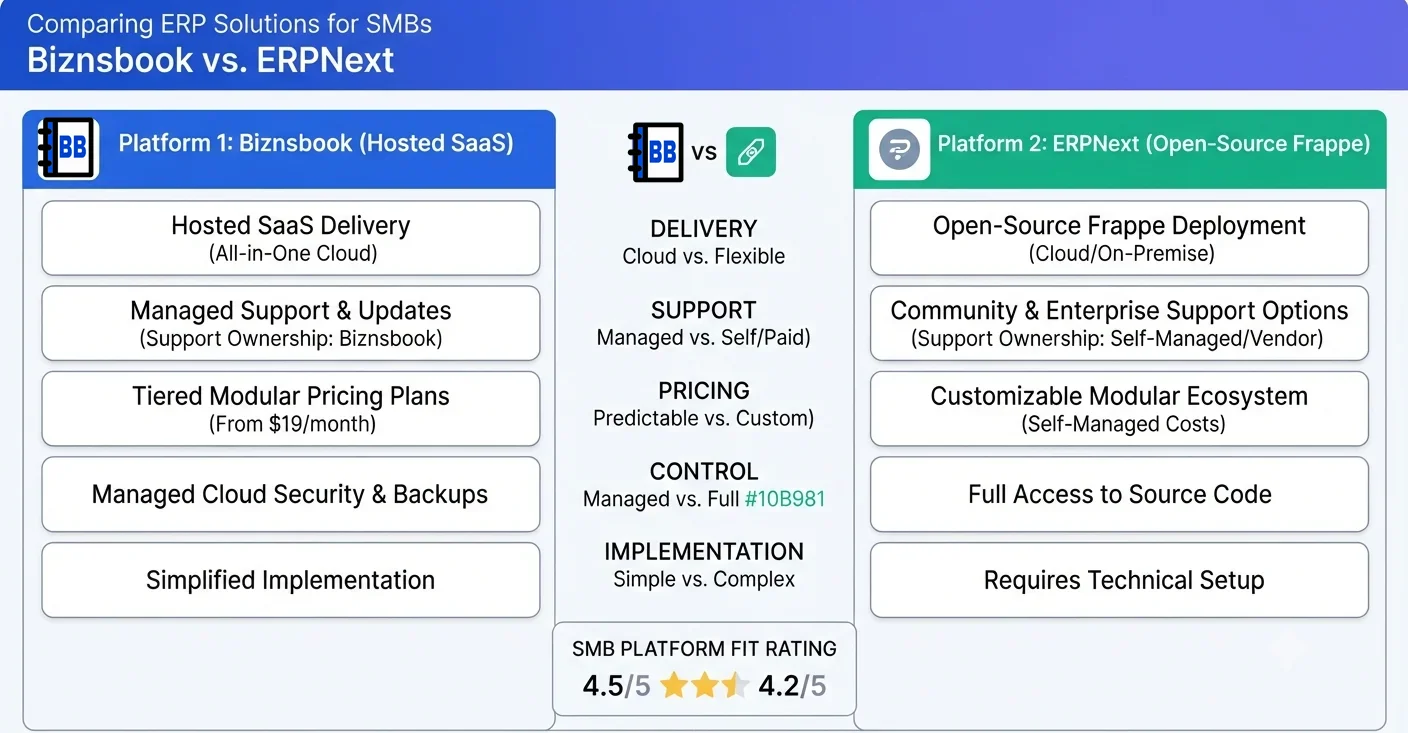
Biznsbook focuses on hosted SaaS convenience and vendor-managed support, while ERPNext is often chosen for open-source control on the Frappe stack.
Related guides: Topic guides hub · All ERP comparisons
At a glance
Side-by-side summary on six criteria teams usually evaluate first. Pricing and packaging change over time — verify current plans on each vendor site before you buy.
| Criterion | Biznsbook | ERPNext |
|---|---|---|
| Hosting responsibility | Vendor-hosted SaaS environment | Often self-hosted open-source deployment on Frappe |
| Support ownership | Single vendor SaaS support path | Support ownership varies by self-managed or partner setup |
| Pricing model | Published modular tiers and add-ons | Cost profile depends on hosting and implementation choices |
| Go-live effort | Packaged cloud onboarding path | Can involve more setup decisions for infrastructure and operations |
| Module coverage | Native accounting, inventory, HRMS, payroll, manufacturing, real estate | Broad open-source ERP capabilities on Frappe framework |
| Integration approach | Integration Hub with connectors such as QuickBooks, Shopify, Stripe | Integration design depends on selected implementation approach |
ERP module depth
How far each platform reaches beyond checkout or bookkeeping into operations, inventory, and finance on one ledger.
| Module / capability | Biznsbook | ERPNext |
|---|---|---|
| Hosting model | Vendor-hosted SaaS | Often self-hosted Frappe stack |
| Support ownership | Single vendor SaaS channel | Internal or partner-dependent |
| Inventory & warehouse | Native modules, multi-warehouse in Pro | Broad ERPNext inventory features |
| Accounting | Central posting from operational docs | ERPNext accounts; same-database model |
| Manufacturing | BOM, work orders, shop floor | Manufacturing module on Frappe |
| Customization | Configured modules and automation | Framework-level Python/JS customization |
| Upgrade path | Vendor-managed releases | Self-managed upgrades and migrations |
| Total cost modeling | Published modular tiers from $19/mo | Hosting + implementation + support TCO |
Hosting responsibility
Biznsbook is offered as hosted cloud ERP SaaS, which reduces the need for in-house infrastructure management in typical SMB deployments.
ERPNext is open-source on the Frappe stack and is often self-hosted, so many teams evaluate server ownership, maintenance effort, and technical governance early.
Support ownership
With Biznsbook, support conversations usually follow one vendor SaaS channel tied to the hosted product model.
With ERPNext, support can be very effective but responsibility may vary depending on whether support is handled internally or through external implementation partners.
Pricing model
Biznsbook publishes modular tiers: Starter at $19 per month, Pro at $39 per month, and Business at $89 per month, with optional add-ons on lower tiers.
ERPNext budgeting is often built from hosting, implementation, and support decisions, so total ownership modeling can look different across organizations.
Go-live effort
Teams selecting hosted SaaS often focus on process setup and user adoption because infrastructure is already standardized by the vendor model.
Teams selecting frequently self-hosted open-source software usually include additional planning for environment readiness, upgrades, and operational controls.
Module coverage
Biznsbook includes native modules spanning accounting, inventory, CRM, sales, purchase, POS, HRMS, payroll, manufacturing, real estate, and automation tooling.
ERPNext is recognized for broad open-source ERP capabilities on Frappe, which appeals to businesses that prioritize framework-level openness.
Integration approach
Biznsbook offers an Integration Hub module with connectors including Shopify, QuickBooks, and Stripe as part of its module strategy.
ERPNext integration options can be broad as well, but the implementation and maintenance pattern generally follows the organization chosen delivery model.
Who should choose each
Choose Biznsbook if…
- Teams wanting hosted SaaS with less infrastructure overhead
- Businesses preferring published modular pricing tiers
- Organizations needing inventory and accounting quickly in one system
- Companies that want vendor-managed support flow
- SMBs that value zero implementation fees messaging
Choose ERPNext if…
- Teams committed to open-source ERP principles
- Organizations with technical resources for self-hosting operations
- Businesses that prefer deeper control over deployment stack
- Companies comfortable managing infrastructure and upgrade planning
- Teams that prioritize framework-level customization flexibility
Biznsbook capabilities referenced in this comparison
- Hosted cloud ERP SaaS architecture
- Tiered pricing from $19/month, then $39/month and $89/month
- Accounting and Inventory available from Starter tier
- HRMS, Payroll, multi-warehouse in Pro tier
- Manufacturing and Real Estate available via module strategy
- Integration Hub add-on option on lower tiers
- Zero implementation fees marketed on pricing page
See all modules, current pricing, and topic guides for workflow detail.
Frequently asked questions
What is the core difference in deployment?
Biznsbook is hosted cloud SaaS, while ERPNext is open-source on Frappe and is frequently deployed in self-hosted or custom-managed environments.
Does Biznsbook include multi-warehouse support?
Yes. Multi-warehouse is included in the Pro plan, together with HRMS and Payroll.
Can Biznsbook integrate with QuickBooks?
Yes. QuickBooks integration is available through the Integration Hub as an optional push workflow.
Is ERPNext a weak choice for SMBs?
No. ERPNext can be a strong fit for SMBs that want open-source control and can support the operational model required for their deployment approach.
Compare with your own data
Book a short demo to walk through inventory, accounting, or your priority module — no obligation.
Book a demo View pricing