How to Manage Multiple Real Estate Projects
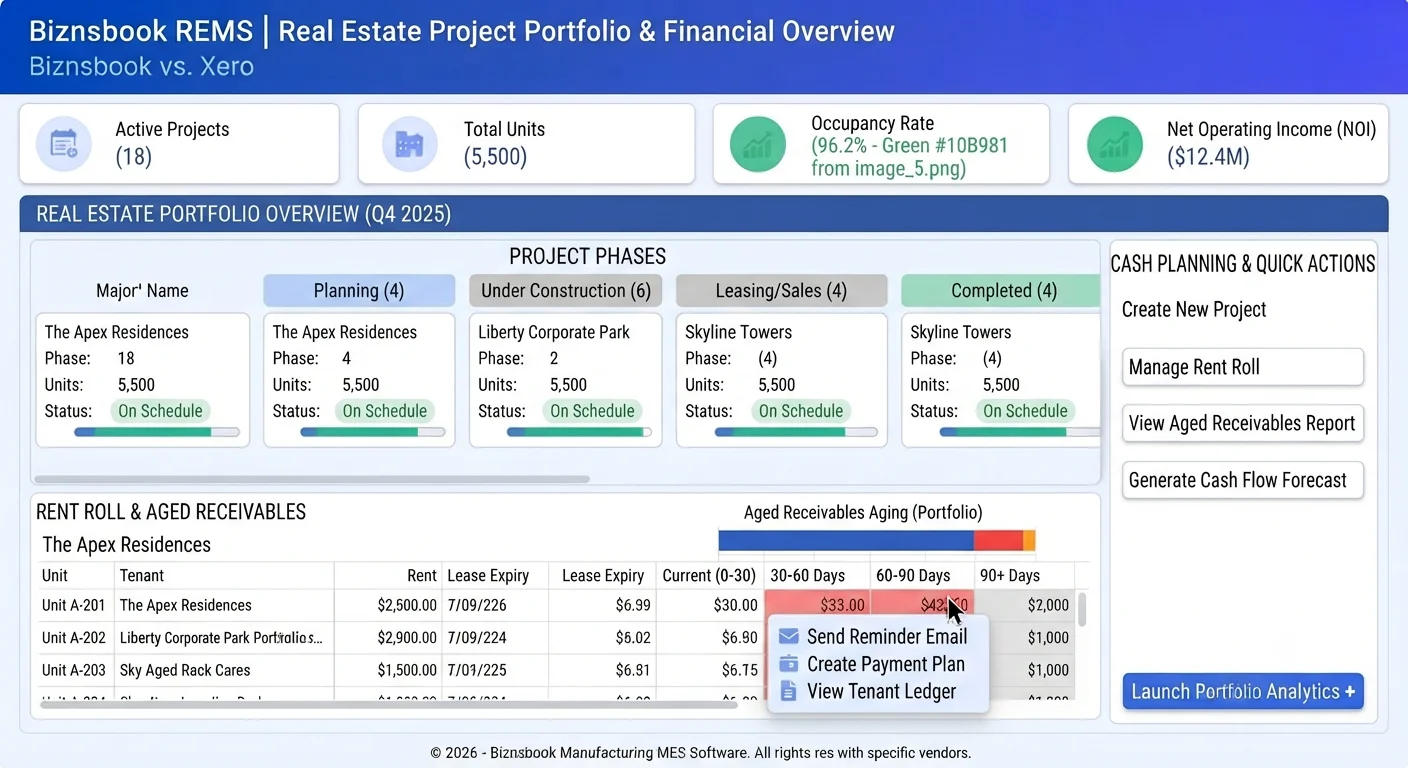
Portfolio growth creates coordination overload
Managing one project well does not automatically scale to a portfolio. Teams face fragmented updates, varying process quality, and inconsistent reporting logic across business units or project teams.
Without shared receivables visibility, leadership may overestimate cash readiness. Projects with similar sales momentum can have very different collection health, especially when payment terms and tenant profiles vary.
A portfolio operating model with standardized project controls and consolidated reporting helps management compare performance fairly and act before local issues become portfolio-level risks.
Why this happens
- Project teams use different status and reporting standards.
- Portfolio reviews focus on bookings but ignore receivable aging trends.
- Rent and installment data are analyzed in disconnected reports.
- Resource planning is not linked to project risk and workload signals.
Biznsbook addresses this through Projects and phases, Rent roll, Aged receivables when the Real Estate (REMS) module is enabled, with optional Accounting, Communication Center, and Business Automation for collections and workflows.
Finance teams lose days each month reconciling versions that should never have diverged. Naming Biznsbook screens as the system of record — and closing periods when agreed — prevents silent edits that auditors flag immediately.
Step-by-step: Manage Multiple Real Estate Projects
Built for developers, sales coordinators, and property ops teams managing units from booking through possession and leasing.
- Standardize portfolio taxonomy. Use consistent project and phase naming, ownership, and status structures across all projects.
- Define shared KPI pack. Track a common set of KPIs including availability movement, collections pace, and receivable aging.
- Use rent roll for occupancy economics. Monitor rent roll snapshots to understand occupancy and recurring income trends by project.
- Review aged receivables weekly. Analyze aged receivables to identify projects with rising collection risk and delayed recovery.
- Segment projects by risk. Classify projects by delivery, leasing, and receivable risk for targeted intervention planning.
- Align cross-team cadences. Run consistent review routines across sales, collections, and operations teams at portfolio level.
- Rebalance resources proactively. Shift support capacity to projects with highest urgency based on trend signals, not anecdotal requests.
Review results after the first full weekly cycle. Adjust roles, mappings, or approvals where the same exception repeats.
Screen-level flows live in the Help Center (tax setup, expense claims, sale invoices). This guide focuses on finance process; help articles cover navigation.
Common mistakes to avoid
- Mistake 1: Project teams use different status and reporting standards. Repeating this each month usually shows up first in aged receivables or installment status reports.
- Mistake 2: Portfolio reviews focus on bookings but ignore receivable aging trends. Repeating this each month usually shows up first in aged receivables or installment status reports.
- Mistake 3: Rent and installment data are analyzed in disconnected reports. Repeating this each month usually shows up first in aged receivables or installment status reports.
- Mistake 4: Resource planning is not linked to project risk and workload signals. Repeating this each month usually shows up first in aged receivables or installment status reports.
Track recurring exceptions in month-end notes; each should map to a control above.
Best practices that hold up as you scale
- Standardize portfolio taxonomy — Use consistent project and phase naming, ownership, and status structures across all projects.
- Define shared KPI pack — Track a common set of KPIs including availability movement, collections pace, and receivable aging.
- Use rent roll for occupancy economics — Monitor rent roll snapshots to understand occupancy and recurring income trends by project.
- Review aged receivables weekly — Analyze aged receivables to identify projects with rising collection risk and delayed recovery.
- Segment projects by risk — Classify projects by delivery, leasing, and receivable risk for targeted intervention planning.
Teams that reconcile unit status and schedules weekly avoid the month-end scramble that delays disbursements and handovers.
How Biznsbook supports this workflow
Projects and phases is documented in Biznsbook Real Estate (REMS) capabilities. Use it as part of a controlled finance process — posting, review, and period close — not as an isolated export. When Sales, Purchase, Inventory, Taxation, Expense, or Finance Management modules are enabled, related documents can post through the central accounting posting service with double-entry validation.
Rent roll is documented in Biznsbook Real Estate (REMS) capabilities. Use it as part of a controlled finance process — posting, review, and period close — not as an isolated export. When Sales, Purchase, Inventory, Taxation, Expense, or Finance Management modules are enabled, related documents can post through the central accounting posting service with double-entry validation.
Aged receivables is documented in Biznsbook Real Estate (REMS) capabilities. Use it as part of a controlled finance process — posting, review, and period close — not as an isolated export. When Sales, Purchase, Inventory, Taxation, Expense, or Finance Management modules are enabled, related documents can post through the central accounting posting service with double-entry validation.
REMS permissions govern view, create, edit, and payment link actions. Guest collection pages work without buyer or tenant login.
Suggested implementation timeline
- Week 1: Document current process gaps and configure Projects and phases with finance owner sign-off.
- Weeks 2–3: Pilot on one month or one entity; post all test transactions through Biznsbook; freeze parallel spreadsheet journals.
- Week 4: Run first trial balance or report tie-out; fix mapping and permission issues.
- Month 2–3: Roll out to full team; add approvals and period close cadence from this guide.
- Ongoing: Monthly review using portfolio review agenda and leadership dashboard.
Metrics to track monthly
- Available vs booked vs sold unit counts by project
- Installment schedule overdue value and count
- Collection rate on due installments and rent
- Days from booking to possession/handover
- Aged receivables buckets (30/60/90+ days)
Start with three metrics; trend direction matters more than a single point-in-time snapshot.
Spreadsheet / manual books vs integrated ERP
Compare typical manual finance work with Biznsbook Projects and phases and related capabilities.
| Capability | Manual / Spreadsheet | Biznsbook |
|---|---|---|
| Portfolio structure | ❌ Project-by-project variance | ✅ Standardized taxonomy |
| KPI governance | ❌ Custom local reports | ✅ Common portfolio scorecard |
| Receivables insight | ❌ Lagging summaries | ✅ Aged receivables drill-down |
| Recurring income tracking | ❌ Manual rent sheets | ✅ Rent roll reporting |
| Intervention timing | ❌ Reactive escalation | ✅ Risk-based prioritization |
| Resource allocation | ❌ Fixed staffing | ✅ Data-driven rebalancing |
Portfolio review agenda
Use a fixed agenda covering project risks, receivable aging shifts, occupancy movement, and action ownership. A repeatable review format improves accountability at scale.
Document this in your finance SOP and revisit each quarter as transaction volume or entity structure changes.
Frequently asked questions
What should portfolio leaders review first each week?
Start with aged receivables movement and project-level collection trends, then pair that with availability and booking updates for a complete view.
Why include rent roll in multi-project reviews?
Rent roll adds recurring income visibility, which balances one-time sales metrics and improves portfolio cash planning decisions.
Can one process work for different project types?
Yes, if core governance is consistent while allowing local parameter differences for leasing models, payment terms, and operating context.
How does this improve execution speed?
Shared structures and KPI routines reduce debate on data quality, so teams spend more time resolving risks and less time reconciling numbers.
How this differs by industry
Retail
Residential developers managing several communities can compare collection quality and occupancy signals consistently, improving launch and support prioritization decisions.
Wholesale & distribution
Commercial and mixed portfolio teams can align reporting across office, retail, and mixed assets while controlling receivable risk with one review cadence.
Manufacturing
Property management firms overseeing distributed assets can use rent roll and aging insights to optimize staffing, service cycles, and tenant communication plans.