How to Reduce Accounting Errors
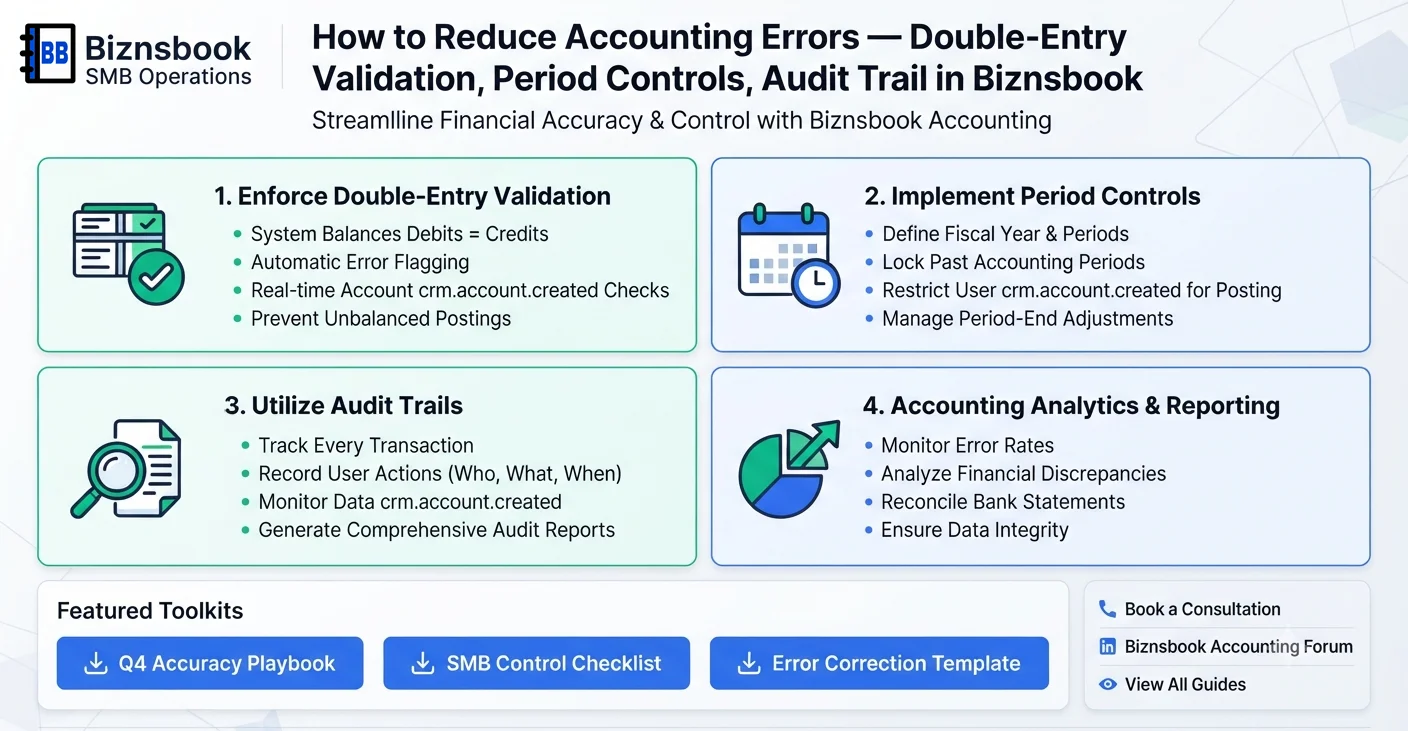
Small posting mistakes compound into major rework
A few incorrect entries can distort financial statements, delay close, and force repeated report revisions for management.
When old periods remain open, back-dated edits quietly change already approved numbers.
Without audit trail habits, teams cannot quickly identify who changed what and why.
Why this happens
- Weak posting validation.
- Periods stay open too long.
- No routine audit trail checks.
- Manual overrides are undocumented.
Biznsbook addresses this through double-entry validation, period controls, audit trail when Accounting is enabled; add Finance Management, Taxation, Expense, Sales, or Purchase modules as your operating model requires.
Finance teams lose days each month reconciling versions that should never have diverged. Naming Biznsbook screens as the system of record — and closing periods when agreed — prevents silent edits that auditors flag immediately.
Step-by-step: Reduce Accounting Errors
Designed for owners, bookkeepers, and controllers who need repeatable month-end discipline. Adapt roles to team size — separation of duties matters more than headcount.
- Use double-entry validation. Ensure every entry remains balanced before posting to ledgers.
- Apply period controls. Close approved periods so unauthorized or accidental back-dated edits are blocked.
- Review audit trail weekly. Scan key changes and corrections to spot repeat error patterns.
- Define posting checklists. Create standard checks for journals, supplier bills, and revenue entries.
- Segregate finance responsibilities. Separate creator and approver roles for sensitive transactions.
- Investigate recurring mistakes. Document root causes and train teams on common failure points.
- Track error-rate KPI monthly. Measure corrections per period and target steady reduction over time.
Review results after the first full monthly cycle. Adjust roles, mappings, or approvals where the same exception repeats.
Screen-level flows live in the Help Center. This guide focuses on the business process; help articles cover click-by-click navigation.
Common mistakes to avoid
- Mistake 1: Weak posting validation. Repeating this each month usually shows up first in trial balance or AR/AP aging.
- Mistake 2: Periods stay open too long. Repeating this each month usually shows up first in trial balance or AR/AP aging.
- Mistake 3: No routine audit trail checks. Repeating this each month usually shows up first in trial balance or AR/AP aging.
- Mistake 4: Manual overrides are undocumented. Repeating this each month usually shows up first in trial balance or AR/AP aging.
Track recurring exceptions in month-end notes; each should map to a control above.
Best practices that hold up as you scale
- Use double-entry validation — Ensure every entry remains balanced before posting to ledgers.
- Apply period controls — Close approved periods so unauthorized or accidental back-dated edits are blocked.
- Review audit trail weekly — Scan key changes and corrections to spot repeat error patterns.
- Define posting checklists — Create standard checks for journals, supplier bills, and revenue entries.
- Segregate finance responsibilities — Separate creator and approver roles for sensitive transactions.
Consistency beats heroics at month-end. A smaller team that closes the same calendar every month outperforms a larger team that posts sporadically.
How Biznsbook supports this workflow
double-entry validation is documented in Biznsbook Accounting / Finance capabilities. Use it as part of a controlled finance process — posting, review, and period close — not as an isolated export. When Sales, Purchase, Inventory, Taxation, Expense, or Finance Management modules are enabled, related documents can post through the central accounting posting service with double-entry validation.
period controls is documented in Biznsbook Accounting / Finance capabilities. Use it as part of a controlled finance process — posting, review, and period close — not as an isolated export. When Sales, Purchase, Inventory, Taxation, Expense, or Finance Management modules are enabled, related documents can post through the central accounting posting service with double-entry validation.
audit trail is documented in Biznsbook Accounting / Finance capabilities. Use it as part of a controlled finance process — posting, review, and period close — not as an isolated export. When Sales, Purchase, Inventory, Taxation, Expense, or Finance Management modules are enabled, related documents can post through the central accounting posting service with double-entry validation.
Permissions are role-based: separate chart maintenance, journal creation, report viewing, period close, and bank reconciliation per tenant policy.
Suggested implementation timeline
- Week 1: Document current process gaps and configure double-entry validation with finance owner sign-off.
- Weeks 2–3: Pilot on one month or one entity; post all test transactions through Biznsbook; freeze parallel spreadsheet journals.
- Week 4: Run first trial balance or report tie-out; fix mapping and permission issues.
- Month 2–3: Roll out to full team; add approvals and period close cadence from this guide.
- Ongoing: Monthly review using control first, speed second and leadership dashboard.
Separation of duties on a small team
Even two-person finance teams can separate journal creation from posting, or bank reconciliation from payment creation. Shared admin passwords erase audit trails — use named users with role-scoped permissions.
Month-end checklist sign-off by someone other than the primary poster catches duplicate entries and wrong-period postings before filing.
Master data hygiene
Most recurring errors trace to stale tax groups, wrong default GL on products, or duplicate vendor records. Quarterly vendor and customer deduplication reduces misapplied payments.
Freeze chart of accounts changes during external audit windows unless tax advisers require mid-year reclassification.
Closing checklist discipline
Use the same month-end checklist order every period: bank rec, AR/AP tie-out, inventory to GL, tax liabilities, then P&L review. Jumping steps hides errors that compound.
Rotate who performs reconciliation versus who posts journals in small teams — fresh eyes catch transposed digits habitual posters miss.
Metrics to track monthly
- Days to complete month-end close
- Unreconciled bank lines outstanding
- AR and AP aging buckets over 30/60/90 days
- Trial balance out-of-balance exceptions
- Manual journal count vs automated postings ratio
Start with three metrics; trend direction matters more than a single point-in-time snapshot.
Spreadsheet / manual books vs integrated ERP
Compare typical manual finance work with Biznsbook double-entry validation and related capabilities.
| Capability | Manual / Spreadsheet | Biznsbook |
|---|---|---|
| Entry integrity | ❌ Manual balancing | ✅ Double-entry validation |
| Period safety | ❌ Always open | ✅ Controlled close windows |
| Traceability | ❌ Limited logs | ✅ Audit trail review |
| Corrections | ❌ Ad hoc | ✅ Checklist-based process |
| Control ownership | ❌ Shared access | ✅ Separated duties |
| Error trend | ❌ Unknown | ✅ Monthly KPI tracking |
Control first, speed second
The fastest close comes from stable controls and fewer corrections, not from skipping validations. Log root cause when correcting material errors — pattern analysis beats one-off fixes at year-end.
Document this in your finance SOP and revisit each quarter as transaction volume or entity structure changes.
Frequently asked questions
What is double-entry validation?
It confirms debits and credits stay balanced before transactions are accepted.
Why do period controls matter?
They protect approved periods from late changes that alter reported figures.
How does audit trail help?
It provides traceability for edits, approvals, and reversals during review and audits.
Can error reduction be measured?
Yes, track adjustment volume and correction frequency per close period.
What reports find errors fastest?
Start with trial balance out-of-balance, unreconciled bank lines, and AR/AP aging with negative buckets. Inventory teams cross-check stock valuation to GL control accounts.
How this differs by industry
Retail
Retail finance teams should monitor cash and card postings closely because transaction volume is high.
Wholesale & distribution
Wholesale businesses benefit from strict AP and AR checks since invoice volumes and terms are complex.
Manufacturing
Manufacturers should prioritize cost posting controls to prevent margin and inventory misstatements.