How to Reduce Late Customer Payments
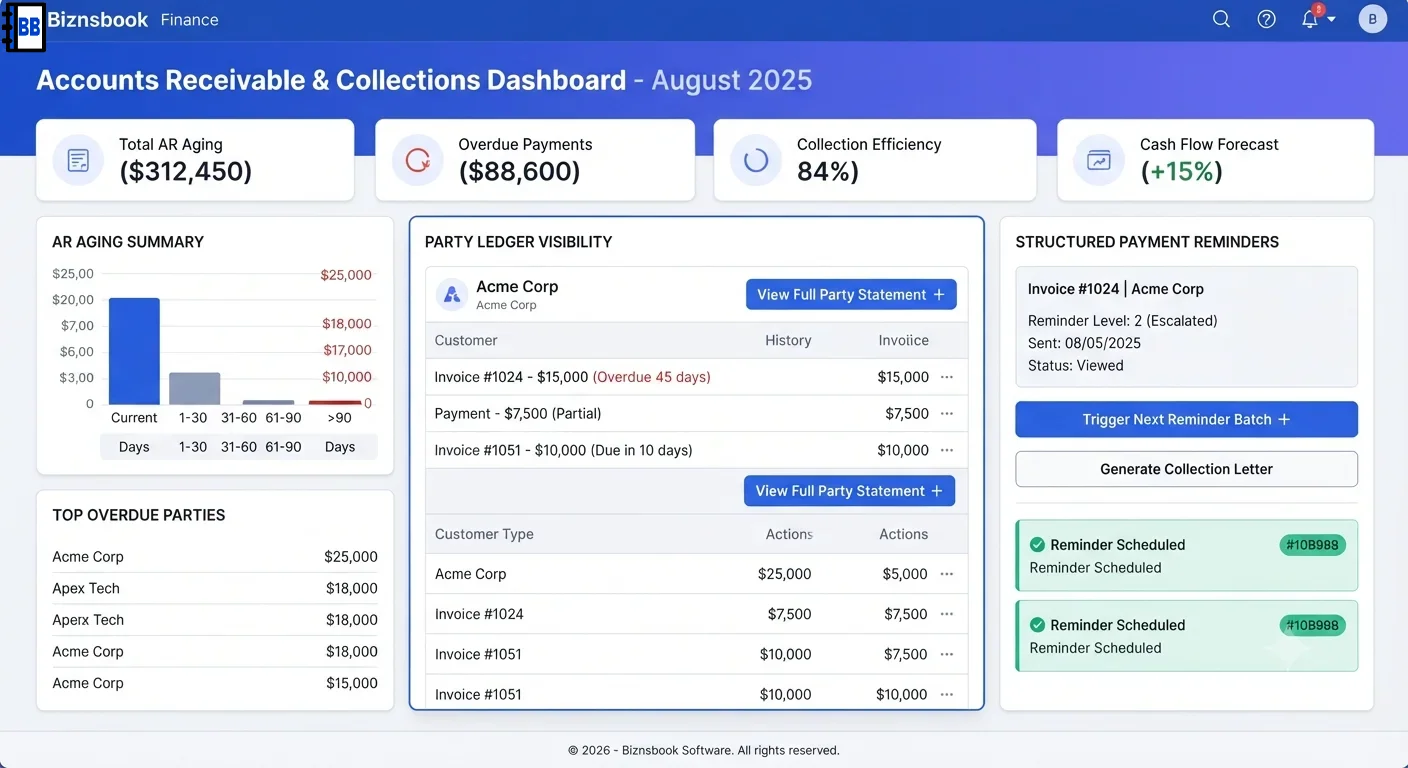
Why overdue invoices become a recurring cash issue
Late customer payments rarely come from one invoice alone. They build over time when follow-up is inconsistent, customer disputes are unresolved, and teams do not prioritize accounts by risk or value.
When finance tracks receivables in spreadsheets, reminder timing becomes irregular. Some customers receive repeated messages, while others with larger overdue balances receive none until month-end.
As overdue balances rise, working capital tightens. Businesses delay supplier payments or rely on short-term borrowing, increasing finance costs and operational stress.
Why this happens
- AR aging is reviewed infrequently, so risk signals are missed.
- Collectors lack customer-level transaction context from party ledger.
- Reminder schedules are ad hoc rather than rule-based.
- Dispute ownership is unclear between sales and finance teams.
Biznsbook addresses this through AR aging, party ledger, payment reminders when Accounting is enabled; add Finance Management, Taxation, Expense, Sales, or Purchase modules as your operating model requires.
Finance teams lose days each month reconciling versions that should never have diverged. Naming Biznsbook screens as the system of record — and closing periods when agreed — prevents silent edits that auditors flag immediately.
Step-by-step: Reduce Late Customer Payments
Designed for owners, bookkeepers, and controllers who need repeatable month-end discipline. Adapt roles to team size — separation of duties matters more than headcount.
- Set collection segments. Group customers by balance size, payment behavior, and credit terms so follow-up intensity is proportional to risk.
- Review AR aging daily. In Biznsbook, monitor AR aging buckets and prioritize accounts moving into older overdue bands.
- Use party ledger before outreach. Check invoice, receipt, and adjustment history in party ledger so collection calls are factual and specific.
- Apply reminder cadences. Send pre-due, due-date, and post-due reminders with clear payment options and escalation windows.
- Escalate unresolved disputes quickly. Assign invoice disputes to named owners and set deadlines to prevent aging inflation from unresolved issues.
- Track outcomes in Biznsbook. Update notes and collection status in Biznsbook-linked processes so finance and sales share one accountability view.
- Review DSO and bucket movement. Measure days sales outstanding and overdue bucket migration monthly to tune reminder timing and credit policy.
Review results after the first full monthly cycle. Adjust roles, mappings, or approvals where the same exception repeats.
Screen-level flows live in the Help Center. This guide focuses on the business process; help articles cover click-by-click navigation.
Common mistakes to avoid
- Mistake 1: AR aging is reviewed infrequently, so risk signals are missed. Repeating this each month usually shows up first in trial balance or AR/AP aging.
- Mistake 2: Collectors lack customer-level transaction context from party ledger. Repeating this each month usually shows up first in trial balance or AR/AP aging.
- Mistake 3: Reminder schedules are ad hoc rather than rule-based. Repeating this each month usually shows up first in trial balance or AR/AP aging.
- Mistake 4: Dispute ownership is unclear between sales and finance teams. Repeating this each month usually shows up first in trial balance or AR/AP aging.
Track recurring exceptions in month-end notes; each should map to a control above.
Best practices that hold up as you scale
- Set collection segments — Group customers by balance size, payment behavior, and credit terms so follow-up intensity is proportional to risk.
- Review AR aging daily — In Biznsbook, monitor AR aging buckets and prioritize accounts moving into older overdue bands.
- Use party ledger before outreach — Check invoice, receipt, and adjustment history in party ledger so collection calls are factual and specific.
- Apply reminder cadences — Send pre-due, due-date, and post-due reminders with clear payment options and escalation windows.
- Escalate unresolved disputes quickly — Assign invoice disputes to named owners and set deadlines to prevent aging inflation from unresolved issues.
Consistency beats heroics at month-end. A smaller team that closes the same calendar every month outperforms a larger team that posts sporadically.
How Biznsbook supports this workflow
AR aging is documented in Biznsbook Accounting / Finance capabilities. Use it as part of a controlled finance process — posting, review, and period close — not as an isolated export. When Sales, Purchase, Inventory, Taxation, Expense, or Finance Management modules are enabled, related documents can post through the central accounting posting service with double-entry validation.
party ledger is documented in Biznsbook Accounting / Finance capabilities. Use it as part of a controlled finance process — posting, review, and period close — not as an isolated export. When Sales, Purchase, Inventory, Taxation, Expense, or Finance Management modules are enabled, related documents can post through the central accounting posting service with double-entry validation.
payment reminders is documented in Biznsbook Accounting / Finance capabilities. Use it as part of a controlled finance process — posting, review, and period close — not as an isolated export. When Sales, Purchase, Inventory, Taxation, Expense, or Finance Management modules are enabled, related documents can post through the central accounting posting service with double-entry validation.
Permissions are role-based: separate chart maintenance, journal creation, report viewing, period close, and bank reconciliation per tenant policy.
Suggested implementation timeline
- Week 1: Document current process gaps and configure AR aging with finance owner sign-off.
- Weeks 2–3: Pilot on one month or one entity; post all test transactions through Biznsbook; freeze parallel spreadsheet journals.
- Week 4: Run first trial balance or report tie-out; fix mapping and permission issues.
- Month 2–3: Roll out to full team; add approvals and period close cadence from this guide.
- Ongoing: Monthly review using collection policy essentials and leadership dashboard.
Metrics to track monthly
- Days to complete month-end close
- Unreconciled bank lines outstanding
- AR and AP aging buckets over 30/60/90 days
- Trial balance out-of-balance exceptions
- Manual journal count vs automated postings ratio
Start with three metrics; trend direction matters more than a single point-in-time snapshot.
Spreadsheet / manual books vs integrated ERP
Compare typical manual finance work with Biznsbook AR aging and related capabilities.
| Capability | Manual / Spreadsheet | Biznsbook |
|---|---|---|
| Overdue prioritization | ❌ Static spreadsheet lists | ✅ AR aging bucket visibility |
| Customer context | ❌ Scattered invoice files | ✅ Party ledger drill-down |
| Reminder process | ❌ Irregular manual emails | ✅ Structured reminder cadence |
| Team alignment | ❌ Sales-finance disconnect | ✅ Shared receivable view |
| Risk tracking | ❌ Late month-end reaction | ✅ Daily aging review discipline |
| Cash impact | ❌ Unpredictable inflows | ✅ Earlier collections and better planning |
Collection policy essentials
Document due-date grace periods, reminder timing, escalation thresholds, and hold rules for repeat offenders. A published policy reduces ad hoc decisions and strengthens collection consistency.
Document this in your finance SOP and revisit each quarter as transaction volume or entity structure changes.
Frequently asked questions
Which customers should be chased first?
Prioritize high-value overdue balances and accounts with worsening aging patterns. Small old balances can wait if resources are limited.
How often should AR aging be reviewed?
Daily or at least twice weekly for active credit customers. Frequent review prevents minor delays from becoming serious delinquency.
Can reminders really reduce delays?
Yes. Consistent reminders before and after due dates significantly improve payment behavior compared with irregular follow-up.
What role does party ledger play in collections?
It gives full customer transaction history, helping collectors address disputes quickly and avoid chasing already settled invoices.
How this differs by industry
Retail
Retail B2B teams can reduce overdue account balances by combining clear invoice terms with routine aging review and reminder discipline.
Wholesale & distribution
Wholesale credit sales often carry larger balances, so structured reminders and bucket-based prioritization are essential for predictable cash inflow.
Manufacturing
Manufacturers with milestone billing can control receivable risk by resolving quantity or quality disputes early through ledger-backed conversations.