How to Track Revenue Growth
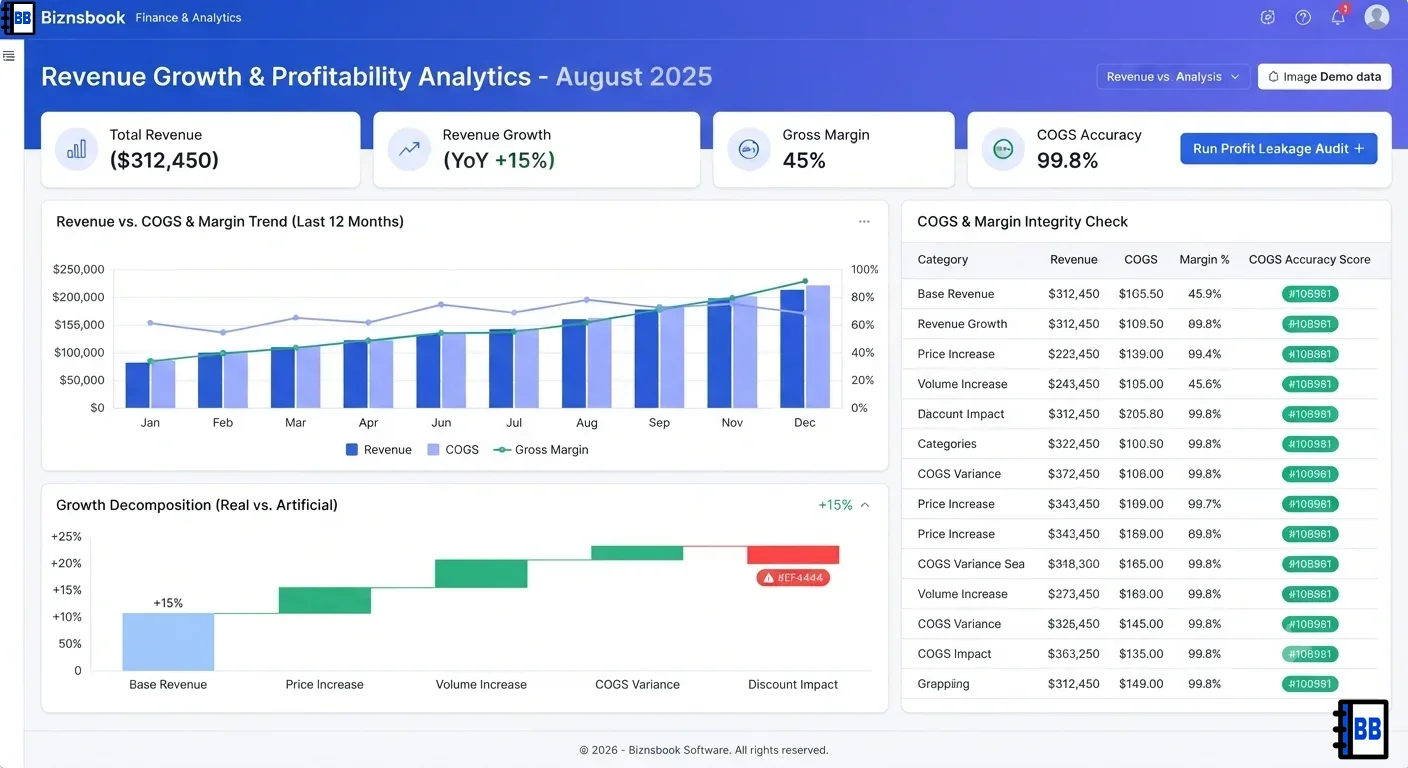
Top-line growth can hide profit decline
Revenue can rise while gross margin falls, creating an illusion of progress that hurts long-term sustainability.
If COGS allocations are inaccurate, management may celebrate growth that does not convert into real earnings.
Teams focused only on sales totals often miss discounting and cost leakage patterns.
Why this happens
- Growth tracked without margin context.
- COGS accuracy checks are skipped.
- Period comparisons are inconsistent.
- Pricing decisions are not reviewed.
Biznsbook addresses this through P&L statement, gross margin, COGS accuracy report when Accounting is enabled; add Finance Management, Taxation, Expense, Sales, or Purchase modules as your operating model requires.
Finance teams lose days each month reconciling versions that should never have diverged. Naming Biznsbook screens as the system of record — and closing periods when agreed — prevents silent edits that auditors flag immediately.
Step-by-step: Track Revenue Growth
Designed for owners, bookkeepers, and controllers who need repeatable month-end discipline. Adapt roles to team size — separation of duties matters more than headcount.
- Run current and prior P&L. Compare top-line and gross profit across aligned periods for true trend visibility.
- Measure gross margin movement. Track margin percentage changes alongside revenue growth percentages.
- Review COGS accuracy report. Verify product and service cost allocations to avoid distorted profitability.
- Segment growth by category. Identify which lines drive growth and whether their margins are sustainable.
- Analyze discount and returns impact. Check if revenue gains rely on heavy discounts or high return rates.
- Set growth quality thresholds. Define acceptable margin floor and COGS confidence levels for expansion.
- Review monthly with leadership. Align sales, finance, and operations on growth actions and corrections.
Review results after the first full monthly cycle. Adjust roles, mappings, or approvals where the same exception repeats.
Screen-level flows live in the Help Center. This guide focuses on the business process; help articles cover click-by-click navigation.
Common mistakes to avoid
- Mistake 1: Growth tracked without margin context. Repeating this each month usually shows up first in trial balance or AR/AP aging.
- Mistake 2: COGS accuracy checks are skipped. Repeating this each month usually shows up first in trial balance or AR/AP aging.
- Mistake 3: Period comparisons are inconsistent. Repeating this each month usually shows up first in trial balance or AR/AP aging.
- Mistake 4: Pricing decisions are not reviewed. Repeating this each month usually shows up first in trial balance or AR/AP aging.
Track recurring exceptions in month-end notes; each should map to a control above.
Best practices that hold up as you scale
- Run current and prior P&L — Compare top-line and gross profit across aligned periods for true trend visibility.
- Measure gross margin movement — Track margin percentage changes alongside revenue growth percentages.
- Review COGS accuracy report — Verify product and service cost allocations to avoid distorted profitability.
- Segment growth by category — Identify which lines drive growth and whether their margins are sustainable.
- Analyze discount and returns impact — Check if revenue gains rely on heavy discounts or high return rates.
Consistency beats heroics at month-end. A smaller team that closes the same calendar every month outperforms a larger team that posts sporadically.
How Biznsbook supports this workflow
P&L statement is documented in Biznsbook Accounting / Finance capabilities. Use it as part of a controlled finance process — posting, review, and period close — not as an isolated export. When Sales, Purchase, Inventory, Taxation, Expense, or Finance Management modules are enabled, related documents can post through the central accounting posting service with double-entry validation.
gross margin is documented in Biznsbook Accounting / Finance capabilities. Use it as part of a controlled finance process — posting, review, and period close — not as an isolated export. When Sales, Purchase, Inventory, Taxation, Expense, or Finance Management modules are enabled, related documents can post through the central accounting posting service with double-entry validation.
COGS accuracy report is documented in Biznsbook Accounting / Finance capabilities. Use it as part of a controlled finance process — posting, review, and period close — not as an isolated export. When Sales, Purchase, Inventory, Taxation, Expense, or Finance Management modules are enabled, related documents can post through the central accounting posting service with double-entry validation.
Permissions are role-based: separate chart maintenance, journal creation, report viewing, period close, and bank reconciliation per tenant policy.
Suggested implementation timeline
- Week 1: Document current process gaps and configure P&L statement with finance owner sign-off.
- Weeks 2–3: Pilot on one month or one entity; post all test transactions through Biznsbook; freeze parallel spreadsheet journals.
- Week 4: Run first trial balance or report tie-out; fix mapping and permission issues.
- Month 2–3: Roll out to full team; add approvals and period close cadence from this guide.
- Ongoing: Monthly review using quality-of-growth lens and leadership dashboard.
Metrics to track monthly
- Days to complete month-end close
- Unreconciled bank lines outstanding
- AR and AP aging buckets over 30/60/90 days
- Trial balance out-of-balance exceptions
- Manual journal count vs automated postings ratio
Start with three metrics; trend direction matters more than a single point-in-time snapshot.
Spreadsheet / manual books vs integrated ERP
Compare typical manual finance work with Biznsbook P&L statement and related capabilities.
| Capability | Manual / Spreadsheet | Biznsbook |
|---|---|---|
| Growth metric | ❌ Revenue only | ✅ Revenue plus margin |
| Cost confidence | ❌ Estimated | ✅ COGS accuracy report |
| Trend analysis | ❌ Single period | ✅ Multi-period P&L view |
| Decision quality | ❌ Volume-led | ✅ Profitability-led |
| Risk detection | ❌ Late | ✅ Early margin warnings |
| Cross-team alignment | ❌ Siloed | ✅ Shared growth review |
Quality-of-growth lens
Healthy growth improves revenue, margin, and cost accuracy together rather than chasing top-line numbers alone.
Document this in your finance SOP and revisit each quarter as transaction volume or entity structure changes.
Frequently asked questions
Why include gross margin in growth tracking?
Margin shows whether revenue growth is creating profit or masking cost and pricing issues.
What does COGS accuracy report help with?
It improves trust in cost allocation so profitability analysis reflects reality.
How often should growth be reviewed?
Monthly minimum, and more frequently during fast expansion or pricing changes.
Can high growth still be risky?
Yes, if it depends on unsustainable discounts or poor-quality cost data.
How this differs by industry
Retail
Retail teams should compare growth with markdown intensity to protect gross margin during promotions.
Wholesale & distribution
Wholesale firms should segment growth by customer tier and contract margin to avoid unprofitable volume.
Manufacturing
Manufacturers should watch COGS accuracy closely since material and conversion shifts can erase growth gains.