Batch & Expiry Tracking for Shopify, Toast & Perishable Retail
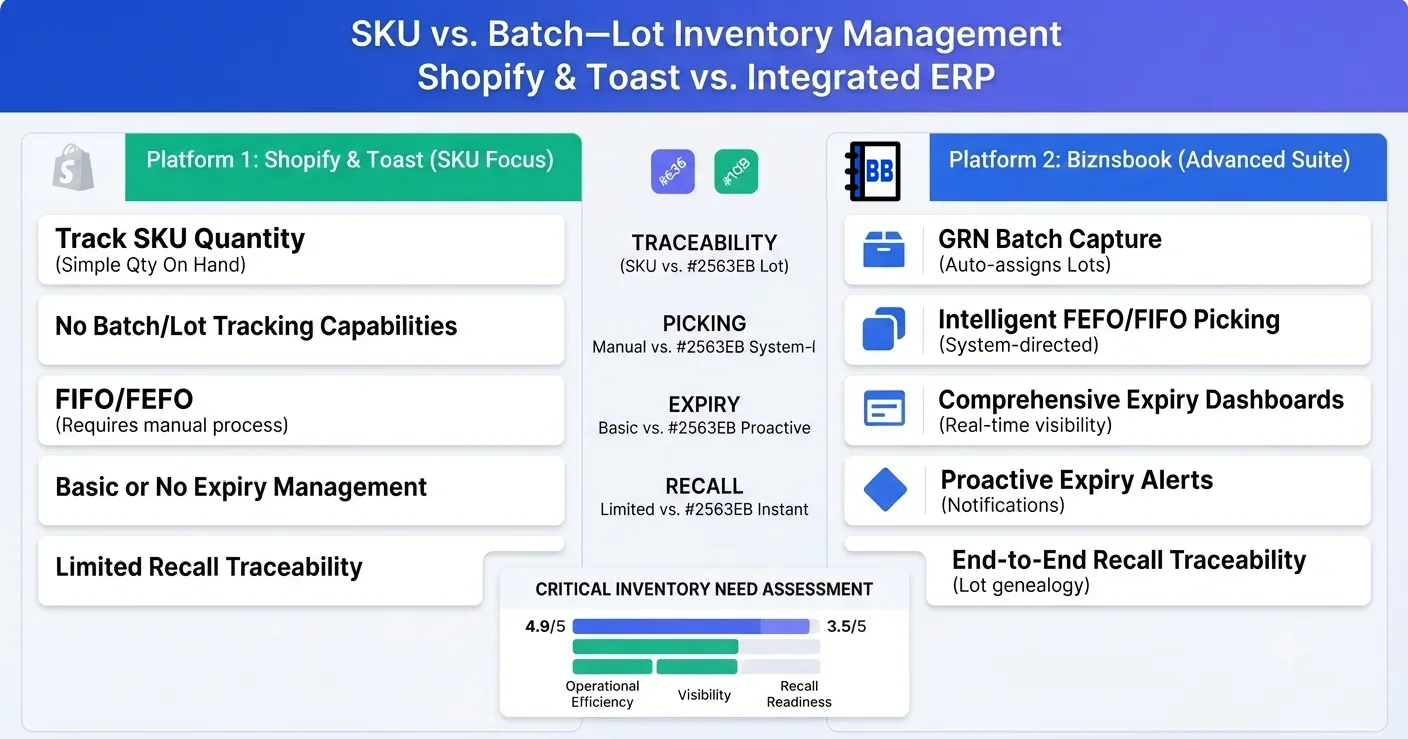
Channel-first tools excel at storefronts and POS, but perishable operators often track lots and expiry in spreadsheets — Biznsbook makes batch control native from receipt through sale.
Related guides: Inventory guides hub · Ecommerce industry · Cin7 + Shopify + CRM revenue
At a glance
Side-by-side summary on six criteria teams usually evaluate first. Pricing and packaging change over time — verify current plans on each vendor site before you buy.
| Criterion | Biznsbook | Shopify, Toast & channel apps |
|---|---|---|
| Inventory granularity | Lot/batch with expiry per receipt line | SKU quantity; lot tracking usually external |
| Receiving workflow | GRN with batch dates, optional QC, and posted stock ledger | No native goods-receipt lot capture |
| Picking on outbound sales | FEFO or FIFO enforced on invoices, POS, and imports | No native lot allocation on checkout |
| Expiry visibility | Expiry tracker, analytics, and batch detail dashboards | Spreadsheets, calendar reminders, or third-party apps |
| Proactive alerts | Tiered email plus in-app bell with deduplicated batch alerts | Limited native expiry alerting |
| Recall readiness | Forward/backward traceability from GRN to customer orders | Hard to prove which batch shipped in which order |
ERP module depth
How far each platform reaches beyond checkout or bookkeeping into operations, inventory, and finance on one ledger.
| Module / capability | Biznsbook | Shopify, Toast & channel apps |
|---|---|---|
| Catalog granularity | Lot/batch with expiry per GRN line | SKU quantity; lots usually external |
| Receiving | GRN with batch dates and QC | No native goods-receipt lots |
| Picking rules | FEFO/FIFO on sales and imports | No native lot allocation |
| Expiry visibility | Tracker, analytics, alerts | Spreadsheets or third-party apps |
| Recall traceability | Forward/backward lot tracing | Hard to prove batch per order |
| Channel role | ERP system of record behind Shopify | Shopify remains storefront |
| Toast / restaurant | Batch-aware sales import | Menu-level sales only |
| Accounting | Valuation and COGS from stock ledger | Revenue in channel; COGS elsewhere |
Why spreadsheet lot tracking appears beside Shopify and Toast
Supplement, food, and pharmacy operators on Shopify often report the same workaround: sell on the storefront, but maintain batch numbers and expiry dates in Excel or Google Sheets because the catalog only knows total on-hand per variant.
Toast restaurants face a similar gap for ingredient inventory — POS handles menu sales well, but lot-level shelf life for perishable back-of-house stock is usually tracked outside the POS unless a dedicated inventory ERP sits behind it.
The pain is not theoretical. Without lot linkage on outbound orders, recalls force broad quarantines, near-expiry stock is discovered too late, and finance cannot tie write-offs to specific supplier lots.
Batch capture at receiving (GRN)
Biznsbook starts lot control at inbound receipt. On a Good Receive Note (GRN), receivers enter batch or lot identifiers plus manufacture and expiry dates on each line for products with track expiry enabled.
Optional quality check separates accepted versus rejected quantities before stock posts to the warehouse. Batch records tie to the stock ledger so on-hand is always lot-aware — not a SKU total with hidden expiry risk in the back room.
Expiry dashboards operators actually open
The Expiry tracker groups batches by urgency so warehouse leads see what is expired or expiring soon without exporting reports. Expiry analytics summarizes risk by category or velocity — useful when buyers ask which lines chronically waste.
Batch detail drills into a specific lot: remaining quantity, receipt history, and movement. Together these screens replace the side spreadsheet teams keep open beside Shopify admin or Toast back office.
Alerts before product becomes waste
Expiry alert settings configure email recipients, day thresholds (for example 30, 14, and 7), and in-app bell notifications. Scheduled background checks fire grouped alerts when batches newly cross a tier — deduplicated per batch so inboxes are not spammed weekly for the same lot.
When Alert on expired is enabled, batches past expiry with remaining quantity trigger a separate tier once. Operators can run test email and run check now from settings before go-live.
FEFO and FIFO on real outbound movement
Configure FEFO (first-expired-first-out) or FIFO (first-in-first-out) on the product master. When sales invoices, POS checkout, or Toast sales import deduct stock, Biznsbook allocates from the correct batch slices automatically.
That matters when shelf life varies by supplier lot — picking the newest pallet because it is easier to reach is how older batches expire unnoticed in channel-only workflows.
Recall traceability and channel integration
Traceability supports forward and backward lot tracing — which batches went to which customers, or which supplier receipt fed a problematic lot. That is the difference between isolating one recall lot and quarantining an entire SKU range.
Biznsbook Integration Hub connects Shopify and WooCommerce for order import and stock sync while keeping authoritative lot inventory in the ERP. Toast integration maps menu items to inventory products and deducts stock on sales import with the same batch rules. Channel apps remain your storefront; Biznsbook becomes the system of record for perishable stock.
Who should choose each
Choose Biznsbook if…
- Supplement, food, pharmacy, or cosmetics brands selling on Shopify with lot compliance needs
- Toast or multi-location restaurants tracking perishable ingredient expiry
- Operators tired of maintaining batch spreadsheets beside their sales channel
- Teams that need FEFO picking, expiry alerts, and recall traceability in one platform
- Businesses wanting inventory, purchasing, and accounting connected to lot-level stock
Choose Shopify, Toast & channel apps if…
- Catalogs with no expiry or lot compliance requirements
- Teams satisfied with SKU-level quantity and manual spreadsheet lot notes
- Pure digital goods or non-perishable SKU businesses
- Operators who only need a storefront or POS without ERP depth
- Businesses not willing to post receipts through a formal GRN workflow
Biznsbook capabilities referenced in this comparison
- Track expiry on the product master with shelf life, alert days, and FEFO/FIFO picking rules
- Batch and lot capture on GRN lines with manufacture and expiry dates
- Expiry tracker with urgency grouping (expired, expiring soon)
- Expiry analytics dashboard for category-level waste patterns
- Batch detail views with lot history and remaining quantity
- Expiry alert settings — email tiers, dashboard bell, scheduled checks, test email
- Traceability report for forward/backward lot movement to customers or suppliers
- Integration Hub for Shopify and WooCommerce order and stock sync
- Toast integration with batch-aware stock deduction on sales import
- Multi-warehouse inventory with structured GRN, transfers, and stock ledger
See all modules, current pricing, and topic guides for workflow detail.
Frequently asked questions
Does Biznsbook replace Shopify or Toast?
No. Shopify and Toast remain strong for e-commerce storefronts and restaurant POS. Biznsbook is the inventory and ERP layer behind them — capturing lots at receipt, enforcing picking rules, and alerting before expiry while channels handle customer-facing sales.
Can Shopify orders still sync if lots are tracked in Biznsbook?
Yes. Integration Hub supports Shopify and WooCommerce connectors so orders import and stock syncs from Biznsbook authoritative warehouse quantities, including batch-aware deductions when configured.
How does Toast fit with batch tracking?
Toast menu items map to Biznsbook inventory products. Sales import deducts stock using the same FEFO or FIFO rules as POS and invoices, so back-of-house perishables stay lot-controlled even when checkout sells at menu-item level.
Do I need to track which batch went into every order?
For day-to-day operations, FEFO/FIFO automatic allocation is usually enough. For regulated categories or recall readiness, use Traceability to prove lot movement forward to customers and backward to supplier receipts.
What dashboards should a perishable team check weekly?
Start with Expiry tracker for urgent lots, Expiry analytics for waste patterns, and Inventory Health for low or out-of-stock SKUs. Configure expiry alert email tiers so buyers are notified before manual spreadsheet reviews.
Compare with your own data
Book a short demo to walk through inventory, accounting, or your priority module — no obligation.
Book a demo View pricing