How to Track Batch Numbers and Expiry Dates
When expiry mistakes become compliance and safety risks
Selling expired product damages brand trust and can trigger regulatory action in food and pharmacy. Even near-expiry clearance rushed at the last minute destroys margin that could have been saved with earlier alerts.
Spreadsheet batch columns are overwritten or skipped during busy receiving. Pickers grab the newest pallet because it is easier to reach, leaving older lots to expire in the back of the rack.
Recalls without batch traceability force you to quarantine entire SKU ranges instead of isolating specific lots — an expensive overreaction.
Why this happens
- Expiry is optional on products so receivers skip batch entry.
- No picking rule enforces first-expired-first-out.
- Buyers over-order long shelf-life SKUs without rotation discipline.
- Alerts are not configured until after the first write-off.
These patterns show up across SMB inventory teams regardless of industry. The fix is usually process plus tooling — not hiring one more buyer. Biznsbook addresses this topic through Expiry tracker, FEFO/FIFO, batch detail, expiry alerts when the Inventory module (and related Warehouse, Purchase, or Integration modules where noted) is enabled for your tenant.
Leaders often underestimate how much informal workarounds cost: extra emails, duplicate counts, and end-of-month fire drills. Documenting who owns each step — and which screen in Biznsbook is the system of record — removes ambiguity that spreadsheets never solve.
Step-by-step: Track Batch Numbers and Expiry Dates
The following workflow is designed for owners, warehouse leads, and finance reviewers who need a repeatable process. Adapt roles to your team size — separation of duties matters more than headcount.
- Enable track expiry on relevant products. Turn on track expiry, shelf life, and alert days on items that require lot control in the product master.
- Capture batches on GRN lines. Enter manufacture and expiry dates on each GRN line when receiving. Quality check can separate accepted vs rejected quantities.
- Set FEFO or FIFO picking rules. Configure FEFO/FIFO rules so outbound issues prioritize the correct lots automatically.
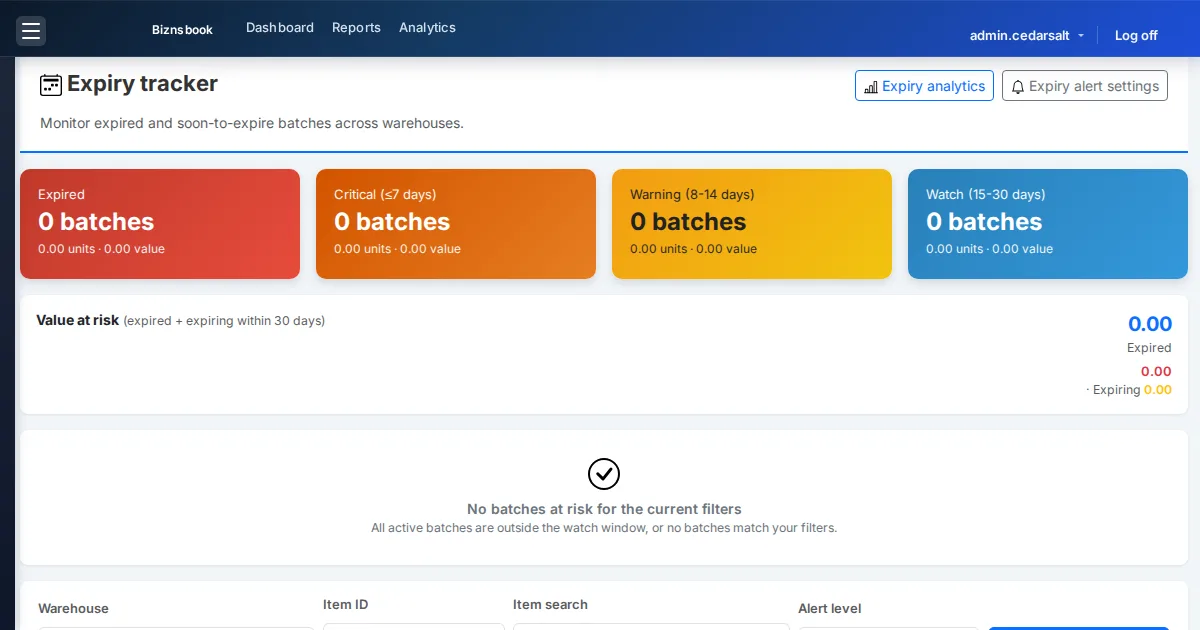
- Monitor the expiry tracker daily. Open the expiry tracker for urgency grouping and drill into batch detail for specific lots.
- Configure expiry alert settings. Set email and in-app rules with scheduled checks. Use test email to verify recipients before go-live.
- Act on bell notifications. Respond to in-app bell notifications for urgent expiry items before they become waste.
- Review expiry analytics monthly. Use expiry analytics to spot categories with chronic waste and adjust order quantities.
After implementing these steps, review results in the first full cycle (usually one month). Adjust thresholds, permissions, or training where the same exception repeats. Inventory improvement compounds when feedback loops are short.
For related screen-level flows, see the Biznsbook Help Center (for example GRN, transfers, batch tracking, or Shopify setup). This guide stays focused on the business problem; help articles cover click-by-click navigation.
Common mistakes to avoid
- Mistake 1: Ignoring that expiry is optional on products so receivers skip batch entry. Teams that skip corrective process here usually see the same emergency twice in one quarter.
- Mistake 2: Ignoring that no picking rule enforces first-expired-first-out. Teams that skip corrective process here usually see the same emergency twice in one quarter.
- Mistake 3: Ignoring that buyers over-order long shelf-life SKUs without rotation discipline. Teams that skip corrective process here usually see the same emergency twice in one quarter.
- Mistake 4: Ignoring that alerts are not configured until after the first write-off. Teams that skip corrective process here usually see the same emergency twice in one quarter.
Most failures are repeat offenses, not one-off disasters. Track exceptions in your ops meeting notes and tie each back to a control in the step-by-step section.
Best practices that hold up as you scale
- Enable track expiry on relevant products — Turn on track expiry, shelf life, and alert days on items that require lot control in the product master.
- Capture batches on GRN lines — Enter manufacture and expiry dates on each GRN line when receiving.
- Set FEFO or FIFO picking rules — Configure FEFO/FIFO rules so outbound issues prioritize the correct lots automatically.
- Monitor the expiry tracker daily — Open the expiry tracker for urgency grouping and drill into batch detail for specific lots.
- Configure expiry alert settings — Set email and in-app rules with scheduled checks.
Consistency beats intensity. A medium-sized distributor that posts every GRN the same day will outperform a larger competitor that counts annually but posts sporadically.
How Biznsbook supports this workflow
Expiry tracker in Biznsbook is part of the verified Inventory module capability set (see product documentation). Use it in the workflow above rather than as a standalone report: connect expiry tracker to daily receiving, shipping, and count routines so data stays current. When Warehouse, Purchase, Sales, POS, or Integration modules are licensed, the same stock ledger feeds expiry tracker without duplicate entry — that integration is where SMB teams recover the hours lost to spreadsheet reconciliation.
FEFO/FIFO in Biznsbook is part of the verified Inventory module capability set (see product documentation). Use it in the workflow above rather than as a standalone report: connect fefo/fifo to daily receiving, shipping, and count routines so data stays current. When Warehouse, Purchase, Sales, POS, or Integration modules are licensed, the same stock ledger feeds fefo/fifo without duplicate entry — that integration is where SMB teams recover the hours lost to spreadsheet reconciliation.
batch detail in Biznsbook is part of the verified Inventory module capability set (see product documentation). Use it in the workflow above rather than as a standalone report: connect batch detail to daily receiving, shipping, and count routines so data stays current. When Warehouse, Purchase, Sales, POS, or Integration modules are licensed, the same stock ledger feeds batch detail without duplicate entry — that integration is where SMB teams recover the hours lost to spreadsheet reconciliation.
expiry alerts in Biznsbook is part of the verified Inventory module capability set (see product documentation). Use it in the workflow above rather than as a standalone report: connect expiry alerts to daily receiving, shipping, and count routines so data stays current. When Warehouse, Purchase, Sales, POS, or Integration modules are licensed, the same stock ledger feeds expiry alerts without duplicate entry — that integration is where SMB teams recover the hours lost to spreadsheet reconciliation.
Module licensing is flexible: Inventory is the foundation; enable Warehouse Management, Purchase, Sales, POS, Manufacturing, or Integration Hub connectors when your operating model requires them. Permissions are role-based per tenant — separate who can view, receive, adjust, and approve so controls scale with headcount.
Suggested implementation timeline
- Week 1: Baseline current performance, assign process owner, configure master data fields tied to Expiry tracker.
- Weeks 2–3: Pilot on one product group or warehouse; post every transaction through Biznsbook documents; no parallel spreadsheet edits.
- Week 4: First review against metrics; tune thresholds, permissions, and training gaps.
- Month 2–3: Expand to all warehouses and categories; add cycle count or replenishment cadence from this guide.
- Ongoing: Monthly ops review using health dashboard and regulatory readiness checklist.
Metrics to track monthly
- Weeks on hand for top twenty SKUs by revenue
- Count accuracy percentage on A-class items
- Open document aging (GRNs, transfers, adjustments in draft)
- Value at risk from low-stock and overstock KPIs on replenishment views
- Exception rate: lines requiring manual override per hundred transactions
Pick three metrics to start — not all five. Review trend direction, not single points. Improving these metrics usually precedes revenue protection and working-capital releases finance can measure.
Manual / spreadsheet vs integrated ERP
Spreadsheets work for snapshots; they fail as a transaction system. Compare typical manual approaches with how Biznsbook supports Expiry tracker and related capabilities.
| Capability | Manual / Spreadsheet | Biznsbook |
|---|---|---|
| Batch capture at receipt | ❌ Optional spreadsheet column | ✅ GRN line batch/expiry fields |
| Picking discipline | ❌ Picker choice | ✅ FEFO/FIFO rules |
| Expiry visibility | ❌ Manual calendar | ✅ Expiry tracker dashboard |
| Alerts | ❌ None | ✅ Email and in-app with schedules |
| Lot traceability | ❌ Incomplete | ✅ Batch detail history |
| QC on receipt | ❌ Informal | ✅ GRN quality check workflow |
Regulatory readiness
Maintain batch traceability from supplier GRN through sale or adjustment. During audits, stock card and batch detail should reconstruct lot movement without reconstructing spreadsheets.
Teams that document this section in their internal inventory SOP onboard new hires faster and pass audits with fewer emergency counts. Revisit quarterly as assortment and warehouse footprint change.
Pair this with the inventory valuation report and stock card when investigating exceptions — numbers in isolation rarely tell the full story without movement history behind them.
Frequently asked questions
What is the difference between FEFO and FIFO?
FIFO issues oldest receipt first by date received. FEFO issues the lot with the earliest expiry first, which matters when shelf life varies by batch.
Can expiry tracking work with POS?
Yes when POS and Inventory share stock. Fast-moving retail still benefits from back-office lot control even if checkout sells at SKU level.
How early should alerts fire?
Common practice is 30, 60, and 90 days before expiry depending on product velocity and clearance channels.
What if a batch fails QC?
Record rejected quantity in GRN quality check and route to vendor return or adjustment instead of posting to sellable stock.
How this differs by industry
Retail
Grocery and pharmacy must pair expiry tracking with promotional markdowns before waste. FEFO reduces shrink at the shelf.
Wholesale & distribution
Distributors rotate pallets on inbound put-away. Batch detail supports customer certificates and recall isolation.
Manufacturing
Raw material lots affect finished goods shelf life. Tie batch capture on GRN to production batch records when Manufacturing is enabled.