How to Reduce Inventory Shrinkage
Shrinkage steals margin without a line on the P&L you expect
Retail shrink averages one to two percent of sales in many industries — enough to erase profit on promotional lines. Distributors blame "warehouse variance" until write-offs become routine.
Without reconciliation, shrink hides inside growing SKU counts. Total inventory value looks stable while individual items drift negative.
Teams that adjust stock without approval or reason codes never learn whether the root cause is theft, damage, or data entry.
Why this happens
- No cycle count program on A SKUs.
- Receiving shortcuts skip QC.
- Negative stock ignored.
- Adjustments lack approval workflow.
These patterns show up across SMB inventory teams regardless of industry. The fix is usually process plus tooling — not hiring one more buyer. Biznsbook addresses this topic through stock adjustments, stock reconciliation, cycle counts when the Inventory module (and related Warehouse, Purchase, or Integration modules where noted) is enabled for your tenant.
Leaders often underestimate how much informal workarounds cost: extra emails, duplicate counts, and end-of-month fire drills. Documenting who owns each step — and which screen in Biznsbook is the system of record — removes ambiguity that spreadsheets never solve.
Step-by-step: Reduce Inventory Shrinkage
The following workflow is designed for owners, warehouse leads, and finance reviewers who need a repeatable process. Adapt roles to your team size — separation of duties matters more than headcount.
- Measure shrink by category. Compare book vs physical from cycle counts; rank categories by shrink dollars.
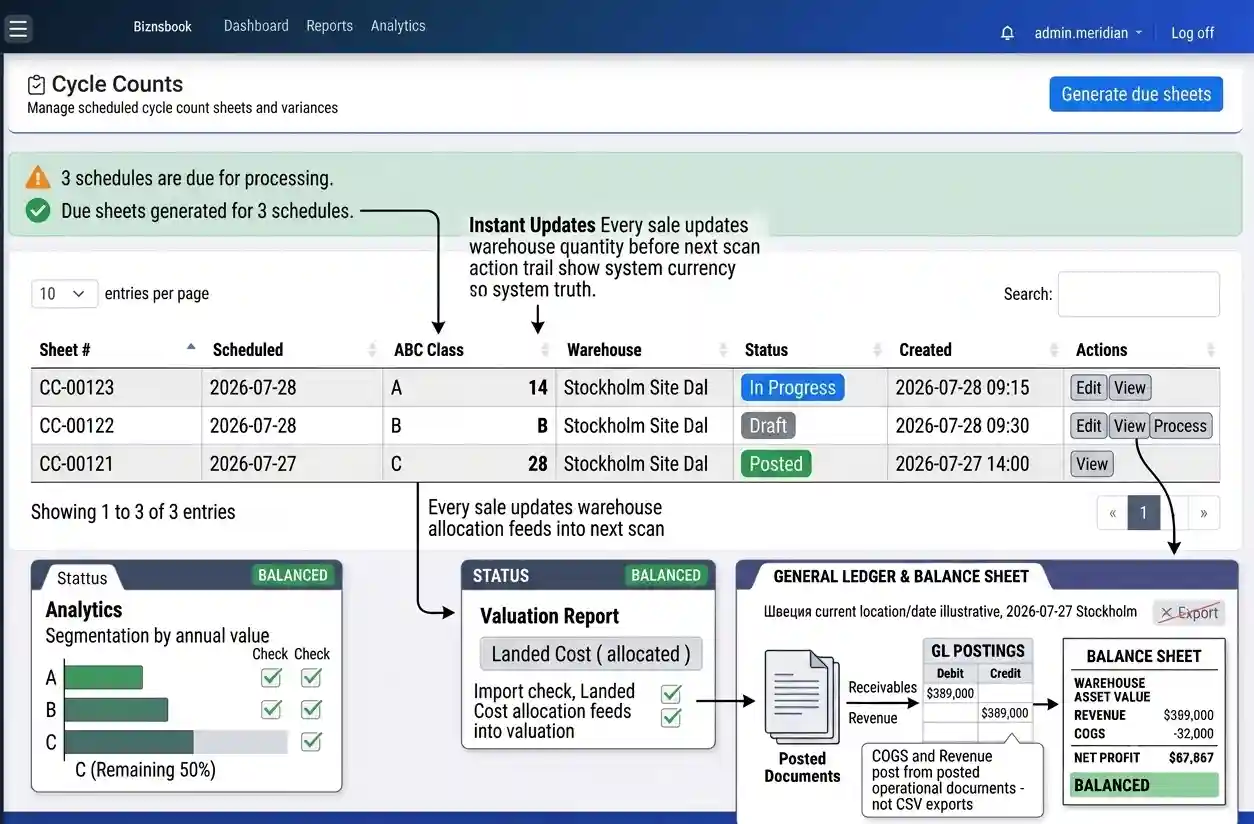
- Run stock reconciliation proactively. Use stock reconciliation to highlight quantity drift before full wall-to-wall counts.
- Count high-risk SKUs frequently. Cycle count A items weekly or monthly based on value and theft risk.
- Use GRN quality check. Post only accepted quantity from receiving; reject damaged inbound before it becomes shrink.
- Process adjustments with approval. Stock adjustments in draft → pending approval → approved with documented reason.
- Investigate negatives same day. Negative on-hand is a control failure — trace on stock card immediately.
- Review supplier returns for recoverable loss. Use return to vendor when vendor-caused damage can recover credit.
After implementing these steps, review results in the first full cycle (usually one month). Adjust thresholds, permissions, or training where the same exception repeats. Inventory improvement compounds when feedback loops are short.
For related screen-level flows, see the Biznsbook Help Center (for example GRN, transfers, batch tracking, or Shopify setup). This guide stays focused on the business problem; help articles cover click-by-click navigation.
Common mistakes to avoid
- Mistake 1: Ignoring that no cycle count program on A SKUs. Teams that skip corrective process here usually see the same emergency twice in one quarter.
- Mistake 2: Ignoring that receiving shortcuts skip QC. Teams that skip corrective process here usually see the same emergency twice in one quarter.
- Mistake 3: Ignoring that negative stock ignored. Teams that skip corrective process here usually see the same emergency twice in one quarter.
- Mistake 4: Ignoring that adjustments lack approval workflow. Teams that skip corrective process here usually see the same emergency twice in one quarter.
Most failures are repeat offenses, not one-off disasters. Track exceptions in your ops meeting notes and tie each back to a control in the step-by-step section.
Best practices that hold up as you scale
- Measure shrink by category — Compare book vs physical from cycle counts; rank categories by shrink dollars.
- Run stock reconciliation proactively — Use stock reconciliation to highlight quantity drift before full wall-to-wall counts.
- Count high-risk SKUs frequently — Cycle count A items weekly or monthly based on value and theft risk.
- Use GRN quality check — Post only accepted quantity from receiving; reject damaged inbound before it becomes shrink.
- Process adjustments with approval — Stock adjustments in draft → pending approval → approved with documented reason.
Consistency beats intensity. A medium-sized distributor that posts every GRN the same day will outperform a larger competitor that counts annually but posts sporadically.
How Biznsbook supports this workflow
stock adjustments in Biznsbook is part of the verified Inventory module capability set (see product documentation). Use it in the workflow above rather than as a standalone report: connect stock adjustments to daily receiving, shipping, and count routines so data stays current. When Warehouse, Purchase, Sales, POS, or Integration modules are licensed, the same stock ledger feeds stock adjustments without duplicate entry — that integration is where SMB teams recover the hours lost to spreadsheet reconciliation.
stock reconciliation in Biznsbook is part of the verified Inventory module capability set (see product documentation). Use it in the workflow above rather than as a standalone report: connect stock reconciliation to daily receiving, shipping, and count routines so data stays current. When Warehouse, Purchase, Sales, POS, or Integration modules are licensed, the same stock ledger feeds stock reconciliation without duplicate entry — that integration is where SMB teams recover the hours lost to spreadsheet reconciliation.
cycle counts in Biznsbook is part of the verified Inventory module capability set (see product documentation). Use it in the workflow above rather than as a standalone report: connect cycle counts to daily receiving, shipping, and count routines so data stays current. When Warehouse, Purchase, Sales, POS, or Integration modules are licensed, the same stock ledger feeds cycle counts without duplicate entry — that integration is where SMB teams recover the hours lost to spreadsheet reconciliation.
Module licensing is flexible: Inventory is the foundation; enable Warehouse Management, Purchase, Sales, POS, Manufacturing, or Integration Hub connectors when your operating model requires them. Permissions are role-based per tenant — separate who can view, receive, adjust, and approve so controls scale with headcount.
Suggested implementation timeline
- Week 1: Baseline current performance, assign process owner, configure master data fields tied to stock adjustments.
- Weeks 2–3: Pilot on one product group or warehouse; post every transaction through Biznsbook documents; no parallel spreadsheet edits.
- Week 4: First review against metrics; tune thresholds, permissions, and training gaps.
- Month 2–3: Expand to all warehouses and categories; add cycle count or replenishment cadence from this guide.
- Ongoing: Monthly ops review using health dashboard and shrink root-cause matrix checklist.
Metrics to track monthly
- Weeks on hand for top twenty SKUs by revenue
- Count accuracy percentage on A-class items
- Open document aging (GRNs, transfers, adjustments in draft)
- Value at risk from low-stock and overstock KPIs on replenishment views
- Exception rate: lines requiring manual override per hundred transactions
Pick three metrics to start — not all five. Review trend direction, not single points. Improving these metrics usually precedes revenue protection and working-capital releases finance can measure.
Manual / spreadsheet vs integrated ERP
Spreadsheets work for snapshots; they fail as a transaction system. Compare typical manual approaches with how Biznsbook supports stock adjustments and related capabilities.
| Capability | Manual / Spreadsheet | Biznsbook |
|---|---|---|
| Drift detection | ❌ Annual count only | ✅ Stock reconciliation screen |
| Adjustments | ❌ Anyone edits | ✅ Approval states |
| Receiving QC | ❌ Skip | ✅ GRN quality check |
| Traceability | ❌ Unknown | ✅ Stock card by document |
| RTV recovery | ❌ Informal | ✅ Return to vendor with reason codes |
| Accountability | ❌ Blameless | ✅ Reason codes on adjustments |
Shrink root-cause matrix
Map each adjustment reason to corrective action: training for mis-picks, security for theft, supplier RTV for inbound damage, process fix for posting lag. Without reason codes you only treat symptoms.
Teams that document this section in their internal inventory SOP onboard new hires faster and pass audits with fewer emergency counts. Revisit quarterly as assortment and warehouse footprint change.
Pair this with the inventory valuation report and stock card when investigating exceptions — numbers in isolation rarely tell the full story without movement history behind them.
Frequently asked questions
What is an acceptable shrink rate?
Varies by industry; track trend down from your baseline rather than a generic benchmark alone.
Are all adjustments shrink?
No. Some adjust for known damage or samples; categorize with reason codes for analysis.
How does QC reduce shrink?
Rejected quantity never enters sellable stock, so damage is flagged at receipt not at sale attempt.
Who approves adjustments?
Configure roles per tenant — typically warehouse proposes, supervisor or finance approves.
How this differs by industry
Retail
High-theft categories need frequent counts and POS exception reports alongside inventory controls.
Wholesale & distribution
Mis-shipments and pick errors dominate — reconcile pick lanes and use barcode verification.
Manufacturing
Scrap and yield loss should post through manufacturing or adjustments, not informal floor bins.