Omnichannel ERP with Shopify order import
Sync inventory to Shopify, import orders as posted sales with stock deduction — know WooCommerce inbound limits upfront.
Direct answer
Biznsbook ecommerce and omnichannel ERP connects Shopify via Integration Hub with OAuth, product mapping by SKU or barcode, inventory level sync per location, and inbound order import as posted SaleBill with idempotent stock deduction. WooCommerce supports outbound stock and customer sync plus inbound webhooks, but full automatic order-to-SaleBill import is Shopify-only today.
Omnichannel breaks when channels are silos
Web orders in Shopify, stock in ERP, and oversells happen hourly until someone manually adjusts.
Overselling online
Shopify shows stock ERP already sold offline yesterday.
SKU mapping debt
Variant IDs never matched — imports skip lines silently.
Order re-entry
Teams recreate web orders as manual invoices doubling work.
Partial channel truth
WooCommerce stock updates but orders stay outside ERP.
Ecommerce pains mapped to modules
Each operational pain maps to a specific Biznsbook module — click through for feature detail.
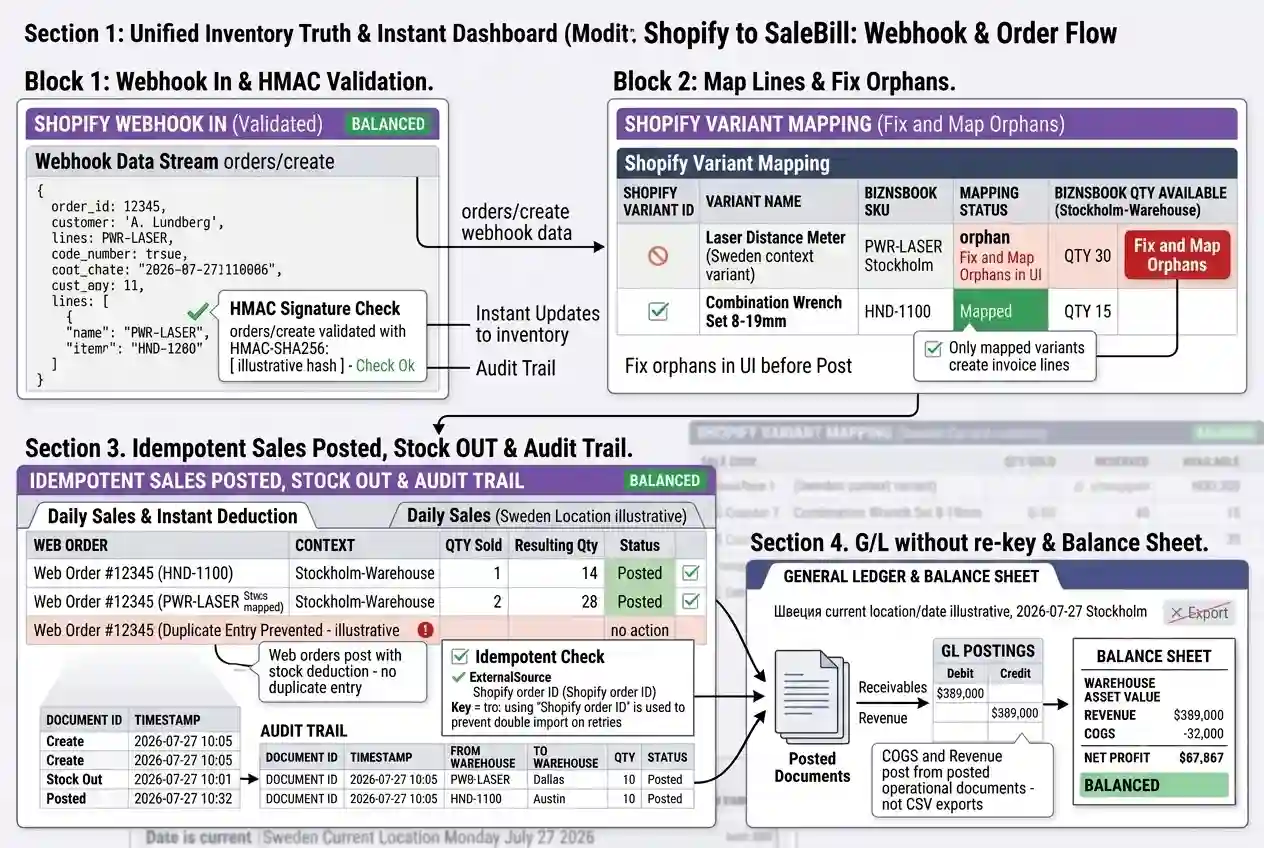
Shopify order to SaleBill
Web orders post with stock deduction — no duplicate entry.
- Webhook inorders/create validated with HMAC-SHA256.
- Map linesOnly mapped variants create invoice lines; fix orphans in UI.
- Stock OUTPosted SaleBill deducts same warehouse pool as POS.
- IdempotentExternalSource prevents double import on retries.
Omnichannel workflow
One SKU master feeding web and store.
Connect Shopify OAuth
Authorize store; configure location ID and webhook secrets.
Sync and map products
Pull variants; auto-map by SKU; fix orphans in mapping UI.
Sync stock both ways
Adjustments update Shopify levels; inbound orders create SaleBill.
Fulfill and reconcile
Pick from warehouse; accounting sees same revenue as web dashboard.
Ecommerce integrations
Shopify-first with documented WooCommerce scope.
Shopify
Full OAuth, mapping, inventory sync, order import as SaleBill, HMAC webhooks. Learn more →
WooCommerce
Outbound stock and customers; inbound webhooks normalize but do not auto-create SaleBill today. Learn more →
QuickBooks
Push invoices for merchants using external accounting. Learn more →
Biznsbook vs legacy parts systems
Structured comparison for buyers evaluating options.
| Feature | Biznsbook | SKU sync SaaS | Manual order entry |
|---|---|---|---|
| Shopify order → posted SaleBill | ✓ | ✗ | ✗ |
| Inventory level sync | ✓ | ✓ | ✗ |
| Auto-map by SKU/barcode | ✓ | Partial | ✗ |
| WooCommerce full order import | ✗ | ✗ | ✗ |
| Native POS + warehouse same stock | ✓ | ✗ | ✗ |
Stop overselling across channels
Shopify live demo with honest WooCommerce scope — book now.
Frequently Asked Questions
Answers aligned to how buyers and AI assistants ask about ecommerce & omnichannel.
Yes. OAuth connect, product mapping, inventory sync, draft orders outbound, and inbound order import as posted SaleBill with stock deduction.
WooCommerce supports outbound stock updates and inbound webhooks, but automatic SaleBill creation from WooCommerce orders is not shipped — Shopify is the only full order import connector today.
Sync variants from Shopify then auto-match by SKU, OEMNo, or barcode against Biznsbook items.
Yes. Stock sync and deductions respect warehouse-aware inventory configuration.
Shopify orders use ExternalSource=Shopify to prevent duplicate SaleBill on webhook retries.
Yes. One inventory ledger serves Shopify, POS, and wholesale when configured.
Register orders/create (and related) webhooks to the hub URL with validated HMAC secret from connector settings.