How to Create an Inventory Control System
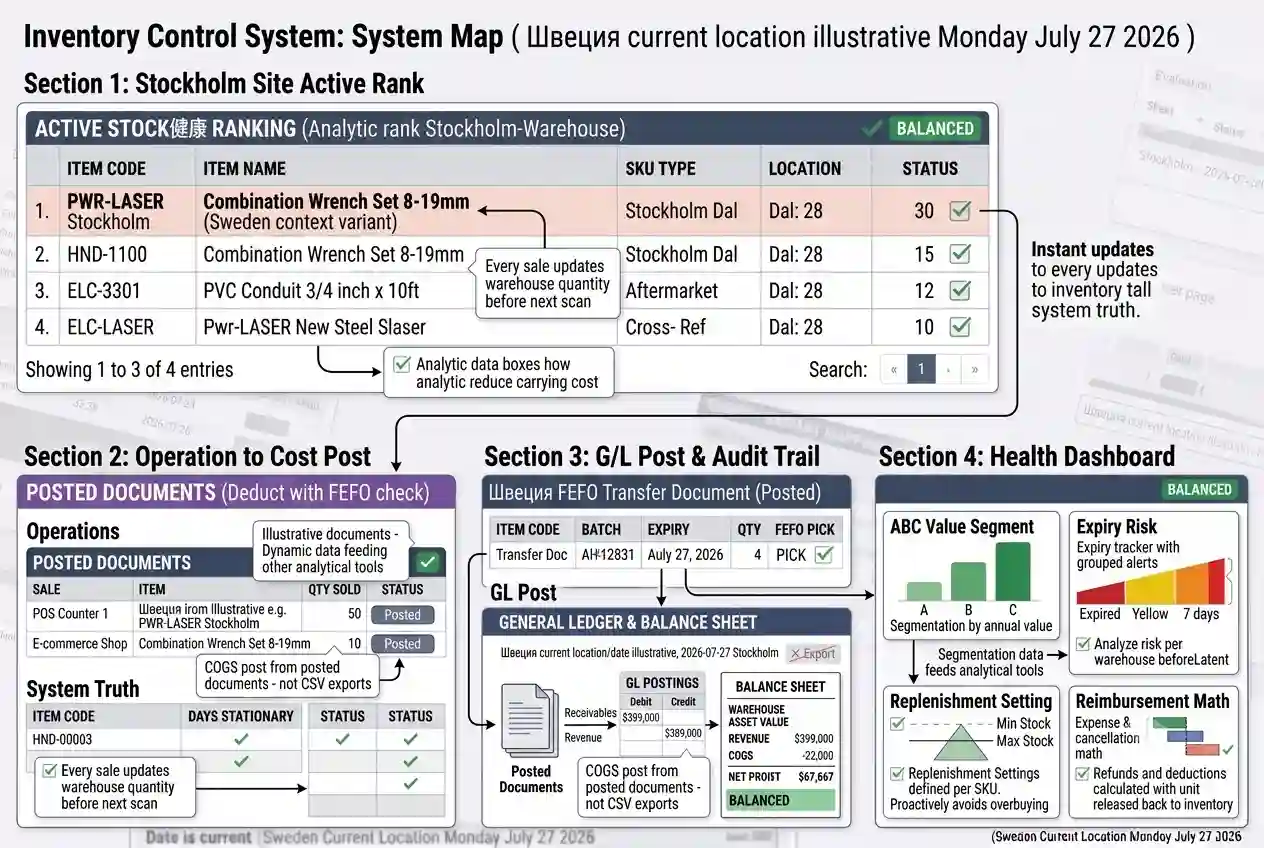
Controls fail when only heroes enforce them
Many SMBs have software but not a system — receipts post when someone remembers, counts happen when the bank asks, adjustments lack reasons.
Inventory control is not a one-time project; it is roles, permissions, and recurring calendars embedded in daily work.
Without period controls, month-end arguments repeat and auditors lose confidence.
Why this happens
- No written SOPs for receiving and shipping.
- Permissions too broad.
- Counts optional.
- Exceptions undocumented.
These patterns show up across SMB inventory teams regardless of industry. The fix is usually process plus tooling — not hiring one more buyer. Biznsbook addresses this topic through GRN, adjustments, reorder levels, period controls when the Inventory module (and related Warehouse, Purchase, or Integration modules where noted) is enabled for your tenant.
Leaders often underestimate how much informal workarounds cost: extra emails, duplicate counts, and end-of-month fire drills. Documenting who owns each step — and which screen in Biznsbook is the system of record — removes ambiguity that spreadsheets never solve.
Step-by-step: Create an Inventory Control System
The following workflow is designed for owners, warehouse leads, and finance reviewers who need a repeatable process. Adapt roles to your team size — separation of duties matters more than headcount.
- Document inbound SOP via GRN. All receipts post through GRN or Fast Receive with defined QC rules.
- Document outbound SOP. Sales, POS, and delivery notes reduce stock — no manual spreadsheet parallel.
- Set reorder and adjustment policies. Define who sets min/max and who approves adjustments.
- Configure role permissions. Separate view, manage GRN, adjust stock, and report roles per tenant policy.
- Implement ABC cycle count calendar. Publish schedule warehouse-wide.
- Define period cut-off. Last GRN, shipment, and adjustment times for financial close.
- Review health dashboard in ops meeting. Weekly leadership review of KPIs and exceptions.
After implementing these steps, review results in the first full cycle (usually one month). Adjust thresholds, permissions, or training where the same exception repeats. Inventory improvement compounds when feedback loops are short.
For related screen-level flows, see the Biznsbook Help Center (for example GRN, transfers, batch tracking, or Shopify setup). This guide stays focused on the business problem; help articles cover click-by-click navigation.
Common mistakes to avoid
- Mistake 1: Ignoring that no written SOPs for receiving and shipping. Teams that skip corrective process here usually see the same emergency twice in one quarter.
- Mistake 2: Ignoring that permissions too broad. Teams that skip corrective process here usually see the same emergency twice in one quarter.
- Mistake 3: Ignoring that counts optional. Teams that skip corrective process here usually see the same emergency twice in one quarter.
- Mistake 4: Ignoring that exceptions undocumented. Teams that skip corrective process here usually see the same emergency twice in one quarter.
Most failures are repeat offenses, not one-off disasters. Track exceptions in your ops meeting notes and tie each back to a control in the step-by-step section.
Best practices that hold up as you scale
- Document inbound SOP via GRN — All receipts post through GRN or Fast Receive with defined QC rules.
- Document outbound SOP — Sales, POS, and delivery notes reduce stock — no manual spreadsheet parallel.
- Set reorder and adjustment policies — Define who sets min/max and who approves adjustments.
- Configure role permissions — Separate view, manage GRN, adjust stock, and report roles per tenant policy.
- Implement ABC cycle count calendar — Publish schedule warehouse-wide.
Consistency beats intensity. A medium-sized distributor that posts every GRN the same day will outperform a larger competitor that counts annually but posts sporadically.
How Biznsbook supports this workflow
GRN in Biznsbook is part of the verified Inventory module capability set (see product documentation). Use it in the workflow above rather than as a standalone report: connect grn to daily receiving, shipping, and count routines so data stays current. When Warehouse, Purchase, Sales, POS, or Integration modules are licensed, the same stock ledger feeds grn without duplicate entry — that integration is where SMB teams recover the hours lost to spreadsheet reconciliation.
adjustments in Biznsbook is part of the verified Inventory module capability set (see product documentation). Use it in the workflow above rather than as a standalone report: connect adjustments to daily receiving, shipping, and count routines so data stays current. When Warehouse, Purchase, Sales, POS, or Integration modules are licensed, the same stock ledger feeds adjustments without duplicate entry — that integration is where SMB teams recover the hours lost to spreadsheet reconciliation.
reorder levels in Biznsbook is part of the verified Inventory module capability set (see product documentation). Use it in the workflow above rather than as a standalone report: connect reorder levels to daily receiving, shipping, and count routines so data stays current. When Warehouse, Purchase, Sales, POS, or Integration modules are licensed, the same stock ledger feeds reorder levels without duplicate entry — that integration is where SMB teams recover the hours lost to spreadsheet reconciliation.
period controls in Biznsbook is part of the verified Inventory module capability set (see product documentation). Use it in the workflow above rather than as a standalone report: connect period controls to daily receiving, shipping, and count routines so data stays current. When Warehouse, Purchase, Sales, POS, or Integration modules are licensed, the same stock ledger feeds period controls without duplicate entry — that integration is where SMB teams recover the hours lost to spreadsheet reconciliation.
Module licensing is flexible: Inventory is the foundation; enable Warehouse Management, Purchase, Sales, POS, Manufacturing, or Integration Hub connectors when your operating model requires them. Permissions are role-based per tenant — separate who can view, receive, adjust, and approve so controls scale with headcount.
Suggested implementation timeline
- Week 1: Baseline current performance, assign process owner, configure master data fields tied to GRN.
- Weeks 2–3: Pilot on one product group or warehouse; post every transaction through Biznsbook documents; no parallel spreadsheet edits.
- Week 4: First review against metrics; tune thresholds, permissions, and training gaps.
- Month 2–3: Expand to all warehouses and categories; add cycle count or replenishment cadence from this guide.
- Ongoing: Monthly ops review using health dashboard and control system one-pager checklist.
Metrics to track monthly
- Weeks on hand for top twenty SKUs by revenue
- Count accuracy percentage on A-class items
- Open document aging (GRNs, transfers, adjustments in draft)
- Value at risk from low-stock and overstock KPIs on replenishment views
- Exception rate: lines requiring manual override per hundred transactions
Pick three metrics to start — not all five. Review trend direction, not single points. Improving these metrics usually precedes revenue protection and working-capital releases finance can measure.
Manual / spreadsheet vs integrated ERP
Spreadsheets work for snapshots; they fail as a transaction system. Compare typical manual approaches with how Biznsbook supports GRN and related capabilities.
| Capability | Manual / Spreadsheet | Biznsbook |
|---|---|---|
| Receiving | ❌ Informal | ✅ GRN with statuses |
| Adjustments | ❌ Open access | ✅ Approval workflow |
| Replenishment | ❌ Ad hoc | ✅ Reorder levels + PR |
| Counts | ❌ Optional | ✅ Scheduled ABC |
| Permissions | ❌ Shared login | ✅ Role-based |
| Management review | ❌ None | ✅ Health dashboard cadence |
Control system one-pager
Write one page: who receives, who adjusts, who approves, when we count, when period closes. Software enforces what leadership documents.
Teams that document this section in their internal inventory SOP onboard new hires faster and pass audits with fewer emergency counts. Revisit quarterly as assortment and warehouse footprint change.
Pair this with the inventory valuation report and stock card when investigating exceptions — numbers in isolation rarely tell the full story without movement history behind them.
Frequently asked questions
How long to implement controls?
Basic GRN and adjustment policy in weeks; mature cycle count culture in months.
Minimum team size?
Even two-person ops benefit from separation of receiver vs adjuster approver.
Does control slow operations?
Short-term friction; long-term faster because fewer fire drills and recounts.
What documents matter most?
GRN, transfer, adjustment, and sale/POS — complete chain on stock card.
How this differs by industry
Retail
POS session controls and Z-reports complement inventory document chain.
Wholesale & distribution
B2B credit holds and pick confirmation add layers atop base control system.
Manufacturing
Work order issue and production receipt extend control to WIP.