How to Handle Slow Movers and Dead Stock
Finding idle stock is not the same as clearing it
Most SMB teams can name a few dusty SKUs. Far fewer have a written path from “this has not moved” to cash recovered, credit booked, or a clean write-off — without buyers quietly reordering the same line next month.
Retailers watch seasonal leftovers become next season’s clutter. Wholesalers tie working capital in slow industrial catalog lines while customers wait on A-movers that share the same aisle. Manufacturers leave obsolete components on the shelf until engineering still issues them into WIP.
Without a disposition strategy, dead stock reviews become meetings that produce opinions, not owners, dates, or blocked replenishment. Finance then absorbs lump write-offs that leadership never saw building.
Why this happens
- Thresholds for “slow” versus “dead” are informal or never configured.
- Reviews stop at identification — no bundle, discount, liquidate, RTV, or write-off decision.
- Decisions live in chat threads, so the next reviewer repeats the same debate.
- Buyers keep auto-replenishing lines that operations already agreed to exit.
These gaps are process failures, not a shortage of reports. Biznsbook addresses them with dead stock and slow-mover analysis, configurable thresholds, action suggestions, Action History, and replenishment dashboard dead-stock KPIs when the Inventory module is enabled.
Naming who owns clearance — merchandising for discounts and bundles, purchasing for RTV and max-stock blocks, finance for write-offs — removes the ambiguity that spreadsheets never resolve.
Strategy framework: classify, decide, execute, lock
Treat slow movers and dead stock as a four-stage loop, not a one-time purge.
- Classify. Use day-without-outbound-movement thresholds so “slow” and “dead” mean the same thing every week.
- Decide. Pick one primary disposition per SKU from the suggestion set: bundle, discount, liquidate, write-off, return, or hold.
- Execute. Carry the decision into kits, promotions/POS, liquidator export, stock adjustment write-off, or supplier returns — then mark the item actioned.
- Lock. Stop auto purchase requisitions and set max stock to zero until on-hand is cleared; re-open only when strategy changes.
Teams that skip the lock step refill the same problem. Teams that skip Action History forget why a hold was chosen and reopen every debate from zero.
Step-by-step: Handle slow movers and dead stock
Designed for owners, merchandisers, warehouse leads, and finance reviewers who need a repeatable clearance process. Adapt roles to your headcount — separation between decide and write-off still matters in small teams.
- Set slow-mover and dead-stock thresholds. In Inventory → Setup, configure days without outbound movement for slow movers and the longer dead-stock threshold, then enable dead stock alerts if you want notifications.
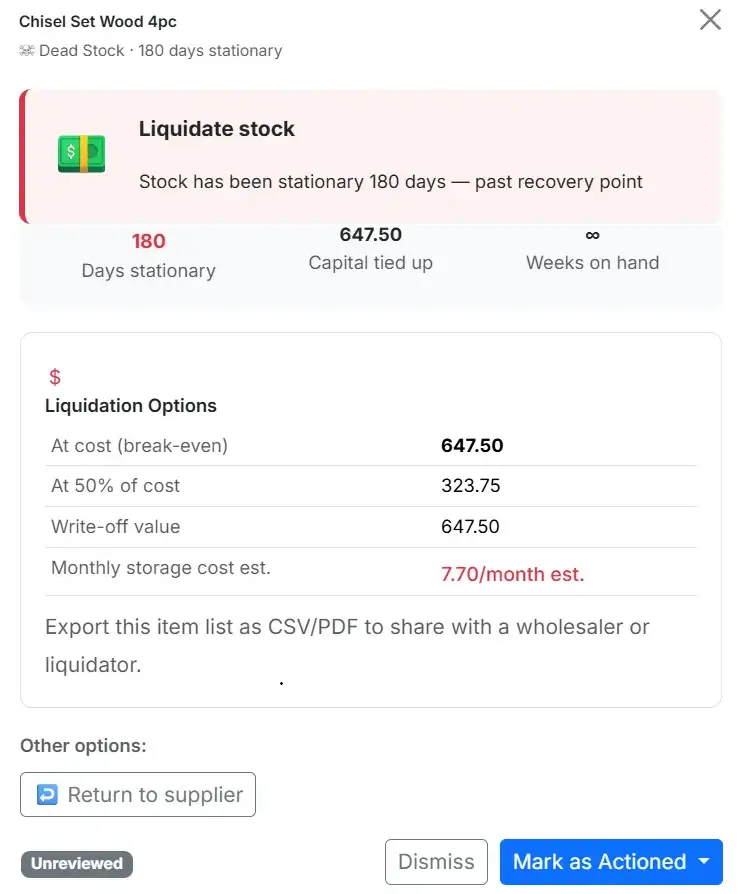
- Open Dead Stock & Slow Movers by value. Open the Dead Stock & Slow Movers page, review capital tied up, SKUs affected, estimated storage cost, and break-even recovery, then filter by Slow Movers or Dead Stock, category, and warehouse.
- Choose a disposition strategy per SKU. Open the strategy suggestion for each line — bundle with a top seller, flash discount, liquidate, write-off, return to vendor, or hold — and pick the path that recovers the most cash with the least brand damage.
- Mark decisions and execute clearance. Mark as Actioned with Will create bundle, Will apply discount, Will liquidate, Will write off, or Custom; then execute in kits, POS/promotions, liquidator export, stock write-off, or supplier return.
- Audit outcomes in Action History. Use Action History to filter decisions by status, confirm owners followed through, and re-open items on the dead stock page when strategy changes.
- Block replenishment on cleared lines. Remove dead and slow SKUs from auto purchase requisitions, lower max stock to zero until cleared, and watch dead stock KPIs on the replenishment dashboard.
- Measure recovery each month. Compare credit recovered via RTV, cash from liquidation or discount, and remaining write-off dollars against capital tied up on the dead stock summary.
After the first full monthly cycle, tighten thresholds where the same category reappears, and loosen them where seasonal catalogs need a longer runway. Inventory improvement compounds when the feedback loop is short.
For related screen-level flows, see the Biznsbook Help Center. Pair this strategy guide with finding slow-moving inventory and monitoring dead stock when training new staff.
Disposition playbook (when to use each action)
Biznsbook surfaces suggested actions from dead stock and slow-mover analysis. Use the suggestion as a starting point, then apply commercial judgment:
- Bundle. High-margin slow movers pair with a top seller so you clear stock without a store-wide sale. Useful when the item still has retail appeal as an add-on.
- Discount. Flash or checkout add-on discounts protect margin on healthy SKUs while moving stationary quantity. Prefer targeted offers over permanent list-price cuts.
- Liquidate. When velocity will never recover, export the liquidator CSV / print write-off list and sell at break-even or below before storage cost exceeds residual value.
- Write-off. Use when there is no buyer path and books must reflect reality. Involve finance — tax and margin treatment differ from selling at a loss.
- Return. Prefer return to vendor when contracts allow; track credit recovery on the supplier returns dashboard instead of absorbing full cost.
- Hold. Park only when a known demand event (season, project, contract) is within the hold window — and calendar a re-open date in Action History follow-up.
For serial-tracked items, aged InStock serials can appear individually in analysis so you clear units, not only aggregate quantity.
Common mistakes to avoid
- Mistake 1: Running a dead stock report once a year and calling it a strategy. Idle capital grows between annual meetings.
- Mistake 2: Choosing “hold” for everything to avoid hard conversations. Holds without re-open dates become permanent dead stock.
- Mistake 3: Clearing quantity in POS or RTV but never marking Actioned — the next review treats the SKU as unreviewed again.
- Mistake 4: Writing off stock while auto-PR and max stock still allow replenishment of the same item.
Most failures are repeat offenses. Tie each exception in your ops notes back to classify, decide, execute, or lock.
Best practices that hold up as you scale
- Review weekly for retail assortments; monthly for slow industrial catalogs — sorted by capital tied up, not by SKU count.
- Assign one owner per category so disposition decisions do not stall in group chat.
- Prefer RTV and liquidation before write-off when cash or credit can still be recovered.
- Connect Health Dashboard slow-mover and dead-stock metrics to the same meeting agenda so leadership sees trend, not anecdotes.
- Keep Action History as the minutes of the clearance meeting — no separate slide deck required.
Consistency beats intensity. A distributor that clears the top ten value lines every week will outperform a larger competitor that runs one dramatic clearance sale per year.
How Biznsbook supports this workflow
Dead stock & slow-mover analysis lists items without outbound movement past configurable thresholds, with Slow Movers and Dead Stock tabs, category and warehouse filters, weeks on hand, liquidation value, and summary KPIs for capital tied up, SKUs affected, estimated storage cost, and break-even recovery.
Action suggestions guide disposition toward bundle, discount, liquidate, write-off, return, or hold, including bundle pairing with a top seller, suggested discount percent, and liquidation value scenarios. Mark decisions as actioned for follow-through.
Action History is the read-only audit trail of dead-stock decisions. Filter by status, and re-open items on the dead stock page when strategy changes.
Replenishment and health views surface dead stock KPIs alongside at-risk and overstock signals, with Health Dashboard links into Slow Movers and Dead Stock reviews. Inventory Setup controls slow and dead day thresholds and optional dead stock alerts.
Module licensing is flexible: Inventory is the foundation. Enable Warehouse, Purchase, Sales, POS, or Integration connectors when your clearance path needs transfers, RTV, promotions, or channel sales. Permissions stay role-based per tenant.
Suggested implementation timeline
- Week 1: Agree slow and dead day thresholds with finance; configure Inventory Setup; assign category owners.
- Weeks 2–3: Pilot on one product group or warehouse; action every top-value line through Biznsbook suggestions and Action History — no parallel spreadsheet tracker.
- Week 4: First recovery review: RTV credit, discount/liquidation cash, write-offs, and remaining capital tied up.
- Month 2–3: Expand to all warehouses; enforce max-zero and auto-PR removal as standard lock steps.
- Ongoing: Weekly or monthly clearance agenda using Dead Stock & Slow Movers plus Action History filters.
Metrics to track monthly
- Capital tied up on the dead stock summary (and trend vs prior month)
- SKUs actioned vs still Unreviewed
- Recovery mix: RTV credit vs liquidation/discount cash vs write-off dollars
- Estimated storage cost still accruing on uncleared lines
- Replenishment exceptions: dead or slow SKUs that still appear on auto-PR
Pick three metrics to start. Improving recovery mix and unreviewed backlog usually precedes working-capital releases finance can measure on the valuation report.
Manual / spreadsheet vs integrated ERP
Spreadsheets can list idle SKUs; they fail as a disposition and audit system. Compare typical manual approaches with how Biznsbook supports a full clearance strategy.
| Capability | Manual / Spreadsheet | Biznsbook |
|---|---|---|
| Slow vs dead classification | ❌ Ad hoc day counts | ✅ Configurable thresholds |
| Disposition guidance | ❌ Tribal knowledge | ✅ Suggested actions (bundle → hold) |
| Decision audit trail | ❌ Chat / email | ✅ Action History |
| Value-at-risk summary | ⚠️ Manual pivot | ✅ Capital, storage, break-even KPIs |
| Liquidator handoff | ⚠️ Copy-paste lists | ✅ Export / print write-off list |
| Stop reordering | ❌ Honor system | ✅ Max zero + auto-PR removal |
Meeting agenda (30 minutes)
Open Dead Stock & Slow Movers sorted by capital tied up. For each of the top ten: confirm disposition, owner, and target date; mark Actioned; confirm max stock and auto-PR are blocked. Close by filtering Action History for overdue statuses.
Document this agenda in your inventory SOP so new buyers and category managers inherit the same loop. Revisit thresholds quarterly as assortment and seasonality change.
Pair exceptions with inventory valuation and stock card history — days since movement alone rarely explain whether a hold or write-off is correct.
Frequently asked questions
What is the difference between a slow mover and dead stock?
In Biznsbook, both are items with no outbound movement past configurable day thresholds. Slow movers sit past the slow-days setting; dead stock sits past the longer dead-days setting. Dead stock is usually zero or negligible movement; slow movers still sell occasionally but uneconomically.
Which disposition actions does Biznsbook suggest?
Dead stock and slow-mover analysis suggests bundle, discount, liquidate, write-off, return, or hold. Teams mark decisions such as will create bundle, will apply discount, will liquidate, will write off, or a custom decision, then follow through in sales, POS, RTV, or stock adjustment.
Where are dead-stock decisions audited?
Action History is the read-only audit trail of dead-stock decisions. Filter by status for follow-up, and re-open items on the dead stock page when market conditions or strategy change.
How do I stop buyers from reordering cleared SKUs?
After you choose a clearance path, remove the SKU from auto purchase requisitions and lower max stock to zero until quantity is cleared. Pair that with replenishment dashboard dead-stock KPIs so the same lines do not refill.
How this differs by industry
Retail
Run clearance before the next season’s inbound buys. Prefer bundle and flash discount for brand-sensitive lines; liquidate or write off fashion leftovers that will not survive markdown calendars.
Wholesale & distribution
Negotiate return windows at purchase for high-obsolescence categories, then use RTV as the first disposition. Export liquidator lists for industrial slow movers that customers will never reorder.
Manufacturing
Include engineering in dead reviews so obsolete raw materials are not issued into WIP. Hold only when a firm work order or spare-parts contract is dated; otherwise liquidate or write off and block replenishment.