How to Manage Business Budgets
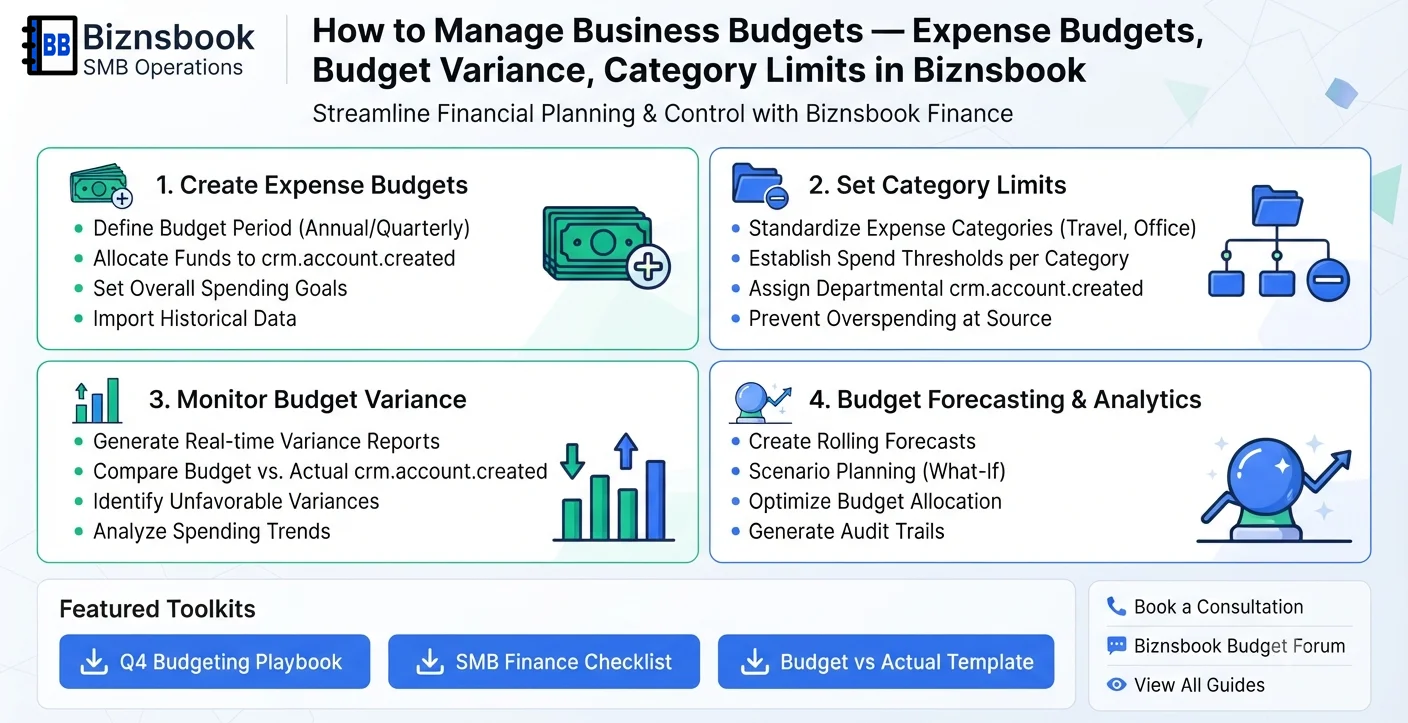
Budgets fail when they are set once and ignored
Annual budgets often become static documents that teams do not revisit until large overruns already exist.
Without category-level limits, discretionary spending can crowd out strategic investments.
If variance analysis is delayed, managers lose the chance to correct course within the same period.
Why this happens
- No category-level limits.
- Variance checks are infrequent.
- Budget ownership is unclear.
- Department spend is not compared on time.
Biznsbook addresses this through expense budgets, budget variance, category limits when Accounting is enabled; add Finance Management, Taxation, Expense, Sales, or Purchase modules as your operating model requires.
Finance teams lose days each month reconciling versions that should never have diverged. Naming Biznsbook screens as the system of record — and closing periods when agreed — prevents silent edits that auditors flag immediately.
Step-by-step: Manage Business Budgets
Designed for owners, bookkeepers, and controllers who need repeatable month-end discipline. Adapt roles to team size — separation of duties matters more than headcount.
- Define budget categories. Create clear expense buckets aligned with your chart of accounts and planning model.
- Set category limits. Apply limits for each category based on business priorities and expected demand.
- Record approved budget baseline. Lock baseline values to preserve a clean variance reference point.
- Track actual spend regularly. Review spend cadence weekly or biweekly instead of waiting for month-end.
- Analyze budget variance. Investigate overages and underspend by department and category owner.
- Adjust plans when needed. Reforecast categories where market conditions changed materially.
- Review with leadership. Use a recurring budget meeting to assign corrective actions and accountability.
Review results after the first full monthly cycle. Adjust roles, mappings, or approvals where the same exception repeats.
Screen-level flows live in the Help Center. This guide focuses on the business process; help articles cover click-by-click navigation.
Common mistakes to avoid
- Mistake 1: No category-level limits. Repeating this each month usually shows up first in trial balance or AR/AP aging.
- Mistake 2: Variance checks are infrequent. Repeating this each month usually shows up first in trial balance or AR/AP aging.
- Mistake 3: Budget ownership is unclear. Repeating this each month usually shows up first in trial balance or AR/AP aging.
- Mistake 4: Department spend is not compared on time. Repeating this each month usually shows up first in trial balance or AR/AP aging.
Track recurring exceptions in month-end notes; each should map to a control above.
Best practices that hold up as you scale
- Define budget categories — Create clear expense buckets aligned with your chart of accounts and planning model.
- Set category limits — Apply limits for each category based on business priorities and expected demand.
- Record approved budget baseline — Lock baseline values to preserve a clean variance reference point.
- Track actual spend regularly — Review spend cadence weekly or biweekly instead of waiting for month-end.
- Analyze budget variance — Investigate overages and underspend by department and category owner.
Consistency beats heroics at month-end. A smaller team that closes the same calendar every month outperforms a larger team that posts sporadically.
How Biznsbook supports this workflow
expense budgets is documented in Biznsbook Accounting / Finance capabilities. Use it as part of a controlled finance process — posting, review, and period close — not as an isolated export. When Sales, Purchase, Inventory, Taxation, Expense, or Finance Management modules are enabled, related documents can post through the central accounting posting service with double-entry validation.
budget variance is documented in Biznsbook Accounting / Finance capabilities. Use it as part of a controlled finance process — posting, review, and period close — not as an isolated export. When Sales, Purchase, Inventory, Taxation, Expense, or Finance Management modules are enabled, related documents can post through the central accounting posting service with double-entry validation.
category limits is documented in Biznsbook Accounting / Finance capabilities. Use it as part of a controlled finance process — posting, review, and period close — not as an isolated export. When Sales, Purchase, Inventory, Taxation, Expense, or Finance Management modules are enabled, related documents can post through the central accounting posting service with double-entry validation.
Permissions are role-based: separate chart maintenance, journal creation, report viewing, period close, and bank reconciliation per tenant policy.
Suggested implementation timeline
- Week 1: Document current process gaps and configure expense budgets with finance owner sign-off.
- Weeks 2–3: Pilot on one month or one entity; post all test transactions through Biznsbook; freeze parallel spreadsheet journals.
- Week 4: Run first trial balance or report tie-out; fix mapping and permission issues.
- Month 2–3: Roll out to full team; add approvals and period close cadence from this guide.
- Ongoing: Monthly review using budget operating rhythm and leadership dashboard.
Budget versus actual review rhythm
Weekly operational reviews use department or category variance; monthly leadership reviews focus on forecast revision triggers. Budgets fail when nobody owns variance explanation — assign category owners even in small companies.
Link expense budgets to approval rules where possible so overspend requires explicit override before posting.
Rolling forecasts alongside annual budget
Annual budgets go stale by Q2 for growing SMBs. Maintain a rolling three-month forecast updated from actuals in Biznsbook rather than forcing year-old assumptions through peak season.
When inventory purchases drive COGS swings, include purchasing lead time in budget conversations — not only GL history.
Capital versus operating budget split
Capital purchases should not consume operating budget lines without board approval — tag capex requests separately even when both post through AP.
When revenue beats budget, resist automatic spending increases; update forecast and release contingency deliberately.
Metrics to track monthly
- Days to complete month-end close
- Unreconciled bank lines outstanding
- AR and AP aging buckets over 30/60/90 days
- Trial balance out-of-balance exceptions
- Manual journal count vs automated postings ratio
Start with three metrics; trend direction matters more than a single point-in-time snapshot.
Spreadsheet / manual books vs integrated ERP
Compare typical manual finance work with Biznsbook expense budgets and related capabilities.
| Capability | Manual / Spreadsheet | Biznsbook |
|---|---|---|
| Spend control | ❌ Broad estimates | ✅ Category limits |
| Variance visibility | ❌ After close | ✅ Ongoing budget variance |
| Ownership | ❌ Unclear | ✅ Assigned category owners |
| Plan updates | ❌ Static annual file | ✅ Periodic reforecast |
| Reporting | ❌ Manual sheets | ✅ System-based tracking |
| Decision quality | ❌ Reactive | ✅ Early intervention |
Budget operating rhythm
A short weekly variance review prevents the long and painful monthly overrun escalation meeting. Archive approved budget versions with effective dates — comparing actuals to the wrong budget version is a common board-reporting mistake.
Document this in your finance SOP and revisit each quarter as transaction volume or entity structure changes.
Frequently asked questions
What is budget variance?
It is the difference between planned budget and actual spending for a period or category.
How often should variance be reviewed?
At least monthly, and weekly for high-spend or rapidly changing categories.
Should budgets be adjusted mid-year?
Yes, when assumptions materially change and leadership approves revised plans.
Who owns budget categories?
Each category should have a business owner accountable for performance and action.
Can budgets include revenue targets?
Expense budgets are the primary control in most setups. Pair with sales forecasts and cash flow guides for full planning; revenue recognition still follows accounting rules on posted invoices.
How this differs by industry
Retail
Retail businesses should set tighter limits on promotional and staffing categories during low-demand periods.
Wholesale & distribution
Wholesale companies should monitor logistics and freight budget variance due to volatile transport costs.
Manufacturing
Manufacturers should review utilities and maintenance budgets closely because variance can affect unit economics.