How to Manage Property Handover Processes
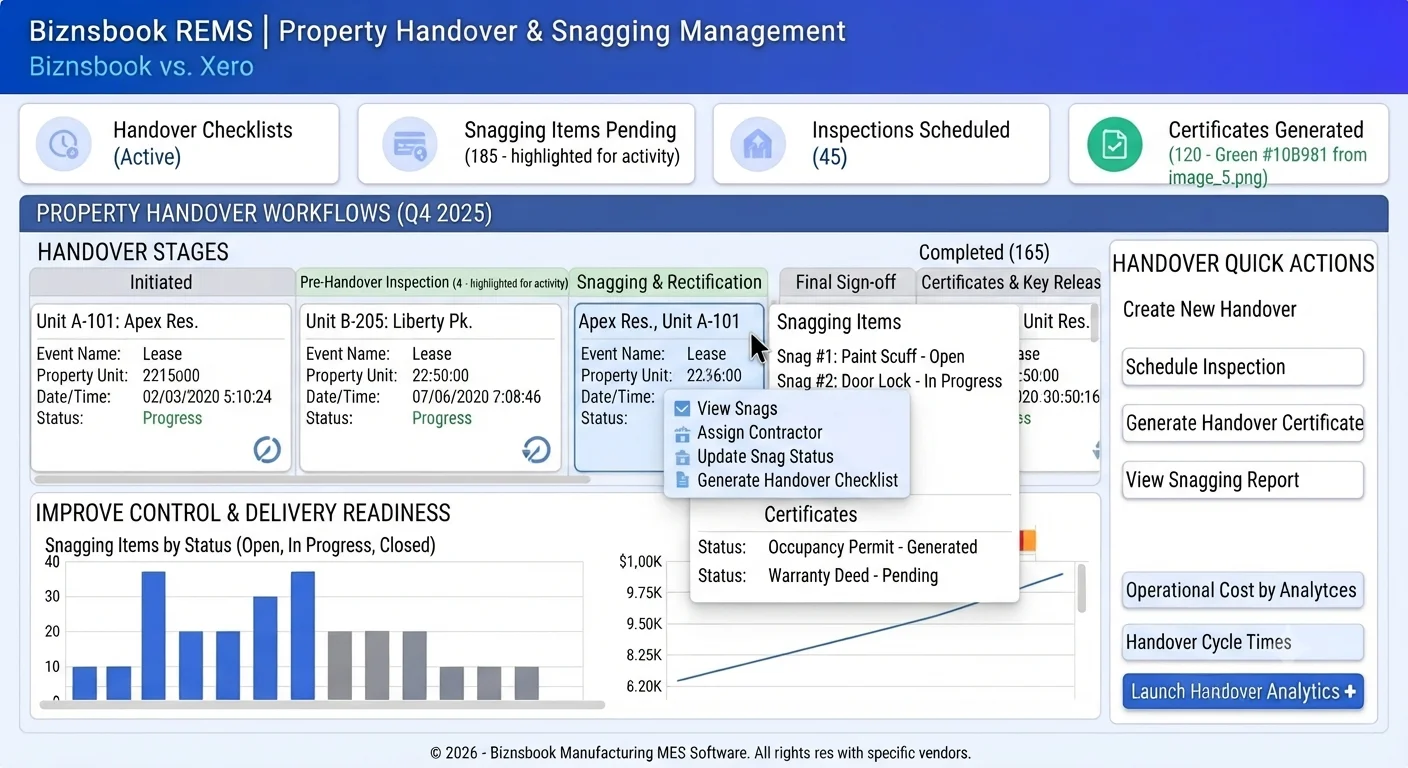
Handover quality failures are expensive to fix later
Handover is often treated as a final administrative step, but it is a critical quality transition. If inspection records are weak or snagging is unmanaged, unresolved issues surface after possession and strain customer trust.
Teams also struggle when ownership of pre-handover tasks is unclear. Construction, QA, and customer service may each assume another team is tracking completion, leading to avoidable delays and escalations.
A checklist-led handover model with clear sign-off stages improves readiness confidence and reduces rework after occupancy.
Why this happens
- Handover readiness criteria are not standardized across projects.
- Inspection findings are not captured in structured templates.
- Snag items are tracked informally without closure workflow.
- Certificates are issued before all dependencies are verified.
Biznsbook addresses this through Handover workflow, Inspections and snagging, Completion certificate when the Real Estate (REMS) module is enabled, with optional Accounting, Communication Center, and Business Automation for collections and workflows.
Finance teams lose days each month reconciling versions that should never have diverged. Naming Biznsbook screens as the system of record — and closing periods when agreed — prevents silent edits that auditors flag immediately.
Step-by-step: Manage Property Handover Processes
Built for developers, sales coordinators, and property ops teams managing units from booking through possession and leasing.
- Define handover criteria. Set mandatory readiness conditions covering civil completion, utilities, compliance, and customer documentation.
- Run checklist inspections. Use inspection templates to record findings consistently across units and project phases.
- Create snag lists immediately. Convert inspection issues into snag items with owner, priority, and due date assignments.
- Track snag resolution flow. Monitor resolve and reject states to ensure only verified fixes are marked complete.
- Validate final readiness. Perform final review after snag closure to confirm possession readiness and policy compliance.
- Issue completion certificate. Generate and archive completion certificates only after all required checks pass.
- Review post-handover feedback. Capture recurring quality issues to improve future inspection templates and execution standards.
Review results after the first full weekly cycle. Adjust roles, mappings, or approvals where the same exception repeats.
Screen-level flows live in the Help Center (tax setup, expense claims, sale invoices). This guide focuses on finance process; help articles cover navigation.
Common mistakes to avoid
- Mistake 1: Handover readiness criteria are not standardized across projects. Repeating this each month usually shows up first in aged receivables or installment status reports.
- Mistake 2: Inspection findings are not captured in structured templates. Repeating this each month usually shows up first in aged receivables or installment status reports.
- Mistake 3: Snag items are tracked informally without closure workflow. Repeating this each month usually shows up first in aged receivables or installment status reports.
- Mistake 4: Certificates are issued before all dependencies are verified. Repeating this each month usually shows up first in aged receivables or installment status reports.
Track recurring exceptions in month-end notes; each should map to a control above.
Best practices that hold up as you scale
- Define handover criteria — Set mandatory readiness conditions covering civil completion, utilities, compliance, and customer documentation.
- Run checklist inspections — Use inspection templates to record findings consistently across units and project phases.
- Create snag lists immediately — Convert inspection issues into snag items with owner, priority, and due date assignments.
- Track snag resolution flow — Monitor resolve and reject states to ensure only verified fixes are marked complete.
- Validate final readiness — Perform final review after snag closure to confirm possession readiness and policy compliance.
Teams that reconcile unit status and schedules weekly avoid the month-end scramble that delays disbursements and handovers.
How Biznsbook supports this workflow
Handover workflow is documented in Biznsbook Real Estate (REMS) capabilities. Use it as part of a controlled finance process — posting, review, and period close — not as an isolated export. When Sales, Purchase, Inventory, Taxation, Expense, or Finance Management modules are enabled, related documents can post through the central accounting posting service with double-entry validation.
Inspections and snagging is documented in Biznsbook Real Estate (REMS) capabilities. Use it as part of a controlled finance process — posting, review, and period close — not as an isolated export. When Sales, Purchase, Inventory, Taxation, Expense, or Finance Management modules are enabled, related documents can post through the central accounting posting service with double-entry validation.
Completion certificate is documented in Biznsbook Real Estate (REMS) capabilities. Use it as part of a controlled finance process — posting, review, and period close — not as an isolated export. When Sales, Purchase, Inventory, Taxation, Expense, or Finance Management modules are enabled, related documents can post through the central accounting posting service with double-entry validation.
REMS permissions govern view, create, edit, and payment link actions. Guest collection pages work without buyer or tenant login.
Suggested implementation timeline
- Week 1: Document current process gaps and configure Handover workflow with finance owner sign-off.
- Weeks 2–3: Pilot on one month or one entity; post all test transactions through Biznsbook; freeze parallel spreadsheet journals.
- Week 4: Run first trial balance or report tie-out; fix mapping and permission issues.
- Month 2–3: Roll out to full team; add approvals and period close cadence from this guide.
- Ongoing: Monthly review using handover readiness score and leadership dashboard.
Metrics to track monthly
- Available vs booked vs sold unit counts by project
- Installment schedule overdue value and count
- Collection rate on due installments and rent
- Days from booking to possession/handover
- Aged receivables buckets (30/60/90+ days)
Start with three metrics; trend direction matters more than a single point-in-time snapshot.
Spreadsheet / manual books vs integrated ERP
Compare typical manual finance work with Biznsbook Handover workflow and related capabilities.
| Capability | Manual / Spreadsheet | Biznsbook |
|---|---|---|
| Readiness control | ❌ Informal approvals | ✅ Defined handover criteria |
| Inspection quality | ❌ Free-form notes | ✅ Template-based inspections |
| Snag tracking | ❌ Spreadsheet punch list | ✅ Workflow-driven snagging |
| Closure validation | ❌ Assumed completion | ✅ Verified resolve/reject states |
| Certificate issuance | ❌ Early release risk | ✅ Dependency-based issuance |
| Continuous improvement | ❌ Issue repetition | ✅ Feedback-linked updates |
Handover readiness score
Track a readiness score combining inspection pass rate, open snag count, and closure lead time. A simple score helps teams forecast handover quality and timing confidence.
Document this in your finance SOP and revisit each quarter as transaction volume or entity structure changes.
Frequently asked questions
When should snagging start in the handover cycle?
Start snagging immediately after initial inspection so issues are prioritized early and closure can be verified before possession dates are committed.
Why use inspection templates?
Templates improve consistency across teams and projects, making quality comparisons and readiness decisions more reliable.
Should certificates be generated before all snags close?
No. Completion certificates should follow verified closure of mandatory snag and compliance dependencies to avoid post-handover disputes.
How can teams reduce repeat quality issues?
Use post-handover issue trends to update checklist criteria, assign accountability, and improve construction-to-handover coordination.
How this differs by industry
Retail
Residential developers can improve buyer satisfaction by enforcing inspection and snag closure discipline before possession appointments are confirmed.
Wholesale & distribution
Commercial and mixed-use delivery teams can reduce tenant fit-out delays by aligning handover checklists with occupancy and compliance readiness standards.
Manufacturing
Property management firms can use structured handover records to improve transition quality from development teams into long-term operations and maintenance.