How to Monitor Workforce Productivity
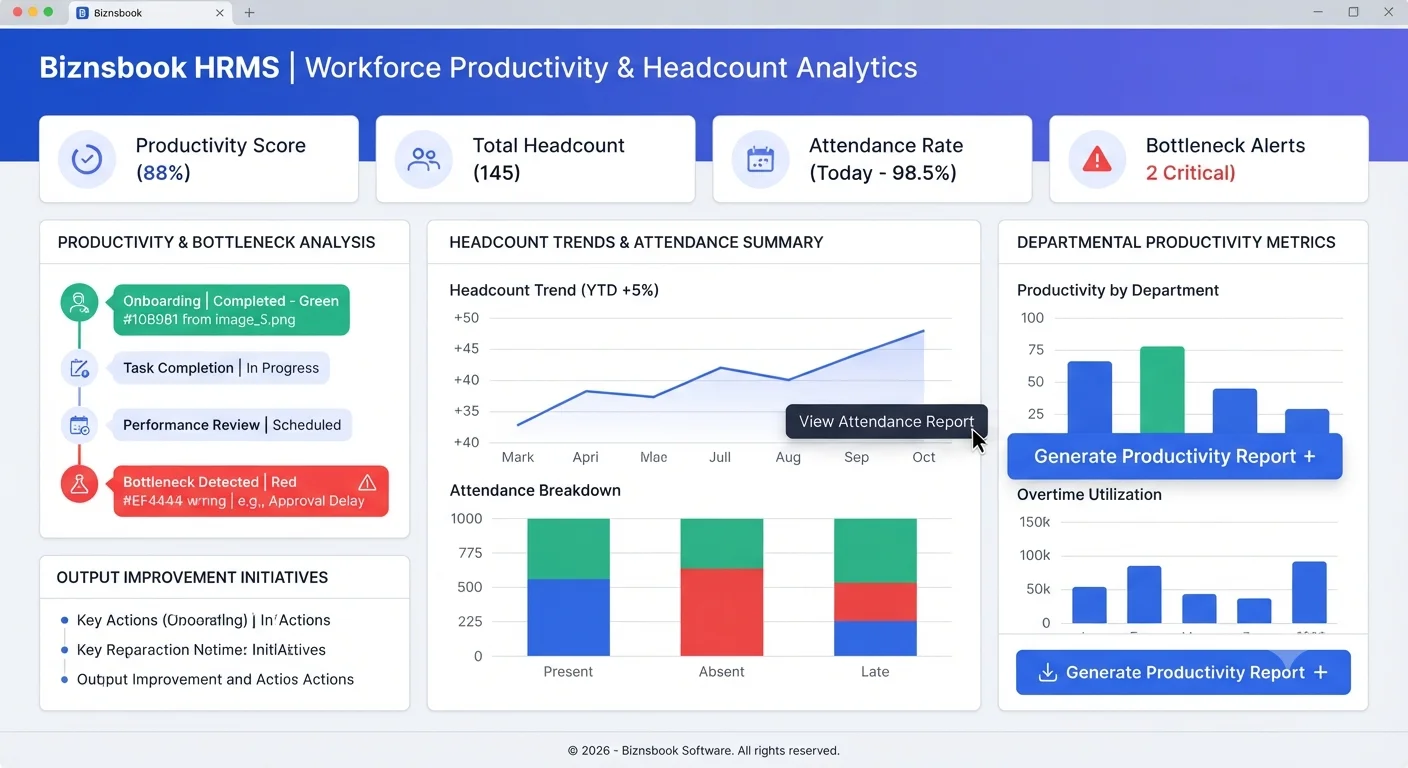
Productivity drops when teams monitor output in isolation
Many organizations judge productivity only by final output numbers. They miss early warning signs such as attendance inconsistency or sudden team size changes.
Without integrated dashboard views, leaders make staffing decisions using outdated reports. Operational bottlenecks then appear after deadlines are already missed.
A workforce productivity routine should combine people capacity and attendance discipline with delivery outcomes for clearer decision making.
Why this happens
- Headcount trend and attendance summary are reviewed separately.
- Dashboard checks happen only during monthly reporting cycles.
- Managers lack threshold alerts for productivity risk signals.
- Corrective actions are not tracked after trend anomalies appear.
Biznsbook addresses this through HR dashboard, headcount trend, attendance summary when HR Management is enabled; add the Payroll module for salary structures, pay runs, and payslips, and Accounting for GL posting when configured.
Finance teams lose days each month reconciling versions that should never have diverged. Naming Biznsbook screens as the system of record — and closing periods when agreed — prevents silent edits that auditors flag immediately.
Step-by-step: Monitor Workforce Productivity
Built for HR generalists, payroll administrators, and owners who need hire-to-pay discipline without spreadsheet chaos.
- Define productivity signals. Select indicators that combine team output, attendance reliability, and capacity changes.
- Use HR dashboard weekly. Review workforce dashboard trends on a fixed weekly management cadence.
- Track headcount movement. Monitor hiring, transfers, and exits that affect team productivity potential.
- Review attendance summary. Identify absenteeism or lateness trends that correlate with delivery delays.
- Set risk thresholds. Create thresholds for sudden declines in attendance or output consistency.
- Assign corrective actions. Link each risk signal to owner, action plan, and due date.
- Evaluate trend recovery. Measure whether interventions improved productivity in the following cycle.
Review results after the first full monthly cycle. Adjust roles, mappings, or approvals where the same exception repeats.
Screen-level flows live in the Help Center (tax setup, expense claims, sale invoices). This guide focuses on finance process; help articles cover navigation.
Common mistakes to avoid
- Mistake 1: Headcount trend and attendance summary are reviewed separately. Repeating this each month usually shows up first in payroll runs or attendance summary reports.
- Mistake 2: Dashboard checks happen only during monthly reporting cycles. Repeating this each month usually shows up first in payroll runs or attendance summary reports.
- Mistake 3: Managers lack threshold alerts for productivity risk signals. Repeating this each month usually shows up first in payroll runs or attendance summary reports.
- Mistake 4: Corrective actions are not tracked after trend anomalies appear. Repeating this each month usually shows up first in payroll runs or attendance summary reports.
Track recurring exceptions in month-end notes; each should map to a control above.
Best practices that hold up as you scale
- Define productivity signals — Select indicators that combine team output, attendance reliability, and capacity changes.
- Use HR dashboard weekly — Review workforce dashboard trends on a fixed weekly management cadence.
- Track headcount movement — Monitor hiring, transfers, and exits that affect team productivity potential.
- Review attendance summary — Identify absenteeism or lateness trends that correlate with delivery delays.
- Set risk thresholds — Create thresholds for sudden declines in attendance or output consistency.
Teams that close attendance and leave before payroll cut-off day avoid the rework cycle that erodes trust in payslips.
How Biznsbook supports this workflow
HR dashboard is documented in Biznsbook HRMS / Payroll capabilities. Use it as part of a controlled finance process — posting, review, and period close — not as an isolated export. When Sales, Purchase, Inventory, Taxation, Expense, or Finance Management modules are enabled, related documents can post through the central accounting posting service with double-entry validation.
headcount trend is documented in Biznsbook HRMS / Payroll capabilities. Use it as part of a controlled finance process — posting, review, and period close — not as an isolated export. When Sales, Purchase, Inventory, Taxation, Expense, or Finance Management modules are enabled, related documents can post through the central accounting posting service with double-entry validation.
attendance summary is documented in Biznsbook HRMS / Payroll capabilities. Use it as part of a controlled finance process — posting, review, and period close — not as an isolated export. When Sales, Purchase, Inventory, Taxation, Expense, or Finance Management modules are enabled, related documents can post through the central accounting posting service with double-entry validation.
HRMS and Payroll permissions separate employee edits, attendance, leave approval, and payroll approval. Payroll requires HRMS as the employee system of record.
Suggested implementation timeline
- Week 1: Document current process gaps and configure HR dashboard with finance owner sign-off.
- Weeks 2–3: Pilot on one month or one entity; post all test transactions through Biznsbook; freeze parallel spreadsheet journals.
- Week 4: Run first trial balance or report tie-out; fix mapping and permission issues.
- Month 2–3: Roll out to full team; add approvals and period close cadence from this guide.
- Ongoing: Monthly review using productivity action board and leadership dashboard.
Metrics to track monthly
- Attendance correction backlog and approval time
- Leave requests pending approval count
- Payroll run cycle time (draft to paid)
- Headcount and joiner/leaver trend monthly
- Payslip exceptions or manual adjustments per run
Start with three metrics; trend direction matters more than a single point-in-time snapshot.
Spreadsheet / manual books vs integrated ERP
Compare typical manual finance work with Biznsbook HR dashboard and related capabilities.
| Capability | Manual / Spreadsheet | Biznsbook |
|---|---|---|
| Monitoring scope | ❌ Output only | ✅ Output plus workforce signals |
| Review cadence | ❌ Monthly snapshots | ✅ Weekly dashboard rhythm |
| Capacity awareness | ❌ Assumed staffing | ✅ Headcount trend tracking |
| Attendance linkage | ❌ No context | ✅ Attendance-summary correlation |
| Risk response | ❌ Delayed reaction | ✅ Threshold-driven action plans |
| Improvement follow-up | ❌ One-off fixes | ✅ Measured recovery checks |
Productivity action board
Keep a visible board of flagged trends, assigned actions, and recovery status. Action tracking is essential to convert dashboards into measurable improvement.
Document this in your finance SOP and revisit each quarter as transaction volume or entity structure changes.
Frequently asked questions
What is the first productivity metric to watch?
Start with attendance consistency and workload completion trend, then add headcount movement for deeper capacity context.
How often should HR dashboards be reviewed?
Weekly review is ideal for active teams because it allows early correction before performance degrades.
Why include headcount trend in productivity monitoring?
Headcount changes affect team capacity directly, so they explain shifts in output quality and delivery speed.
How can managers make monitoring actionable?
Set thresholds and assign owners for every risk signal so data leads to timely interventions.
How this differs by industry
Retail
Retail workforce productivity monitoring should combine store attendance trends with staffing movement to protect service speed during peak hours.
Wholesale & distribution
Office and services organizations can improve outcomes by using weekly dashboard checks that connect attendance reliability with delivery commitments.
Manufacturing
Factory managers should monitor productivity with attendance trends and headcount shifts to avoid output dips and overtime spikes.