How to Track Employee Performance
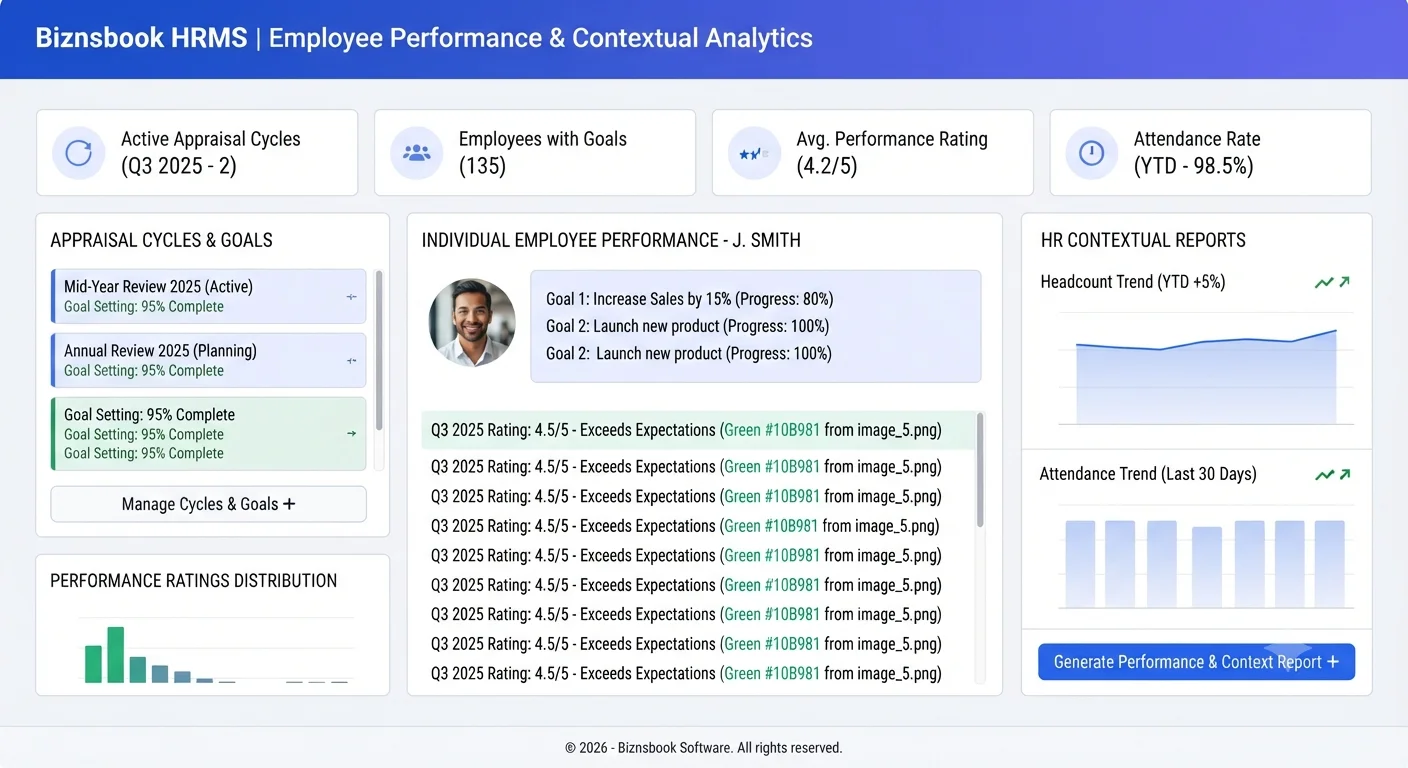
Teams confuse reporting with real performance reviews
Managers export attendance summaries and call that a performance process.
Headcount charts explain staffing pressure but not individual goal delivery.
Without appraisal cycles, ratings cannot be compared across the company.
Why this happens
- Using only dashboard KPIs without goal records.
- Skipping employee acknowledgement on final ratings.
- No link between probation ratings and later annual cycles.
- Review meetings without attendance or leave context.
Biznsbook addresses this through performance appraisal cycles, goals and ratings, HR reports, headcount, attendance summary when HR Management is enabled; license Employee Self Service for My Profile / My Leave / My Attendance, and Payroll when you need pay runs.
Finance teams lose days each month reconciling versions that should never have diverged. Naming Biznsbook screens as the system of record — and closing periods when agreed — prevents silent edits that auditors flag immediately.
Step-by-step: Track Employee Performance
Built for HR generalists and managers using Biznsbook HR Management — directory, org chart, leave policy engine, performance cycles, employee assets, and optional Employee Self Service.
- Open Performance. Use HRMS → Performance to create or open an appraisal cycle for the review period.
- Generate appraisals. Create per-employee appraisals and capture weighted goals with targets.
- Rate and comment. Managers enter goal and overall ratings with comments on Appraisal Details.
- Acknowledge. Employees acknowledge completed reviews so HR retains a dated sign-off.
- Pull HR reports. Use Headcount and Attendance Summary reports for team context in coaching conversations.
- Review Directory and Org Chart. Confirm span of control before calibrating ratings across managers.
- Close the cycle. Close when appraisals are complete; keep reports for ongoing monthly ops reviews.
Review results after the first full monthly cycle. Adjust roles, mappings, or approvals where the same exception repeats.
Screen-level flows live in the Help Center. This guide focuses on the business process; help articles cover click-by-click navigation.
Common mistakes to avoid
- Mistake 1: Using only dashboard KPIs without goal records. Repeating this each month usually shows up first in people ops accuracy, leave compliance, and exit accountability.
- Mistake 2: Skipping employee acknowledgement on final ratings. Repeating this each month usually shows up first in people ops accuracy, leave compliance, and exit accountability.
- Mistake 3: No link between probation ratings and later annual cycles. Repeating this each month usually shows up first in people ops accuracy, leave compliance, and exit accountability.
- Mistake 4: Review meetings without attendance or leave context. Repeating this each month usually shows up first in people ops accuracy, leave compliance, and exit accountability.
Track recurring exceptions in month-end notes; each should map to a control above.
Best practices that hold up as you scale
- Open Performance — Use HRMS → Performance to create or open an appraisal cycle for the review period.
- Generate appraisals — Create per-employee appraisals and capture weighted goals with targets.
- Rate and comment — Managers enter goal and overall ratings with comments on Appraisal Details.
- Acknowledge — Employees acknowledge completed reviews so HR retains a dated sign-off.
- Pull HR reports — Use Headcount and Attendance Summary reports for team context in coaching conversations.
Teams that keep reporting managers current, initialize leave balances, and link ESS users before go-live avoid the ticket backlog that follows every hire wave.
How Biznsbook supports this workflow
performance appraisal cycles is documented in Biznsbook HRMS capabilities. Use it as part of a controlled finance process — posting, review, and period close — not as an isolated export. When Sales, Purchase, Inventory, Taxation, Expense, or Finance Management modules are enabled, related documents can post through the central accounting posting service with double-entry validation.
goals and ratings is documented in Biznsbook HRMS capabilities. Use it as part of a controlled finance process — posting, review, and period close — not as an isolated export. When Sales, Purchase, Inventory, Taxation, Expense, or Finance Management modules are enabled, related documents can post through the central accounting posting service with double-entry validation.
HR reports is documented in Biznsbook HRMS capabilities. Use it as part of a controlled finance process — posting, review, and period close — not as an isolated export. When Sales, Purchase, Inventory, Taxation, Expense, or Finance Management modules are enabled, related documents can post through the central accounting posting service with double-entry validation.
headcount is documented in Biznsbook HRMS capabilities. Use it as part of a controlled finance process — posting, review, and period close — not as an isolated export. When Sales, Purchase, Inventory, Taxation, Expense, or Finance Management modules are enabled, related documents can post through the central accounting posting service with double-entry validation.
attendance summary is documented in Biznsbook HRMS capabilities. Use it as part of a controlled finance process — posting, review, and period close — not as an isolated export. When Sales, Purchase, Inventory, Taxation, Expense, or Finance Management modules are enabled, related documents can post through the central accounting posting service with double-entry validation.
HRMS permissions separate employee edits, leave approve, performance manage, and assets. ESS requires Linked User on the employee record.
Suggested implementation timeline
- Week 1: Document current process gaps and configure performance appraisal cycles with finance owner sign-off.
- Weeks 2–3: Pilot on one month or one entity; post all test transactions through Biznsbook; freeze parallel spreadsheet journals.
- Week 4: Run first trial balance or report tie-out; fix mapping and permission issues.
- Month 2–3: Roll out to full team; add approvals and period close cadence from this guide.
- Ongoing: Monthly review using cadence tip and leadership dashboard.
Metrics to track monthly
- Employees with Reporting Manager set
- Leave requests rejected by policy vs approved
- Open appraisal cycles and completion rate
- ESS users with Linked User
- Assigned assets cleared at exit
Start with three metrics; trend direction matters more than a single point-in-time snapshot.
Spreadsheet / manual books vs integrated ERP
Compare typical manual finance work with Biznsbook performance appraisal cycles and related capabilities.
| Capability | Manual / Spreadsheet | Biznsbook |
|---|---|---|
| Formal review | ❌ Spreadsheet scores | ✅ Appraisal cycles with goals |
| Evidence | ❌ Memory | ✅ Ratings + attendance/headcount reports |
| Ack | ❌ Optional email | ✅ EmployeeAckDate on appraisal |
| Calibration | ❌ Hard across teams | ✅ Org Chart + shared cycle |
| Probation | ❌ Mixed into annual | ✅ Separate tracker + later cycles |
| Cadence | ❌ Ad hoc | ✅ Open/close windows per cycle |
Cadence tip
Keep a monthly ops review on HR reports, and reserve Performance cycles for formal mid-year and year-end ratings.
Document this in your finance SOP and revisit each quarter as transaction volume or entity structure changes.
Frequently asked questions
Are HR reports enough for performance?
Reports provide context. Formal ratings and goals belong in appraisal cycles.
Should attendance affect ratings?
Use attendance as context for reliability discussions; document goals separately.
Where do I start if I never ran appraisals?
Create one open cycle, generate appraisals for a pilot department, then expand.
How often should I review reports?
Monthly for attendance and headcount; align formal appraisals to your cycle (mid-year/year-end).
How this differs by industry
Retail
Branch managers combine appraisal goals with attendance summaries before coaching underperforming stores.
Wholesale & distribution
Sales leaders score account goals in cycles while headcount reports explain territory coverage.
Manufacturing
Supervisors rate quality goals and review attendance calendars for shift reliability.