How to Reconcile Bank Transactions Faster
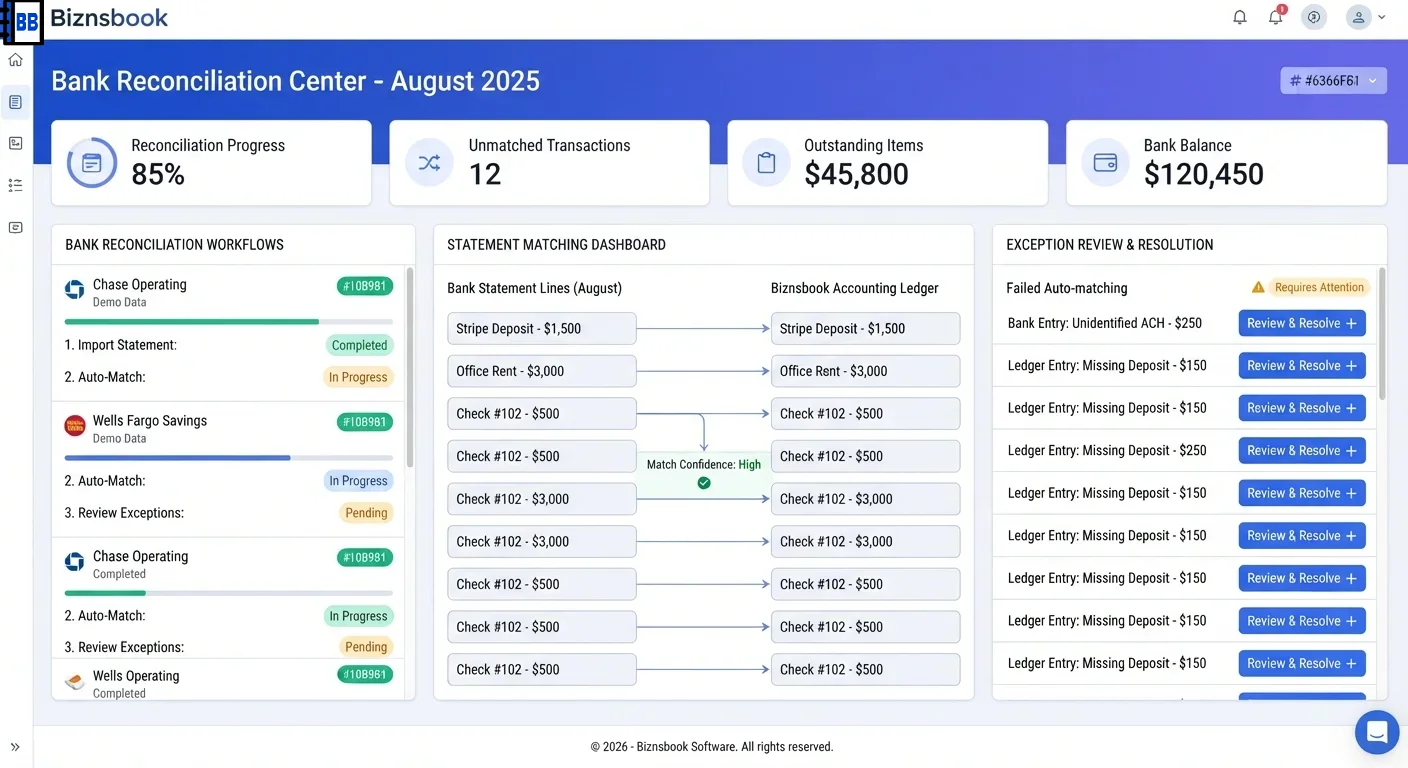
Why bank reconciliation gets stuck every month
Many finance teams reconcile only at month-end, when unmatched entries have already accumulated. This creates long exception lists and pressure to close books quickly with incomplete visibility.
Manual matching in spreadsheets is slow and error-prone. Similar amounts and dates can be misclassified, while missed bank charges and timing differences remain unresolved for weeks.
Without a repeatable workflow, reconciliation depends on individual memory. That introduces inconsistency across entities, accounts, and reporting periods.
Why this happens
- Statement matching is performed manually without system-level tracking.
- Bank entries are posted late, so expected matches are missing.
- Ownership of unmatched items is unclear across finance roles.
- Finance Management tools are not used for continuous reconciliation.
Biznsbook addresses this through bank reconciliation, Finance Management module when Accounting is enabled; add Finance Management, Taxation, Expense, Sales, or Purchase modules as your operating model requires.
Finance teams lose days each month reconciling versions that should never have diverged. Naming Biznsbook screens as the system of record — and closing periods when agreed — prevents silent edits that auditors flag immediately.
Step-by-step: Reconcile Bank Transactions Faster
Designed for owners, bookkeepers, and controllers who need repeatable month-end discipline. Adapt roles to team size — separation of duties matters more than headcount.
- Reconcile more frequently. Shift from month-end-only reconciliation to weekly cycles so exception volume stays manageable.
- Use dedicated bank reconciliation tools. In Biznsbook Finance Management, open Bank Reconciliation and compare statement lines with ledger entries by account and date range.
- Classify timing vs true differences. Separate timing differences from posting errors to avoid unnecessary adjusting entries.
- Post missing vouchers promptly. Use Biznsbook voucher and cash workflows to enter missing receipts, payments, or fees before final matching.
- Investigate stale unmatched lines. Escalate entries still unmatched after your review window and document required corrective action.
- Lock reconciled periods. After reconciliation, close the period in Biznsbook so reconciled balances are not altered without controlled reopen permissions.
- Track KPI trends. Measure days to reconcile, unmatched count, and aging of differences to improve process discipline each month.
Review results after the first full monthly cycle. Adjust roles, mappings, or approvals where the same exception repeats.
Screen-level flows live in the Help Center. This guide focuses on the business process; help articles cover click-by-click navigation.
Common mistakes to avoid
- Mistake 1: Statement matching is performed manually without system-level tracking. Repeating this each month usually shows up first in trial balance or AR/AP aging.
- Mistake 2: Bank entries are posted late, so expected matches are missing. Repeating this each month usually shows up first in trial balance or AR/AP aging.
- Mistake 3: Ownership of unmatched items is unclear across finance roles. Repeating this each month usually shows up first in trial balance or AR/AP aging.
- Mistake 4: Finance Management tools are not used for continuous reconciliation. Repeating this each month usually shows up first in trial balance or AR/AP aging.
Track recurring exceptions in month-end notes; each should map to a control above.
Best practices that hold up as you scale
- Reconcile more frequently — Shift from month-end-only reconciliation to weekly cycles so exception volume stays manageable.
- Use dedicated bank reconciliation tools — In Biznsbook Finance Management, open Bank Reconciliation and compare statement lines with ledger entries by account and date range.
- Classify timing vs true differences — Separate timing differences from posting errors to avoid unnecessary adjusting entries.
- Post missing vouchers promptly — Use Biznsbook voucher and cash workflows to enter missing receipts, payments, or fees before final matching.
- Investigate stale unmatched lines — Escalate entries still unmatched after your review window and document required corrective action.
Consistency beats heroics at month-end. A smaller team that closes the same calendar every month outperforms a larger team that posts sporadically.
How Biznsbook supports this workflow
bank reconciliation is documented in Biznsbook Accounting / Finance capabilities. Use it as part of a controlled finance process — posting, review, and period close — not as an isolated export. When Sales, Purchase, Inventory, Taxation, Expense, or Finance Management modules are enabled, related documents can post through the central accounting posting service with double-entry validation.
Finance Management module is documented in Biznsbook Accounting / Finance capabilities. Use it as part of a controlled finance process — posting, review, and period close — not as an isolated export. When Sales, Purchase, Inventory, Taxation, Expense, or Finance Management modules are enabled, related documents can post through the central accounting posting service with double-entry validation.
Permissions are role-based: separate chart maintenance, journal creation, report viewing, period close, and bank reconciliation per tenant policy.
Suggested implementation timeline
- Week 1: Document current process gaps and configure bank reconciliation with finance owner sign-off.
- Weeks 2–3: Pilot on one month or one entity; post all test transactions through Biznsbook; freeze parallel spreadsheet journals.
- Week 4: Run first trial balance or report tie-out; fix mapping and permission issues.
- Month 2–3: Roll out to full team; add approvals and period close cadence from this guide.
- Ongoing: Monthly review using reconciliation service levels and leadership dashboard.
Metrics to track monthly
- Days to complete month-end close
- Unreconciled bank lines outstanding
- AR and AP aging buckets over 30/60/90 days
- Trial balance out-of-balance exceptions
- Manual journal count vs automated postings ratio
Start with three metrics; trend direction matters more than a single point-in-time snapshot.
Spreadsheet / manual books vs integrated ERP
Compare typical manual finance work with Biznsbook bank reconciliation and related capabilities.
| Capability | Manual / Spreadsheet | Biznsbook |
|---|---|---|
| Statement matching | ❌ Manual line-by-line spreadsheet checks | ✅ Bank reconciliation workspace with filtered matching |
| Exception handling | ❌ Ad hoc notes | ✅ Trackable unmatched item review |
| Posting timeliness | ❌ Late manual adjustments | ✅ Integrated voucher posting before final match |
| Cash visibility | ❌ Uncertain true balance | ✅ Cleaner reconciled cash position |
| Period governance | ❌ Balances changed after close | ✅ Controlled lock and reopen workflow |
| Audit evidence | ❌ Scattered supporting files | ✅ Consistent reconciliation trail by period |
Reconciliation service levels
Set internal targets such as 95% line match within three business days and zero critical unmatched items at close. Service-level goals keep reconciliation proactive rather than reactive.
Document this in your finance SOP and revisit each quarter as transaction volume or entity structure changes.
Frequently asked questions
How often should bank reconciliation be done?
Weekly is practical for most SMBs, with final month-end confirmation. More frequent cycles reduce backlog and make exceptions easier to resolve accurately.
Does Biznsbook include bank reconciliation by default?
Bank reconciliation is part of Finance Management, which extends Accounting capabilities such as fiscal years and advanced finance controls.
What should I do with old unmatched items?
Review each item for posting errors, duplicates, or timing differences. Resolve or escalate aging items with clear ownership and documented decisions.
Can reconciliation improve cash planning?
Yes. Reconciled balances provide a more reliable cash position for near-term payment planning and forecast decisions.
How this differs by industry
Retail
Retail finance teams can reconcile high-volume card settlements and cash deposits faster when reconciliation is performed weekly, not only at month-end.
Wholesale & distribution
Wholesale businesses with frequent supplier payments benefit from cleaner cash books and fewer unresolved timing differences across bank accounts.
Manufacturing
Manufacturers can improve treasury planning by reconciling payroll, supplier, and utility outflows consistently before period close.