How to Automate Recurring Business Expenses
Why recurring costs slip through the cracks
Recurring costs are the easiest expenses to forget precisely because they are routine. The rent is the same every month, the software subscription renews quietly, the cleaning contract invoices on the first. Someone has to remember to record each one, every time.
When that someone is on leave, or the reminder lives in their calendar, a month gets skipped. The cost is still paid, but the expense is missing from that month's figures, so profit looks better than it was and the next month looks worse when two entries land together. Copying last month's entry by hand also invites typos and duplicates.
A recurring template solves this by making the schedule the system's job. The template holds the amount, category, vendor and description once, and the expenses appear on the right dates whether or not anyone remembers.
Why this happens
- Recurring costs are recorded from memory or calendar reminders.
- A missed month is recorded late, so the cost lands in the wrong period.
- Entries are copied by hand, so amounts and categories drift.
- Re-running a catch-up creates duplicates of months already recorded.
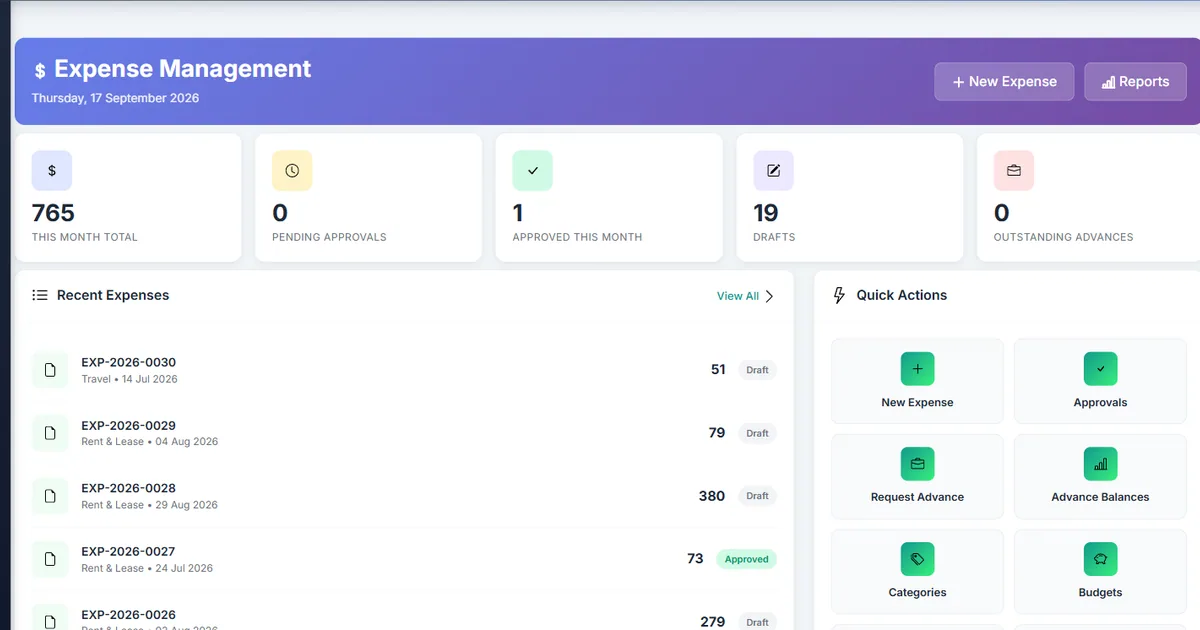
Biznsbook addresses this through recurring expense templates, daily to yearly schedules, missed-date catch-up, optional auto-submit in the Expense Management module, which posts to the same general ledger as the rest of the ERP when Accounting is licensed.
Expense problems rarely come from one big mistake. They come from many small claims handled slightly differently each time. A single record per claim, with every decision and payment attached to it, removes that variation.
Step-by-step: Automate Recurring Business Expenses
Written for finance teams and office managers running staff spend — employees file claims, approvers sign them off, and finance pays and posts them, all inside the Biznsbook Expense Management module.
- Start from a correct expense. Create one expense with the right category, amount, tax, vendor and description. It becomes the pattern for every copy.
- Create the recurring template. Under Expense Settings → Recurring, create a template from that expense and choose the frequency: daily, weekly, monthly, quarterly or yearly.
- Set the next run date. Pick the first date the expense should be created. Later dates follow the schedule from the start date, so a template on the 31st does not drift to the 28th.
- Decide on auto-submit. Turn on auto-submit to send each generated expense into approval straight away. Auto-approve is stored but not applied — a real approver still signs off.
- Let the daily job create the expenses. A background job runs daily and creates one expense per due date, dated on that date. If runs were missed, it catches up — up to 12 dates per template per run.
- Pause and resume when contracts change. Pause a template from the recurring list to stop it. Resuming starts again from the next scheduled date and does not create the dates missed while it was paused.
- Review generated expenses. Generated expenses appear in the expense list like any other claim, with their own numbers, and follow the normal approval and posting path.
Review results after the first full monthly cycle. Adjust roles, mappings, or approvals where the same exception repeats.
Inside Biznsbook, the Expense module has its own step-by-step Guide (Expenses → Guide) covering claims, approvals, advances, budgets, recurring expenses and payments. This article focuses on the business process behind those screens.
Common mistakes to avoid
- Mistake 1: Recurring costs are recorded from memory or calendar reminders. Repeating this each month usually shows up first in an expense report finance cannot reconcile to the ledger.
- Mistake 2: A missed month is recorded late, so the cost lands in the wrong period. Repeating this each month usually shows up first in an expense report finance cannot reconcile to the ledger.
- Mistake 3: Entries are copied by hand, so amounts and categories drift. Repeating this each month usually shows up first in an expense report finance cannot reconcile to the ledger.
- Mistake 4: Re-running a catch-up creates duplicates of months already recorded. Repeating this each month usually shows up first in an expense report finance cannot reconcile to the ledger.
Each of these shows up as a difference between the expense reports and the ledger. Fix the process on the claim record rather than with manual journals.
Best practices that hold up as you scale
- Start from a correct expense — Create one expense with the right category, amount, tax, vendor and description.
- Create the recurring template — Under Expense Settings → Recurring, create a template from that expense and choose the frequency: daily, weekly, monthly, quarterly or yearly.
- Set the next run date — Pick the first date the expense should be created.
- Decide on auto-submit — Turn on auto-submit to send each generated expense into approval straight away.
- Let the daily job create the expenses — A background job runs daily and creates one expense per due date, dated on that date.
Keep the process inside the claim record. Every approval, payment and settlement recorded on the claim is one less manual journal to explain at month-end.
How Biznsbook supports this workflow
recurring expense templates is part of Biznsbook Expense Management and follows the claim through the same record — submission, approval, payment and posting — rather than living in a separate spreadsheet. With Accounting licensed, each journal is posted as a balanced double entry under its own reference, so a payout or reversal can never be mistaken for the original expense.
daily to yearly schedules is part of Biznsbook Expense Management and follows the claim through the same record — submission, approval, payment and posting — rather than living in a separate spreadsheet. With Accounting licensed, each journal is posted as a balanced double entry under its own reference, so a payout or reversal can never be mistaken for the original expense.
missed-date catch-up is part of Biznsbook Expense Management and follows the claim through the same record — submission, approval, payment and posting — rather than living in a separate spreadsheet. With Accounting licensed, each journal is posted as a balanced double entry under its own reference, so a payout or reversal can never be mistaken for the original expense.
optional auto-submit is part of Biznsbook Expense Management and follows the claim through the same record — submission, approval, payment and posting — rather than living in a separate spreadsheet. With Accounting licensed, each journal is posted as a balanced double entry under its own reference, so a payout or reversal can never be mistaken for the original expense.
Access is permission-based: Expense Manager holds approve, categories, budgets, settings and reports; Expense Approver can approve and view reports. Every company user can still file their own claims and advance requests, and company admins see everything.
Suggested implementation timeline
- Week 1: Set up categories with GL accounts and the Expense Settings default accounts, then configure recurring expense templates.
- Week 2: Pilot with one team: file real claims, approve them and record payments in Biznsbook only.
- Week 3: Check the postings: approved claims, employee payable and advances should match the expense reports.
- Month 2: Roll out to all staff, assign Expense Manager and Expense Approver roles, and retire the spreadsheet.
- Ongoing: Monthly review using keeping templates current.
Metrics to track monthly
- Approved claims waiting for payment, and their total
- Average days from submission to final approval
- Outstanding employee advances past their expected settlement date
- Spend against budget by category for the month
Start with three metrics; trend direction matters more than a single point-in-time snapshot.
Spreadsheets and email vs Biznsbook Expense Management
Compare a typical email-and-spreadsheet expense process with Biznsbook recurring expense templates and the related Expense capabilities.
| Capability | Manual / Spreadsheet | Biznsbook |
|---|---|---|
| Remembering the cost | ❌ Calendar reminder | ✅ Template on a daily-to-yearly schedule |
| Expense date | ❌ Whenever it is entered | ✅ Dated on the scheduled date |
| Missed runs | ❌ Recorded late or forgotten | ✅ Caught up, up to 12 dates per run |
| Duplicates | ❌ Easy when catching up | ✅ Never two expenses for the same date |
| Contract on hold | ❌ Delete and recreate | ✅ Pause and resume the template |
| Approval | ❌ Often skipped for routine costs | ✅ Optional auto-submit into the normal workflow |
Keeping templates current
Review recurring templates every quarter. Rent increases, subscription price changes and cancelled contracts are the usual reasons a template is wrong. Edit the template amount when a price changes, pause it when a contract is suspended, and check that each template still points at an active category with a GL account so the generated expenses can post.
Write the rule into your expense policy so employees, approvers and finance follow the same steps, and revisit it each quarter.
Frequently asked questions
Which frequencies can a recurring expense use?
Daily, weekly, monthly, quarterly and yearly. Dates are worked out from the template's start date, so month-end templates keep their day of the month where the calendar allows.
What happens if the recurring job does not run for a while?
The next run catches up the missed dates, up to 12 per template per run, each dated on its own scheduled date. It never creates two expenses for the same date, even if a run is repeated.
Are recurring expenses approved automatically?
No. Auto-submit sends each generated expense into the approval workflow. Auto-approve is stored on the template but not applied, because approval stages need an authorised approver. A category that needs no approval is approved on submit as usual.
What happens to dates missed while a template was paused?
They are skipped. Resuming starts again from the next scheduled date from today on; it does not generate the dates that passed while the template was paused.
When does the recurring job run?
It is a daily background job, by default at 06:00 UTC, and only for companies licensed for Expense Management. Your administrator can change the schedule.
How this differs by industry
Retail
Retailers with several stores can keep one rent template per store, each tagged with its own cost center, so every store's occupancy cost lands in the right month.
Wholesale & distribution
Distributors can template warehouse leases, vehicle insurance and software subscriptions, and use quarterly or yearly frequencies for the bills that are not monthly.
Manufacturing
Plants can template equipment leases and maintenance contracts so the monthly cost appears on schedule, even during busy production months when nobody remembers to enter it.