How to Track Business Expenses Efficiently
Why expense tracking drifts without controls
Expense tracking often starts with ad hoc reimbursement requests and scattered receipts. Over time, this creates inconsistent records and weak visibility into where money is actually being spent.
When categories are not standardized, management cannot compare costs across periods or departments reliably. Budget discussions then become opinion-based instead of evidence-based.
Missing approval checkpoints increase policy breaches and late surprises, especially when high-value expenses are paid before review.
Why this happens
- Employees submit expenses through unstructured channels.
- Category definitions and GL mappings are inconsistent.
- Approvals are bypassed during urgent payment requests.
- Expense data is disconnected from accounting reports.
Biznsbook addresses this through Expense module, categories, approval workflow when Accounting is enabled; add Finance Management, Taxation, Expense, Sales, or Purchase modules as your operating model requires.
Finance teams lose days each month reconciling versions that should never have diverged. Naming Biznsbook screens as the system of record — and closing periods when agreed — prevents silent edits that auditors flag immediately.
Step-by-step: Track Business Expenses Efficiently
Designed for owners, bookkeepers, and controllers who need repeatable month-end discipline. Adapt roles to team size — separation of duties matters more than headcount.
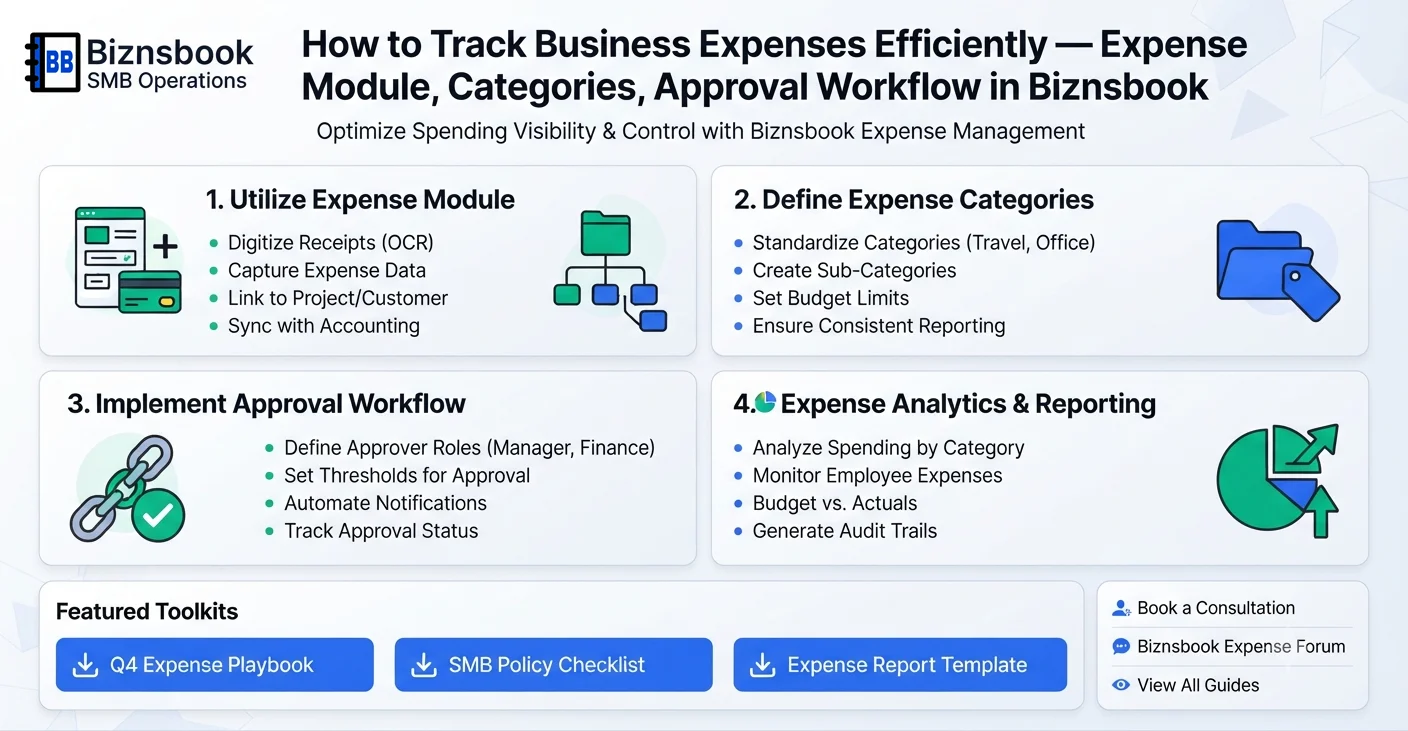
- Standardize expense categories. Define active categories with clear tax treatment and GL mapping to improve analysis consistency.
- Capture expenses in one module. Use Biznsbook Expense module for create, edit, attachment, and status tracking rather than email threads.
- Enforce approval stages. Configure amount-based approval workflow with escalation and delegation rules for timely decisions.
- Review pending queues daily. In Biznsbook approvals pages, clear bottlenecks so valid claims do not wait unnecessarily.
- Post approved payments correctly. Apply company-paid, reimbursement, or advance-settlement flows based on policy and supporting documents.
- Use accounting integration. Let Biznsbook expense accounting templates post DR/CR entries and input tax lines consistently.
- Monitor spend variance. Track category trends and budget variance monthly to reduce leakage and improve accountability.
Review results after the first full monthly cycle. Adjust roles, mappings, or approvals where the same exception repeats.
Screen-level flows live in the Help Center. This guide focuses on the business process; help articles cover click-by-click navigation.
Common mistakes to avoid
- Mistake 1: Employees submit expenses through unstructured channels. Repeating this each month usually shows up first in trial balance or AR/AP aging.
- Mistake 2: Category definitions and GL mappings are inconsistent. Repeating this each month usually shows up first in trial balance or AR/AP aging.
- Mistake 3: Approvals are bypassed during urgent payment requests. Repeating this each month usually shows up first in trial balance or AR/AP aging.
- Mistake 4: Expense data is disconnected from accounting reports. Repeating this each month usually shows up first in trial balance or AR/AP aging.
Track recurring exceptions in month-end notes; each should map to a control above.
Best practices that hold up as you scale
- Standardize expense categories — Define active categories with clear tax treatment and GL mapping to improve analysis consistency.
- Capture expenses in one module — Use Biznsbook Expense module for create, edit, attachment, and status tracking rather than email threads.
- Enforce approval stages — Configure amount-based approval workflow with escalation and delegation rules for timely decisions.
- Review pending queues daily — In Biznsbook approvals pages, clear bottlenecks so valid claims do not wait unnecessarily.
- Post approved payments correctly — Apply company-paid, reimbursement, or advance-settlement flows based on policy and supporting documents.
Consistency beats heroics at month-end. A smaller team that closes the same calendar every month outperforms a larger team that posts sporadically.
How Biznsbook supports this workflow
Expense module is documented in Biznsbook Accounting / Finance capabilities. Use it as part of a controlled finance process — posting, review, and period close — not as an isolated export. When Sales, Purchase, Inventory, Taxation, Expense, or Finance Management modules are enabled, related documents can post through the central accounting posting service with double-entry validation.
categories is documented in Biznsbook Accounting / Finance capabilities. Use it as part of a controlled finance process — posting, review, and period close — not as an isolated export. When Sales, Purchase, Inventory, Taxation, Expense, or Finance Management modules are enabled, related documents can post through the central accounting posting service with double-entry validation.
approval workflow is documented in Biznsbook Accounting / Finance capabilities. Use it as part of a controlled finance process — posting, review, and period close — not as an isolated export. When Sales, Purchase, Inventory, Taxation, Expense, or Finance Management modules are enabled, related documents can post through the central accounting posting service with double-entry validation.
Permissions are role-based: separate chart maintenance, journal creation, report viewing, period close, and bank reconciliation per tenant policy.
Suggested implementation timeline
- Week 1: Document current process gaps and configure Expense module with finance owner sign-off.
- Weeks 2–3: Pilot on one month or one entity; post all test transactions through Biznsbook; freeze parallel spreadsheet journals.
- Week 4: Run first trial balance or report tie-out; fix mapping and permission issues.
- Month 2–3: Roll out to full team; add approvals and period close cadence from this guide.
- Ongoing: Monthly review using expense policy essentials and leadership dashboard.
Metrics to track monthly
- Days to complete month-end close
- Unreconciled bank lines outstanding
- AR and AP aging buckets over 30/60/90 days
- Trial balance out-of-balance exceptions
- Manual journal count vs automated postings ratio
Start with three metrics; trend direction matters more than a single point-in-time snapshot.
Spreadsheet / manual books vs integrated ERP
Compare typical manual finance work with Biznsbook Expense module and related capabilities.
| Capability | Manual / Spreadsheet | Biznsbook |
|---|---|---|
| Expense capture | ❌ Email and paper receipts | ✅ Centralized Expense module records |
| Category consistency | ❌ Free-text labels | ✅ Configured categories with GL mapping |
| Approval discipline | ❌ Manager memory | ✅ Multi-stage approval workflow |
| Payment control | ❌ Untracked reimbursements | ✅ Policy-based payment methods |
| Accounting impact | ❌ Manual periodic journals | ✅ Template-driven journal posting |
| Management visibility | ❌ Limited cost analytics | ✅ Dashboard and report exports |
Expense policy essentials
Define required documents, approval thresholds, reimbursement timelines, and prohibited categories. Clear policy rules reduce back-and-forth and improve compliance.
Document this in your finance SOP and revisit each quarter as transaction volume or entity structure changes.
Frequently asked questions
What is the first improvement for expense control?
Capture every expense in one system with required categories and supporting documents. Consistent data is the foundation for all other controls.
Why do approval workflows matter?
They enforce policy, reduce unauthorized spend, and create a clear audit trail of who approved what and when.
Can expense tracking support budgeting?
Yes. Category-level visibility and variance reporting help managers compare actual spend against approved budgets.
How does this help accounting teams?
Structured categories and posting templates reduce manual journal effort and improve report accuracy at month-end.
How this differs by industry
Retail
Retail teams can control store-level spending by enforcing category-based claims and timely approvals for recurring operational costs.
Wholesale & distribution
Wholesale businesses gain better margin control when logistics, travel, and admin expenses are categorized consistently and reviewed against budget.
Manufacturing
Manufacturers can improve oversight of maintenance, procurement support, and project-linked expenses through structured workflows and posting controls.