How to Create a Trial Balance Correctly
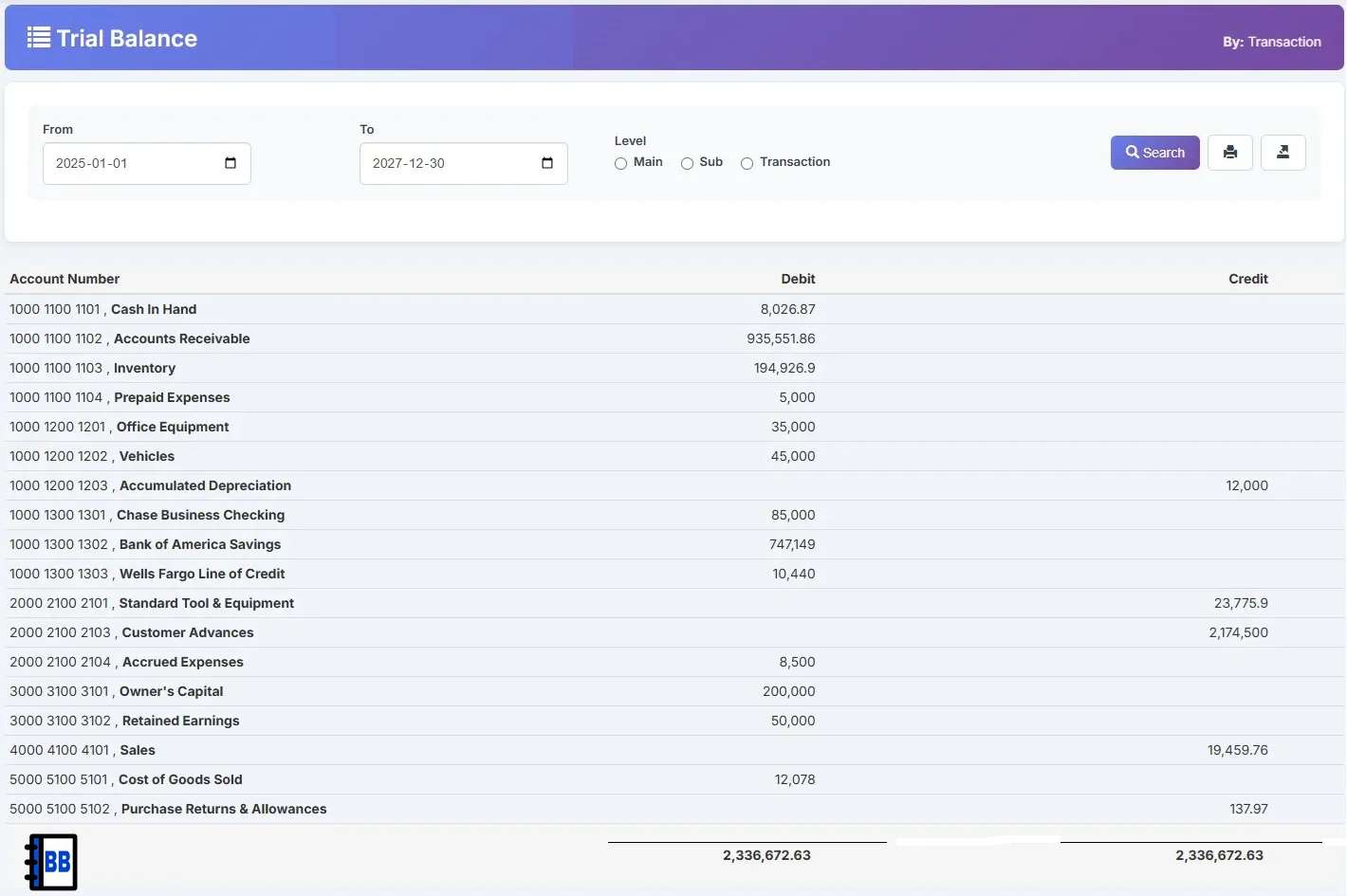
Why trial balance errors delay month-end close
Trial balance issues usually indicate upstream posting problems, timing gaps, or incorrect account selection. If detected late, finance teams scramble to adjust entries under deadline pressure.
Many organizations run trial balance after preparing other statements, which reverses the correct control order and causes avoidable rework across reports.
Without period-level governance, entries may be posted in wrong months, creating confusing movements that are hard to explain to management and auditors.
Why this happens
- Entries are posted late or into incorrect accounting periods.
- Manual journals are created without sufficient review controls.
- Teams do not use period manager checks before finalization.
- Trial balance validation is treated as a final formality.
Biznsbook addresses this through trial balance, accounting period manager when Accounting is enabled; add Finance Management, Taxation, Expense, Sales, or Purchase modules as your operating model requires.
Finance teams lose days each month reconciling versions that should never have diverged. Naming Biznsbook screens as the system of record — and closing periods when agreed — prevents silent edits that auditors flag immediately.
Step-by-step: Create a Trial Balance Correctly
Designed for owners, bookkeepers, and controllers who need repeatable month-end discipline. Adapt roles to team size — separation of duties matters more than headcount.
- Complete posting cut-off. Confirm sales, purchases, expenses, and adjustments are entered before running final checks.
- Review period status. Use Biznsbook accounting period manager to confirm the target month is open and prior periods are controlled.
- Run trial balance draft. Generate a draft trial balance and investigate any unusual account movements or classifications.
- Validate journal quality. In Biznsbook, inspect journal references and manual entries that drive large variances.
- Resolve and rerun. Post required corrections, then rerun trial balance until totals and classifications are satisfactory.
- Lock period with approval. Use Biznsbook period controls to close the month once trial balance checks pass governance review.
- Publish as baseline. Use the approved trial balance as the base for P&L, balance sheet, and management reporting packs.
Review results after the first full monthly cycle. Adjust roles, mappings, or approvals where the same exception repeats.
Screen-level flows live in the Help Center. This guide focuses on the business process; help articles cover click-by-click navigation.
Common mistakes to avoid
- Mistake 1: Entries are posted late or into incorrect accounting periods. Repeating this each month usually shows up first in trial balance or AR/AP aging.
- Mistake 2: Manual journals are created without sufficient review controls. Repeating this each month usually shows up first in trial balance or AR/AP aging.
- Mistake 3: Teams do not use period manager checks before finalization. Repeating this each month usually shows up first in trial balance or AR/AP aging.
- Mistake 4: Trial balance validation is treated as a final formality. Repeating this each month usually shows up first in trial balance or AR/AP aging.
Track recurring exceptions in month-end notes; each should map to a control above.
Best practices that hold up as you scale
- Complete posting cut-off — Confirm sales, purchases, expenses, and adjustments are entered before running final checks.
- Review period status — Use Biznsbook accounting period manager to confirm the target month is open and prior periods are controlled.
- Run trial balance draft — Generate a draft trial balance and investigate any unusual account movements or classifications.
- Validate journal quality — In Biznsbook, inspect journal references and manual entries that drive large variances.
- Resolve and rerun — Post required corrections, then rerun trial balance until totals and classifications are satisfactory.
Consistency beats heroics at month-end. A smaller team that closes the same calendar every month outperforms a larger team that posts sporadically.
How Biznsbook supports this workflow
trial balance is documented in Biznsbook Accounting / Finance capabilities. Use it as part of a controlled finance process — posting, review, and period close — not as an isolated export. When Sales, Purchase, Inventory, Taxation, Expense, or Finance Management modules are enabled, related documents can post through the central accounting posting service with double-entry validation.
accounting period manager is documented in Biznsbook Accounting / Finance capabilities. Use it as part of a controlled finance process — posting, review, and period close — not as an isolated export. When Sales, Purchase, Inventory, Taxation, Expense, or Finance Management modules are enabled, related documents can post through the central accounting posting service with double-entry validation.
Permissions are role-based: separate chart maintenance, journal creation, report viewing, period close, and bank reconciliation per tenant policy.
Suggested implementation timeline
- Week 1: Document current process gaps and configure trial balance with finance owner sign-off.
- Weeks 2–3: Pilot on one month or one entity; post all test transactions through Biznsbook; freeze parallel spreadsheet journals.
- Week 4: Run first trial balance or report tie-out; fix mapping and permission issues.
- Month 2–3: Roll out to full team; add approvals and period close cadence from this guide.
- Ongoing: Monthly review using trial balance review order and leadership dashboard.
Metrics to track monthly
- Days to complete month-end close
- Unreconciled bank lines outstanding
- AR and AP aging buckets over 30/60/90 days
- Trial balance out-of-balance exceptions
- Manual journal count vs automated postings ratio
Start with three metrics; trend direction matters more than a single point-in-time snapshot.
Spreadsheet / manual books vs integrated ERP
Compare typical manual finance work with Biznsbook trial balance and related capabilities.
| Capability | Manual / Spreadsheet | Biznsbook |
|---|---|---|
| Validation timing | ❌ Checked at end only | ✅ Used as first report gate |
| Period governance | ❌ Loose month boundaries | ✅ Accounting period manager controls |
| Error investigation | ❌ Spreadsheet tracing | ✅ Journal reference drill-down |
| Correction cycle | ❌ Single risky adjustment batch | ✅ Iterative rerun and validation |
| Close confidence | ❌ Frequent restatements | ✅ Controlled sign-off before lock |
| Report foundation | ❌ Unstable opening figures | ✅ Dependable baseline for statements |
Trial balance review order
Prioritize cash and bank, receivables, payables, tax, inventory-linked accounts, then equity and retained earnings. A fixed sequence makes anomaly detection faster and repeatable.
Document this in your finance SOP and revisit each quarter as transaction volume or entity structure changes.
Frequently asked questions
What does a trial balance confirm?
It confirms that total debits and credits are balanced by account for a period, providing a key control before preparing statements.
When should trial balance be run?
Run a draft during close and a final version before locking the period and publishing management reports.
Can a balanced trial balance still hide issues?
Yes. Misclassification can exist even when totals balance, so account-level variance review is still necessary.
Why use accounting period manager with trial balance?
It ensures entries are posted in the correct month and supports controlled close, reducing cross-period reporting errors.
How this differs by industry
Retail
Retail finance teams can reduce close delays by validating high-volume sales and expense postings through trial balance checks each month.
Wholesale & distribution
Wholesale businesses gain better period discipline when receivable and payable movements are reviewed against trial balance before lock.
Manufacturing
Manufacturers benefit from stronger close control by validating production-related postings and adjustments before final statement preparation.