How to Create Accurate Financial Reports
Why financial reports lose trust
Leaders lose confidence in reports when numbers change after each review. Reworked statements often signal weak close discipline, delayed postings, or inconsistent account usage.
If teams build P&L and balance sheet from separate exports, inter-report consistency breaks. Cash movements may not tie to ledger activity, and balance sheet movements become hard to explain.
Late issue discovery stretches close timelines. Finance spends days investigating preventable differences rather than providing insights to management.
Why this happens
- Trial balance validation is skipped before report publication.
- Accounts are posted inconsistently across departments.
- Reports are built from disconnected data extracts.
- Exception investigation starts too late in the close cycle.
Biznsbook addresses this through trial balance, P&L, balance sheet, cash flow when Accounting is enabled; add Finance Management, Taxation, Expense, Sales, or Purchase modules as your operating model requires.
Finance teams lose days each month reconciling versions that should never have diverged. Naming Biznsbook screens as the system of record — and closing periods when agreed — prevents silent edits that auditors flag immediately.
Step-by-step: Create Accurate Financial Reports
Designed for owners, bookkeepers, and controllers who need repeatable month-end discipline. Adapt roles to team size — separation of duties matters more than headcount.
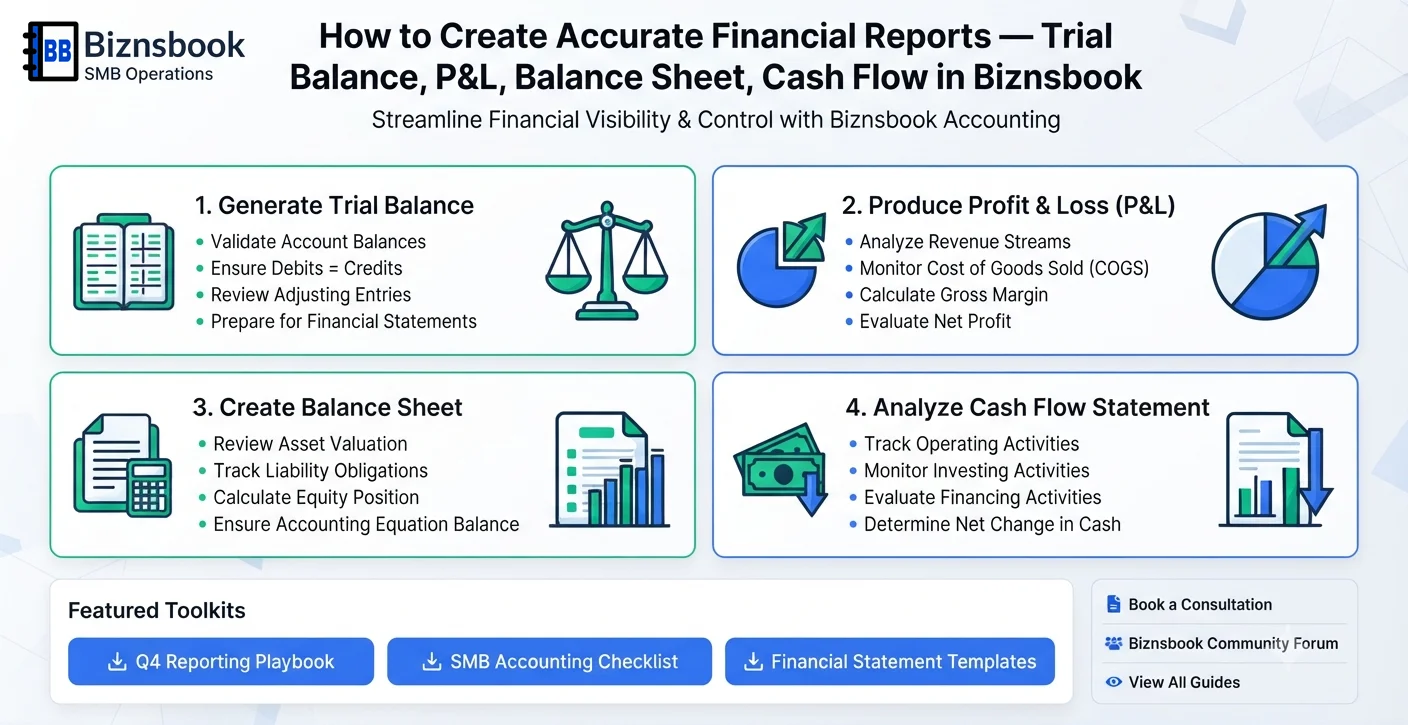
- Validate trial balance first. Confirm debits and credits balance before generating management packs to avoid downstream restatement.
- Review core statements together. In Biznsbook, analyze P&L, balance sheet, and cash flow in one review cycle to spot cross-report inconsistencies.
- Investigate material variances. Compare current period to prior periods and budget to isolate unusual swings needing journal or classification review.
- Drill into journal references. Use Biznsbook journal viewer and voucher search to trace balances back to originating documents quickly.
- Confirm period status. Ensure all relevant periods and entries are open or closed correctly before final report export.
- Publish with review controls. Use Biznsbook-close checklists and approval sign-off before sharing reports externally.
- Archive supporting evidence. Store key reconciliations and commentary for audit readiness and faster future close cycles.
Review results after the first full monthly cycle. Adjust roles, mappings, or approvals where the same exception repeats.
Screen-level flows live in the Help Center. This guide focuses on the business process; help articles cover click-by-click navigation.
Common mistakes to avoid
- Mistake 1: Trial balance validation is skipped before report publication. Repeating this each month usually shows up first in trial balance or AR/AP aging.
- Mistake 2: Accounts are posted inconsistently across departments. Repeating this each month usually shows up first in trial balance or AR/AP aging.
- Mistake 3: Reports are built from disconnected data extracts. Repeating this each month usually shows up first in trial balance or AR/AP aging.
- Mistake 4: Exception investigation starts too late in the close cycle. Repeating this each month usually shows up first in trial balance or AR/AP aging.
Track recurring exceptions in month-end notes; each should map to a control above.
Best practices that hold up as you scale
- Validate trial balance first — Confirm debits and credits balance before generating management packs to avoid downstream restatement.
- Review core statements together — In Biznsbook, analyze P&L, balance sheet, and cash flow in one review cycle to spot cross-report inconsistencies.
- Investigate material variances — Compare current period to prior periods and budget to isolate unusual swings needing journal or classification review.
- Drill into journal references — Use Biznsbook journal viewer and voucher search to trace balances back to originating documents quickly.
- Confirm period status — Ensure all relevant periods and entries are open or closed correctly before final report export.
Consistency beats heroics at month-end. A smaller team that closes the same calendar every month outperforms a larger team that posts sporadically.
How Biznsbook supports this workflow
trial balance is documented in Biznsbook Accounting / Finance capabilities. Use it as part of a controlled finance process — posting, review, and period close — not as an isolated export. When Sales, Purchase, Inventory, Taxation, Expense, or Finance Management modules are enabled, related documents can post through the central accounting posting service with double-entry validation.
P&L is documented in Biznsbook Accounting / Finance capabilities. Use it as part of a controlled finance process — posting, review, and period close — not as an isolated export. When Sales, Purchase, Inventory, Taxation, Expense, or Finance Management modules are enabled, related documents can post through the central accounting posting service with double-entry validation.
balance sheet is documented in Biznsbook Accounting / Finance capabilities. Use it as part of a controlled finance process — posting, review, and period close — not as an isolated export. When Sales, Purchase, Inventory, Taxation, Expense, or Finance Management modules are enabled, related documents can post through the central accounting posting service with double-entry validation.
cash flow is documented in Biznsbook Accounting / Finance capabilities. Use it as part of a controlled finance process — posting, review, and period close — not as an isolated export. When Sales, Purchase, Inventory, Taxation, Expense, or Finance Management modules are enabled, related documents can post through the central accounting posting service with double-entry validation.
Permissions are role-based: separate chart maintenance, journal creation, report viewing, period close, and bank reconciliation per tenant policy.
Suggested implementation timeline
- Week 1: Document current process gaps and configure trial balance with finance owner sign-off.
- Weeks 2–3: Pilot on one month or one entity; post all test transactions through Biznsbook; freeze parallel spreadsheet journals.
- Week 4: Run first trial balance or report tie-out; fix mapping and permission issues.
- Month 2–3: Roll out to full team; add approvals and period close cadence from this guide.
- Ongoing: Monthly review using reporting quality checklist and leadership dashboard.
Metrics to track monthly
- Days to complete month-end close
- Unreconciled bank lines outstanding
- AR and AP aging buckets over 30/60/90 days
- Trial balance out-of-balance exceptions
- Manual journal count vs automated postings ratio
Start with three metrics; trend direction matters more than a single point-in-time snapshot.
Spreadsheet / manual books vs integrated ERP
Compare typical manual finance work with Biznsbook trial balance and related capabilities.
| Capability | Manual / Spreadsheet | Biznsbook |
|---|---|---|
| Statement consistency | ❌ Separate exported workbooks | ✅ Unified reports from one ledger |
| Balance validation | ❌ Manual eyeballing | ✅ Trial balance validation workflow |
| Variance analysis | ❌ Late ad hoc review | ✅ Structured period-to-period checks |
| Drill-down speed | ❌ Search through files | ✅ Journal viewer and voucher lookup |
| Close control | ❌ Informal approvals | ✅ Period and sign-off governance |
| Audit readiness | ❌ Scattered evidence folders | ✅ System-backed transaction traceability |
Reporting quality checklist
Check trial balance status, period completeness, large variance explanations, and sign-off records before release. A simple checklist prevents avoidable reporting rework.
Document this in your finance SOP and revisit each quarter as transaction volume or entity structure changes.
Frequently asked questions
What report should be checked first?
Start with trial balance to confirm ledger integrity, then review profit and loss, balance sheet, and cash flow together.
Why review all core statements together?
Cross-statement review catches classification or timing issues that may look acceptable when each report is viewed in isolation.
How can finance shorten review cycles?
Use structured validation checkpoints and source-linked drill-down tools so issues are resolved quickly and consistently.
Can SMBs apply the same controls as larger firms?
Yes. Scaled controls such as period checks, variance thresholds, and documented sign-off work well for small teams too.
How this differs by industry
Retail
Retail finance teams can improve reporting confidence by reconciling high-volume sales and expense postings before statement publication.
Wholesale & distribution
Wholesalers gain better margin and working-capital insights when AR, AP, and inventory effects are reflected in one reporting cycle.
Manufacturing
Manufacturers benefit from accurate statement packs that connect production costs, receivables, and payables into a coherent financial story.