How to Build a Repeatable Sales Process
Why wins remain inconsistent across reps
When every rep follows a different method, strong results are hard to replicate. New hires take longer to ramp, forecasting becomes noisy, and managers cannot tell whether performance differences come from skill or process variation.
Inconsistent lead intake causes poor qualification. Missing fields, weak discovery notes, and nonstandard handoffs force reps to restart conversations and lose momentum.
Without process discipline, improvement efforts fail. Training, playbooks, and reporting only work when teams operate from a common sales framework.
Why this happens
- Lead capture is inconsistent and missing required qualification fields.
- Pipeline stages do not enforce shared operating definitions.
- Convert Lead handoff lacks mandatory ownership and next actions.
- Process adherence is not measured or coached consistently.
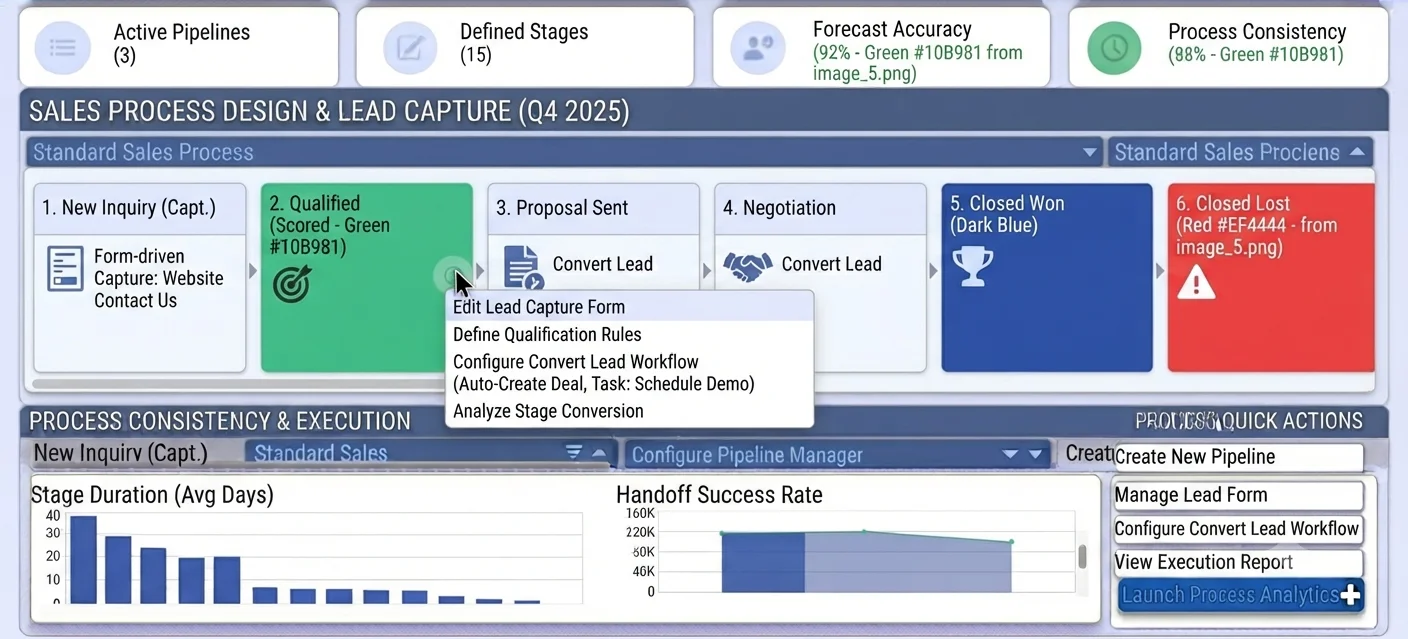
Biznsbook addresses this through Pipeline stages, form builder, convert lead when the CRM module is enabled. Add Business Automation and Communication Center for drip nurture on crm.lead.created; add Sales and Accounting for order-to-cash when deals close.
Finance teams lose days each month reconciling versions that should never have diverged. Naming Biznsbook screens as the system of record — and closing periods when agreed — prevents silent edits that auditors flag immediately.
Step-by-step: Build a Repeatable Sales Process
Built for sales reps, managers, and RevOps leads who need a repeatable funnel — not heroic inbox chasing. Adapt roles to your team size.
- Design your core sales path. Map lead intake, qualification, proposal, and closing milestones with clear role ownership.
- Standardize lead intake forms. Use Form Builder to collect required fields consistently from web and campaign channels.
- Deploy form capture channels. Publish embed codes and public API integrations so every lead source feeds the same data model.
- Align stage criteria. Ensure pipeline stages reflect actual milestone evidence, not optimistic status labels.
- Set Convert Lead rules. Convert only when qualification criteria are met and assign clear deal ownership immediately.
- Create process adherence reviews. Audit random deals weekly for missing fields, skipped steps, and weak next-action clarity.
- Refine and document playbook. Update the sales playbook quarterly using conversion data and frontline rep feedback.
Review results after the first full weekly cycle. Adjust roles, mappings, or approvals where the same exception repeats.
Screen-level flows live in the Help Center (tax setup, expense claims, sale invoices). This guide focuses on finance process; help articles cover navigation.
Common mistakes to avoid
- Mistake 1: Lead capture is inconsistent and missing required qualification fields. Repeating this each month usually shows up first in pipeline velocity or lead aging reports.
- Mistake 2: Pipeline stages do not enforce shared operating definitions. Repeating this each month usually shows up first in pipeline velocity or lead aging reports.
- Mistake 3: Convert Lead handoff lacks mandatory ownership and next actions. Repeating this each month usually shows up first in pipeline velocity or lead aging reports.
- Mistake 4: Process adherence is not measured or coached consistently. Repeating this each month usually shows up first in pipeline velocity or lead aging reports.
Track recurring exceptions in month-end notes; each should map to a control above.
Best practices that hold up as you scale
- Design your core sales path — Map lead intake, qualification, proposal, and closing milestones with clear role ownership.
- Standardize lead intake forms — Use Form Builder to collect required fields consistently from web and campaign channels.
- Deploy form capture channels — Publish embed codes and public API integrations so every lead source feeds the same data model.
- Align stage criteria — Ensure pipeline stages reflect actual milestone evidence, not optimistic status labels.
- Set Convert Lead rules — Convert only when qualification criteria are met and assign clear deal ownership immediately.
Teams that review pipeline and lead aging weekly close more consistently than teams that only report at month-end.
How Biznsbook supports this workflow
Pipeline stages is documented in Biznsbook CRM / Sales capabilities. Use it as part of a controlled finance process — posting, review, and period close — not as an isolated export. When Sales, Purchase, Inventory, Taxation, Expense, or Finance Management modules are enabled, related documents can post through the central accounting posting service with double-entry validation.
form builder is documented in Biznsbook CRM / Sales capabilities. Use it as part of a controlled finance process — posting, review, and period close — not as an isolated export. When Sales, Purchase, Inventory, Taxation, Expense, or Finance Management modules are enabled, related documents can post through the central accounting posting service with double-entry validation.
convert lead is documented in Biznsbook CRM / Sales capabilities. Use it as part of a controlled finance process — posting, review, and period close — not as an isolated export. When Sales, Purchase, Inventory, Taxation, Expense, or Finance Management modules are enabled, related documents can post through the central accounting posting service with double-entry validation.
CRM roles (rep, manager, admin) govern export, settings, and reassignment. Workflow automations live in Business Automation — not buried in personal inboxes.
Suggested implementation timeline
- Week 1: Document current process gaps and configure Pipeline stages with finance owner sign-off.
- Weeks 2–3: Pilot on one month or one entity; post all test transactions through Biznsbook; freeze parallel spreadsheet journals.
- Week 4: Run first trial balance or report tie-out; fix mapping and permission issues.
- Month 2–3: Roll out to full team; add approvals and period close cadence from this guide.
- Ongoing: Monthly review using process maturity milestones and leadership dashboard.
Metrics to track monthly
- Lead response time (minutes from create to first activity)
- Lead-to-opportunity conversion rate by source
- Pipeline velocity and stage aging days
- Win rate and average deal size
- Forecast vs actual revenue (closed-won)
Start with three metrics; trend direction matters more than a single point-in-time snapshot.
Spreadsheet / manual books vs integrated ERP
Compare typical manual finance work with Biznsbook Pipeline stages and related capabilities.
| Capability | Manual / Spreadsheet | Biznsbook |
|---|---|---|
| Lead capture | ❌ Free-form notes | ✅ Form Builder standard fields |
| Input channels | ❌ One-off forms | ✅ Embed codes plus public API |
| Stage progression | ❌ Subjective movement | ✅ Criteria-based transitions |
| Lead conversion | ❌ Inconsistent handoff | ✅ Structured Convert Lead flow |
| Onboarding | ❌ Rep-specific methods | ✅ Repeatable playbook |
| Improvement loop | ❌ Ad hoc fixes | ✅ Measured process audits |
Process maturity milestones
Track progression from ad hoc selling to documented stages, governed data capture, and outcome-driven coaching. Each maturity step improves scalability and forecast trust.
Document this in your finance SOP and revisit each quarter as transaction volume or entity structure changes.
Frequently asked questions
How do I make process adoption easier for reps?
Keep the framework simple, explain the business impact, and coach from real deals. Adoption rises when reps see fewer stalled opportunities and clearer priorities.
Why use Form Builder for sales intake?
Form Builder standardizes required data fields and supports embed codes and public API capture, reducing missing information at qualification time.
When should a lead be converted?
Convert only after minimum qualification evidence is met, such as fit, intent, and defined next-step timeline.
How often should the process be reviewed?
Quarterly process reviews are practical for most teams, with monthly checks on adherence and stage conversion patterns.
How this differs by industry
Retail
Retail B2B teams can unify branch inquiry handling with one lead form and clear stage rules for account setup and reorder planning.
Wholesale & distribution
Wholesale organizations should define repeatable steps from distributor inquiry to pricing approval and first order conversion.
Manufacturing
Manufacturing sales can standardize technical qualification checkpoints so engineering and commercial teams execute in a predictable sequence.