How to Calculate Restaurant Food Cost
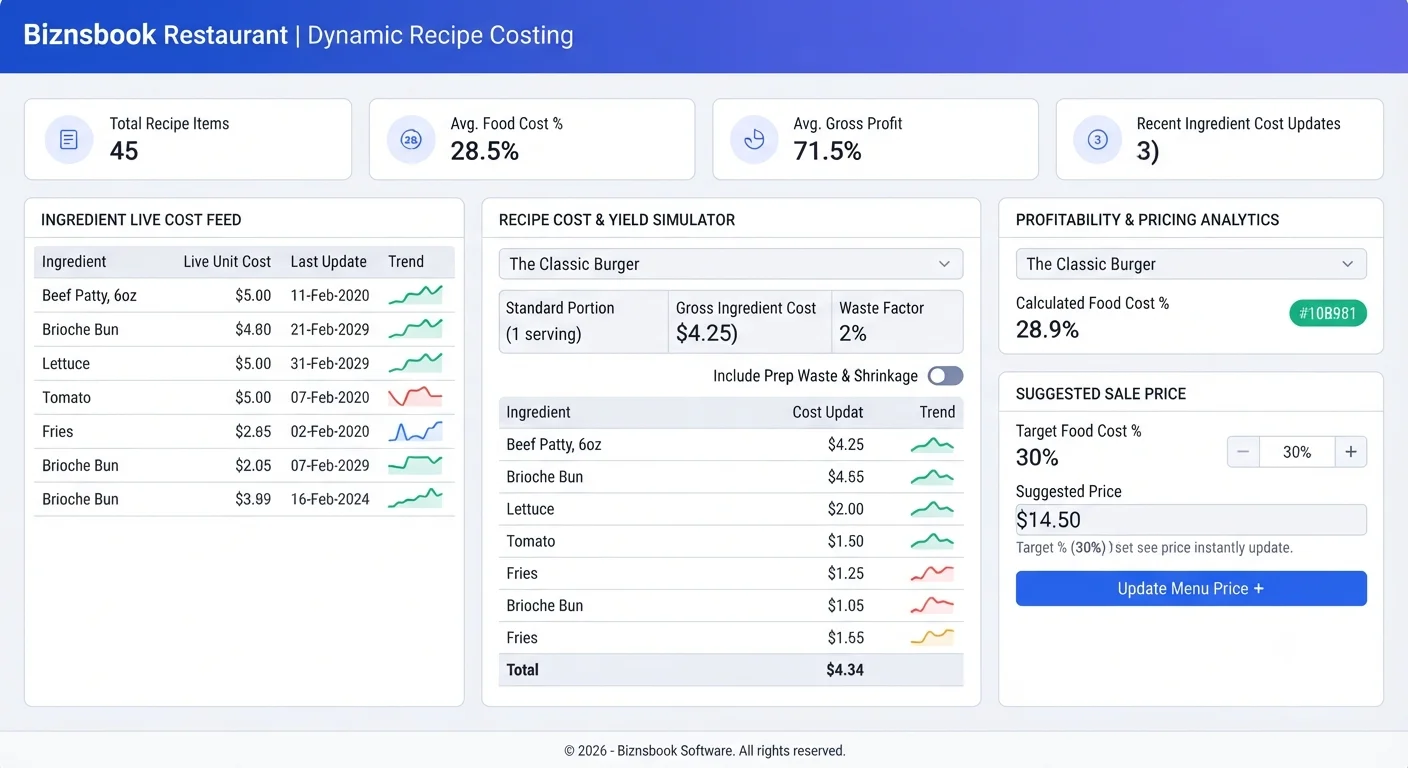
Food cost drifts when recipes live outside inventory
Many restaurants price menus from memory or old spreadsheets while supplier costs move weekly. Without a recipe tied to live ingredient costs, margin decisions become guesswork and slow sellers hide expensive plates.
Teams also underestimate true plate cost when prep components and waste are ignored. Sauces, doughs, and trim loss often sit in separate notes instead of structured sub-recipes with waste percentages.
When food-cost percentage is not reviewed after cost changes, leaders discover margin erosion only after month-end P&L reviews, when corrective pricing or portion changes are already overdue.
Why this happens
- Recipes are maintained in spreadsheets disconnected from inventory average cost.
- Sub-recipes and prep batches are not rolled into parent dish costing.
- Waste percentages are omitted from ingredient lines.
- Sale prices are not compared to a target food-cost percentage regularly.
Biznsbook addresses this through Recipe costing, food-cost %, suggested sale price when Restaurant, Inventory, and POS are licensed — recipes pull live ingredient costs, POS sales drive theoretical COGS and optional auto-depletion, and purchasing workflows stay in the same ERP.
Finance teams lose days each month reconciling versions that should never have diverged. Naming Biznsbook screens as the system of record — and closing periods when agreed — prevents silent edits that auditors flag immediately.
Step-by-step: Calculate Restaurant Food Cost
Built for restaurant owners, kitchen managers, and operations leads running recipe-based food costing, POS-linked depletion, and back-of-house controls in Biznsbook.
- Create recipes from inventory items. Build Standard menu-item recipes using the ingredient picker so each row pulls the correct unit and live average cost automatically.
- Add sub-recipes for prep components. Reuse Sub-Recipe and Prep types for sauces, doughs, and bases up to three levels deep so parent dishes inherit accurate component cost.
- Set portion count and target food-cost %. Enter portion count, portion size, batch yield, and your target food-cost percentage so Biznsbook can compute cost per portion and suggested sale price.
- Apply waste % on ingredient lines. Record waste per ingredient so effective quantities and line costs reflect real kitchen usage, not ideal theoretical picks.
- Activate validated recipes. Move recipes from Draft to Active only after ingredients are complete, so costing and downstream COGS snapshots use reliable structures.
- Recalculate costs after price changes. Use Recalculate Costs to refresh every ingredient snapshot from today's inventory average cost whenever suppliers change.
- Review costing card and cost cards. Read total ingredient cost, food-cost %, and suggested sale price on the recipe page, then print a cost card PDF when chefs or owners need a paper reference.
Review results after the first full weekly cycle. Adjust roles, mappings, or approvals where the same exception repeats.
Screen-level flows live in the Help Center. This guide focuses on the business process; help articles cover click-by-click navigation.
Common mistakes to avoid
- Mistake 1: Recipes are maintained in spreadsheets disconnected from inventory average cost. Repeating this each month usually shows up first in COGS variance reports or depletion failure logs.
- Mistake 2: Sub-recipes and prep batches are not rolled into parent dish costing. Repeating this each month usually shows up first in COGS variance reports or depletion failure logs.
- Mistake 3: Waste percentages are omitted from ingredient lines. Repeating this each month usually shows up first in COGS variance reports or depletion failure logs.
- Mistake 4: Sale prices are not compared to a target food-cost percentage regularly. Repeating this each month usually shows up first in COGS variance reports or depletion failure logs.
Track recurring exceptions in month-end notes; each should map to a control above.
Best practices that hold up as you scale
- Create recipes from inventory items — Build Standard menu-item recipes using the ingredient picker so each row pulls the correct unit and live average cost automatically.
- Add sub-recipes for prep components — Reuse Sub-Recipe and Prep types for sauces, doughs, and bases up to three levels deep so parent dishes inherit accurate component cost.
- Set portion count and target food-cost % — Enter portion count, portion size, batch yield, and your target food-cost percentage so Biznsbook can compute cost per portion and suggested sale price.
- Apply waste % on ingredient lines — Record waste per ingredient so effective quantities and line costs reflect real kitchen usage, not ideal theoretical picks.
- Activate validated recipes — Move recipes from Draft to Active only after ingredients are complete, so costing and downstream COGS snapshots use reliable structures.
Teams that activate recipes before enabling auto-deplete, review COGS variance weekly, and log waste at the point of discard avoid the month-end surprises that inflate food cost.
How Biznsbook supports this workflow
Recipe costing is documented in Biznsbook Restaurant capabilities. Use it as part of a controlled finance process — posting, review, and period close — not as an isolated export. When Sales, Purchase, Inventory, Taxation, Expense, or Finance Management modules are enabled, related documents can post through the central accounting posting service with double-entry validation.
food-cost % is documented in Biznsbook Restaurant capabilities. Use it as part of a controlled finance process — posting, review, and period close — not as an isolated export. When Sales, Purchase, Inventory, Taxation, Expense, or Finance Management modules are enabled, related documents can post through the central accounting posting service with double-entry validation.
suggested sale price is documented in Biznsbook Restaurant capabilities. Use it as part of a controlled finance process — posting, review, and period close — not as an isolated export. When Sales, Purchase, Inventory, Taxation, Expense, or Finance Management modules are enabled, related documents can post through the central accounting posting service with double-entry validation.
Restaurant permissions separate recipe management, waste logging, par levels, floor plans, KDS, reservations, and settings. Inventory and POS are prerequisites for depletion and costing.
Suggested implementation timeline
- Week 1: Document current process gaps and configure Recipe costing with finance owner sign-off.
- Weeks 2–3: Pilot on one month or one entity; post all test transactions through Biznsbook; freeze parallel spreadsheet journals.
- Week 4: Run first trial balance or report tie-out; fix mapping and permission issues.
- Month 2–3: Roll out to full team; add approvals and period close cadence from this guide.
- Ongoing: Monthly review using food-cost review cadence and leadership dashboard.
Metrics to track monthly
- Food cost % vs target (theoretical ÷ POS sales)
- COGS variance % by ingredient (red / amber / green)
- Failed or stuck sale depletions
- Today waste cost vs daily threshold
- Par level shortages and unread supplier price alerts
Start with three metrics; trend direction matters more than a single point-in-time snapshot.
Spreadsheet / manual books vs integrated ERP
Compare typical manual finance work with Biznsbook Recipe costing and related capabilities.
| Capability | Manual / Spreadsheet | Biznsbook |
|---|---|---|
| Cost baseline | ❌ Static spreadsheet | ✅ Live inventory average cost |
| Prep handling | ❌ Manual add-ons | ✅ Sub-recipe roll-up to 3 levels |
| Waste treatment | ❌ Ignored or guessed | ✅ Per-line waste % on ingredients |
| Portion math | ❌ Calculator side work | ✅ Automatic cost per portion |
| Pricing guidance | ❌ Rule-of-thumb markup | ✅ Suggested sale price from target % |
| Refresh cadence | ❌ Quarterly menu review | ✅ One-click recalculate anytime |
Food-cost review cadence
Review active recipe food-cost % weekly against your company default target in Restaurant settings. Flag any dish more than two points above target for portion, recipe, or price adjustment before it erodes weekly margin.
Document this in your finance SOP and revisit each quarter as transaction volume or entity structure changes.
Frequently asked questions
Where do ingredient unit costs come from?
Biznsbook uses each ingredient's inventory average cost, so recipe costing stays aligned with the stock ledger without duplicate entry.
Can one sauce cost multiple dishes?
Yes. Create a Sub-Recipe once and reference it inside parent recipes; its cost per portion rolls up automatically.
What is suggested sale price?
It is the menu price needed to hit your target food-cost percentage, derived from cost per portion and your stated target.
Should I recalculate after every delivery?
Recalculate after meaningful supplier price moves or before menu pricing decisions so food-cost % reflects current ingredient reality.
How this differs by industry
Retail
Fast-casual operators can cost limited-time bowls and wraps from the same ingredient catalogue, then recalculate before launching a seasonal LTO so margin targets hold.
Wholesale & distribution
Commissary kitchens producing components for multiple units can maintain prep sub-recipes once and roll accurate portion cost into every finished menu item.
Manufacturing
Franchise groups can standardize active recipes with target food-cost % and printable cost cards so every location prices from the same costing method.