How to Track Customer Lifetime Value
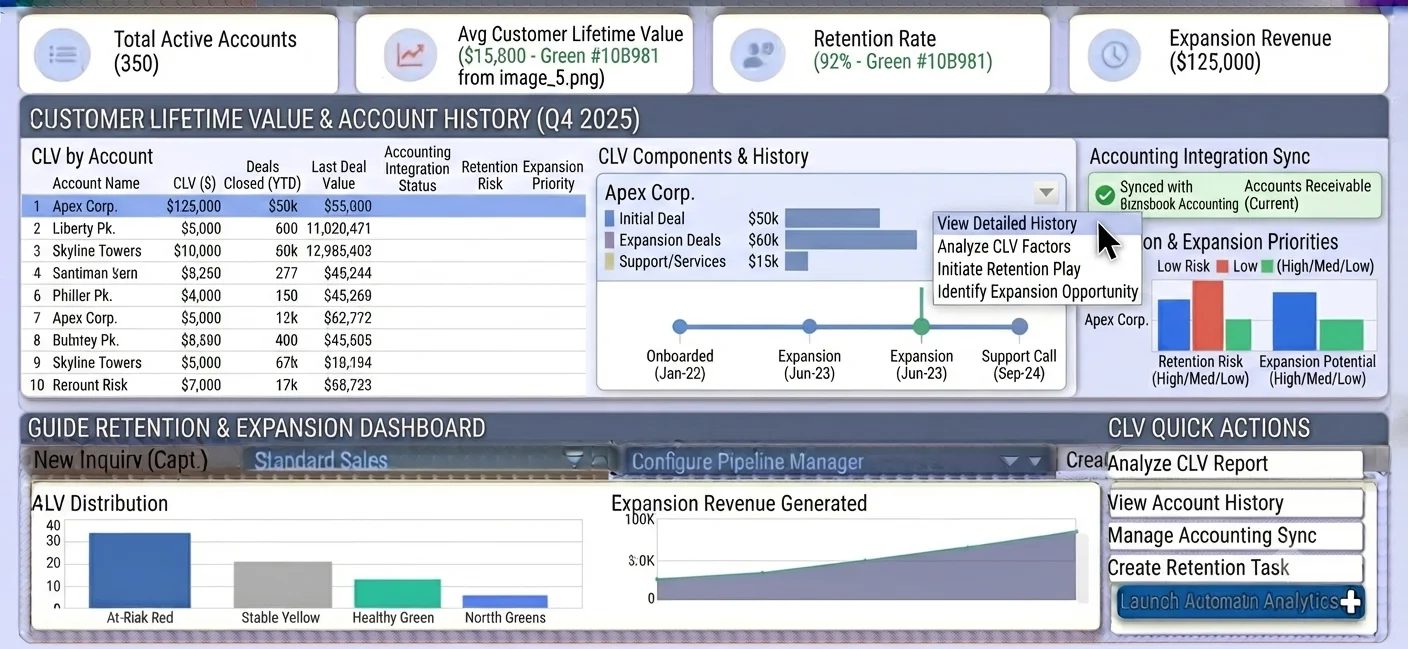
CLV decisions fail when revenue data is fragmented
Many teams estimate lifetime value using incomplete CRM data. Without confirmed invoice outcomes, account value appears higher or lower than reality, leading to poor prioritization decisions.
CLV also gets distorted when closed deals are not linked to post-sale revenue behavior. A one-time large deal may look attractive but underperform in renewals or repeat orders.
When finance and sales disagree on account value, retention and expansion strategy loses focus. Shared metrics are essential for aligned investment decisions.
Why this happens
- CRM and accounting records are analyzed separately.
- Won deals are not consistently converted into invoiced revenue flows.
- Account segmentation ignores retention and repeat-purchase patterns.
- CLV models are not refreshed with recent behavior data.
Biznsbook addresses this through CRM accounts, deal history, accounting integration when the CRM module is enabled. Add Business Automation and Communication Center for drip nurture on crm.lead.created; add Sales and Accounting for order-to-cash when deals close.
Finance teams lose days each month reconciling versions that should never have diverged. Naming Biznsbook screens as the system of record — and closing periods when agreed — prevents silent edits that auditors flag immediately.
Step-by-step: Track Customer Lifetime Value
Built for sales reps, managers, and RevOps leads who need a repeatable funnel — not heroic inbox chasing. Adapt roles to your team size.
- Define CLV formula scope. Set whether CLV includes gross revenue, margin proxy, renewal patterns, or support costs.
- Consolidate account and deal history. Use CRM account records and deal history to build lifecycle context per customer.
- Link won deals to invoicing. Convert won deals to sale invoices in Accounting where applicable to track realized revenue.
- Segment customers by value trend. Group accounts by CLV trajectory, retention risk, and expansion potential.
- Analyze retention influence. Compare churn and renewal outcomes across high and low CLV segments.
- Prioritize success investment. Allocate account-management effort using CLV and health-based risk signals.
- Refresh CLV monthly. Update CLV models with current invoicing, deal outcomes, and account activity changes.
Review results after the first full weekly cycle. Adjust roles, mappings, or approvals where the same exception repeats.
Screen-level flows live in the Help Center (tax setup, expense claims, sale invoices). This guide focuses on finance process; help articles cover navigation.
Common mistakes to avoid
- Mistake 1: CRM and accounting records are analyzed separately. Repeating this each month usually shows up first in pipeline velocity or lead aging reports.
- Mistake 2: Won deals are not consistently converted into invoiced revenue flows. Repeating this each month usually shows up first in pipeline velocity or lead aging reports.
- Mistake 3: Account segmentation ignores retention and repeat-purchase patterns. Repeating this each month usually shows up first in pipeline velocity or lead aging reports.
- Mistake 4: CLV models are not refreshed with recent behavior data. Repeating this each month usually shows up first in pipeline velocity or lead aging reports.
Track recurring exceptions in month-end notes; each should map to a control above.
Best practices that hold up as you scale
- Define CLV formula scope — Set whether CLV includes gross revenue, margin proxy, renewal patterns, or support costs.
- Consolidate account and deal history — Use CRM account records and deal history to build lifecycle context per customer.
- Link won deals to invoicing — Convert won deals to sale invoices in Accounting where applicable to track realized revenue.
- Segment customers by value trend — Group accounts by CLV trajectory, retention risk, and expansion potential.
- Analyze retention influence — Compare churn and renewal outcomes across high and low CLV segments.
Teams that review pipeline and lead aging weekly close more consistently than teams that only report at month-end.
How Biznsbook supports this workflow
CRM accounts is documented in Biznsbook CRM / Sales capabilities. Use it as part of a controlled finance process — posting, review, and period close — not as an isolated export. When Sales, Purchase, Inventory, Taxation, Expense, or Finance Management modules are enabled, related documents can post through the central accounting posting service with double-entry validation.
deal history is documented in Biznsbook CRM / Sales capabilities. Use it as part of a controlled finance process — posting, review, and period close — not as an isolated export. When Sales, Purchase, Inventory, Taxation, Expense, or Finance Management modules are enabled, related documents can post through the central accounting posting service with double-entry validation.
accounting integration is documented in Biznsbook CRM / Sales capabilities. Use it as part of a controlled finance process — posting, review, and period close — not as an isolated export. When Sales, Purchase, Inventory, Taxation, Expense, or Finance Management modules are enabled, related documents can post through the central accounting posting service with double-entry validation.
CRM roles (rep, manager, admin) govern export, settings, and reassignment. Workflow automations live in Business Automation — not buried in personal inboxes.
Suggested implementation timeline
- Week 1: Document current process gaps and configure CRM accounts with finance owner sign-off.
- Weeks 2–3: Pilot on one month or one entity; post all test transactions through Biznsbook; freeze parallel spreadsheet journals.
- Week 4: Run first trial balance or report tie-out; fix mapping and permission issues.
- Month 2–3: Roll out to full team; add approvals and period close cadence from this guide.
- Ongoing: Monthly review using clv governance essentials and leadership dashboard.
Metrics to track monthly
- Lead response time (minutes from create to first activity)
- Lead-to-opportunity conversion rate by source
- Pipeline velocity and stage aging days
- Win rate and average deal size
- Forecast vs actual revenue (closed-won)
Start with three metrics; trend direction matters more than a single point-in-time snapshot.
Spreadsheet / manual books vs integrated ERP
Compare typical manual finance work with Biznsbook CRM accounts and related capabilities.
| Capability | Manual / Spreadsheet | Biznsbook |
|---|---|---|
| Value input | ❌ Lead/deal assumptions only | ✅ CRM + accounting-backed revenue |
| Revenue realization | ❌ Closed-won estimate | ✅ Invoice-confirmed outcomes |
| Account segmentation | ❌ Single revenue tier | ✅ Trend and retention-based tiers |
| Planning use | ❌ Generic account effort | ✅ CLV-prioritized investment |
| Cross-team alignment | ❌ Sales-finance mismatch | ✅ Shared value framework |
| Update cadence | ❌ Annual recalculation | ✅ Monthly refresh cycle |
CLV governance essentials
Document formula assumptions, data sources, and update cadence. Transparent governance improves trust in CLV-driven resource decisions.
Document this in your finance SOP and revisit each quarter as transaction volume or entity structure changes.
Frequently asked questions
Why connect CLV to accounting data?
Accounting confirms realized revenue and payment behavior, reducing overestimation that can happen when CLV relies on opportunity status alone.
Can won deals be used directly for CLV?
Use them as signals, but link to invoice outcomes for stronger accuracy. Won deals can convert to sale invoices in Accounting for better tracking.
How often should CLV be recalculated?
Monthly is practical for SMB teams and keeps segmentation aligned with current retention and expansion patterns.
Should CLV drive customer-success effort allocation?
Yes, alongside health and strategic fit. CLV helps direct effort to accounts with highest long-term return potential.
How this differs by industry
Retail
Retail account programs can combine deal and invoice history to identify high-CLV partners worth deeper assortment and support investment.
Wholesale & distribution
Wholesale teams should monitor repeat order patterns and invoiced revenue to distinguish truly high-value accounts from one-off large buyers.
Manufacturing
Manufacturers can use long-cycle deal history plus accounting outcomes to prioritize service and renewal strategy for durable account value.