How to Improve Customer Retention
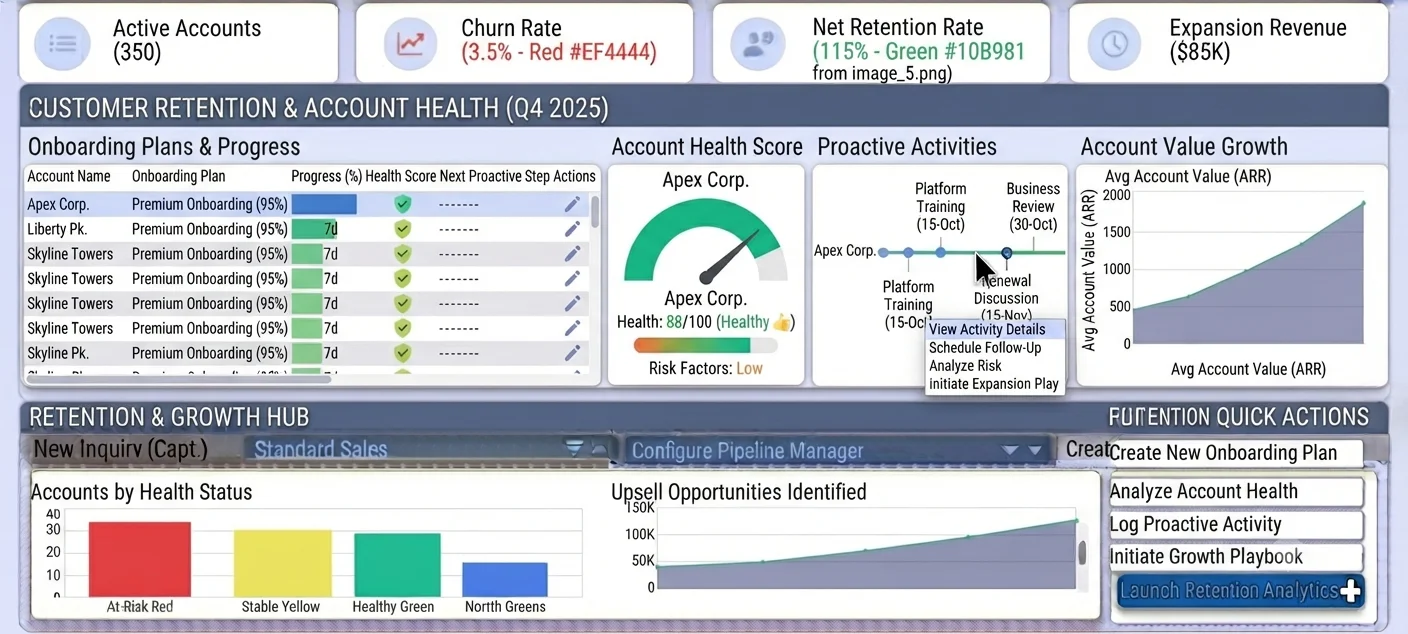
Retention drops when engagement is reactive
Most churn signals appear before cancellation: low engagement, unresolved issues, and delayed value realization. Teams miss these signals when account management is ad hoc and task ownership is unclear.
Onboarding is another common failure point. If new customers do not reach early success milestones quickly, confidence drops and renewal probability declines.
Retention strategy also fails when success teams and sales work from different account data. Misaligned context delays interventions and weakens customer trust.
Why this happens
- Onboarding plans are not standardized across new accounts.
- Customer health indicators are reviewed too infrequently.
- Risk signals are not linked to clear escalation workflows.
- Account communication lacks lifecycle-based structure.
Biznsbook addresses this through CRM accounts, onboarding plans, customer health when the CRM module is enabled. Add Business Automation and Communication Center for drip nurture on crm.lead.created; add Sales and Accounting for order-to-cash when deals close.
Finance teams lose days each month reconciling versions that should never have diverged. Naming Biznsbook screens as the system of record — and closing periods when agreed — prevents silent edits that auditors flag immediately.
Step-by-step: Improve Customer Retention
Built for sales reps, managers, and RevOps leads who need a repeatable funnel — not heroic inbox chasing. Adapt roles to your team size.
- Define onboarding milestones. Set first-value, adoption, and stakeholder alignment milestones for new customer accounts.
- Build account plans in CRM. Capture goals, owners, and success criteria directly on CRM account records.
- Track customer health regularly. Monitor engagement and activity trends to flag accounts showing early risk signs.
- Create retention task playbooks. Assign repeatable interventions for low-health accounts with owner and due date.
- Automate lifecycle communication. Use drip and sequence tools to support onboarding, adoption, and renewal reminders.
- Run monthly risk reviews. Review top churn-risk accounts and escalate support, product, or leadership actions quickly.
- Measure retention impact. Track renewal rate, churn reasons, and net revenue retention to improve strategy quality.
Review results after the first full weekly cycle. Adjust roles, mappings, or approvals where the same exception repeats.
Screen-level flows live in the Help Center (tax setup, expense claims, sale invoices). This guide focuses on finance process; help articles cover navigation.
Common mistakes to avoid
- Mistake 1: Onboarding plans are not standardized across new accounts. Repeating this each month usually shows up first in pipeline velocity or lead aging reports.
- Mistake 2: Customer health indicators are reviewed too infrequently. Repeating this each month usually shows up first in pipeline velocity or lead aging reports.
- Mistake 3: Risk signals are not linked to clear escalation workflows. Repeating this each month usually shows up first in pipeline velocity or lead aging reports.
- Mistake 4: Account communication lacks lifecycle-based structure. Repeating this each month usually shows up first in pipeline velocity or lead aging reports.
Track recurring exceptions in month-end notes; each should map to a control above.
Best practices that hold up as you scale
- Define onboarding milestones — Set first-value, adoption, and stakeholder alignment milestones for new customer accounts.
- Build account plans in CRM — Capture goals, owners, and success criteria directly on CRM account records.
- Track customer health regularly — Monitor engagement and activity trends to flag accounts showing early risk signs.
- Create retention task playbooks — Assign repeatable interventions for low-health accounts with owner and due date.
- Automate lifecycle communication — Use drip and sequence tools to support onboarding, adoption, and renewal reminders.
Teams that review pipeline and lead aging weekly close more consistently than teams that only report at month-end.
How Biznsbook supports this workflow
CRM accounts is documented in Biznsbook CRM / Sales capabilities. Use it as part of a controlled finance process — posting, review, and period close — not as an isolated export. When Sales, Purchase, Inventory, Taxation, Expense, or Finance Management modules are enabled, related documents can post through the central accounting posting service with double-entry validation.
onboarding plans is documented in Biznsbook CRM / Sales capabilities. Use it as part of a controlled finance process — posting, review, and period close — not as an isolated export. When Sales, Purchase, Inventory, Taxation, Expense, or Finance Management modules are enabled, related documents can post through the central accounting posting service with double-entry validation.
customer health is documented in Biznsbook CRM / Sales capabilities. Use it as part of a controlled finance process — posting, review, and period close — not as an isolated export. When Sales, Purchase, Inventory, Taxation, Expense, or Finance Management modules are enabled, related documents can post through the central accounting posting service with double-entry validation.
CRM roles (rep, manager, admin) govern export, settings, and reassignment. Workflow automations live in Business Automation — not buried in personal inboxes.
Suggested implementation timeline
- Week 1: Document current process gaps and configure CRM accounts with finance owner sign-off.
- Weeks 2–3: Pilot on one month or one entity; post all test transactions through Biznsbook; freeze parallel spreadsheet journals.
- Week 4: Run first trial balance or report tie-out; fix mapping and permission issues.
- Month 2–3: Roll out to full team; add approvals and period close cadence from this guide.
- Ongoing: Monthly review using early-warning retention signals and leadership dashboard.
Metrics to track monthly
- Lead response time (minutes from create to first activity)
- Lead-to-opportunity conversion rate by source
- Pipeline velocity and stage aging days
- Win rate and average deal size
- Forecast vs actual revenue (closed-won)
Start with three metrics; trend direction matters more than a single point-in-time snapshot.
Spreadsheet / manual books vs integrated ERP
Compare typical manual finance work with Biznsbook CRM accounts and related capabilities.
| Capability | Manual / Spreadsheet | Biznsbook |
|---|---|---|
| Onboarding model | ❌ Rep-dependent | ✅ Standard account plans |
| Risk detection | ❌ Late complaints | ✅ Customer health monitoring |
| Interventions | ❌ Ad hoc outreach | ✅ Playbook-based tasks |
| Cross-team context | ❌ Siloed records | ✅ Shared CRM account view |
| Lifecycle messaging | ❌ Irregular updates | ✅ Planned communication cadence |
| Retention insight | ❌ Annual snapshot | ✅ Monthly risk analytics |
Early-warning retention signals
Watch for reduced engagement, delayed onboarding milestones, and repeated unresolved issues. Combined signals predict churn better than any single metric.
Document this in your finance SOP and revisit each quarter as transaction volume or entity structure changes.
Frequently asked questions
What is the first retention lever to fix?
Improve onboarding consistency. Customers who reach early value milestones quickly are far more likely to renew and expand.
How often should customer health be reviewed?
Weekly for strategic accounts and at least monthly for broader portfolios, with escalation triggers for rapid decline.
Can automated communication improve retention?
Yes, when it supports human ownership. Automated reminders and education reduce gaps but should complement account-manager follow-up.
Which retention metric should leadership track most?
Track gross and net retention together. Gross reveals churn control, while net retention captures expansion impact.
How this differs by industry
Retail
Retail account retention improves when onboarding covers reorder planning, promotion cadence, and channel-specific support expectations.
Wholesale & distribution
Wholesale teams can reduce churn by formalizing onboarding for procurement and operations contacts while monitoring order-frequency health signals.
Manufacturing
Manufacturers should pair onboarding milestones with technical support checkpoints to protect renewal and service continuity.